Builders Risk Insurance Kentucky: What It Costs and What It Misses
OfferMarket Insurance
Compare 40+ carriers for builder's risk insurance in Kentucky
Fast quotes · 100% free · no obligation
Last updated: November 26, 2026
Your framing crew finishes on a Thursday in Bowling Green. Saturday night a storm pushes through, the roof sheathing peels off, and Monday morning you find out your builders risk quote carried a 2% wind deductible nobody converted into dollars. On a $300,000 limit, that's $6,000 out of your pocket before the carrier pays a cent.

Builders risk insurance Kentucky projects need covers the building while it's under construction or renovation, from the first delivery until the job is done. Every construction lender in the state requires it. Buying a policy is the easy part. The hard part is knowing which Kentucky exposures your quote quietly leaves with you: earthquake in the Jackson Purchase, flood in the hollows, a storm deductible written as a percentage, and a tax stack that can add real money to the premium you were shown.
Insurance disclosure: A portion of the insurance inquiries submitted on OfferMarket are quoted, bound and serviced by OfferMarket Insurance LLC (NPN 20545557), licensed in Kentucky (license number DOI-1490008) and in a number of other states. See the full list at offermarket.us/licenses.
Key Takeaways
- 🏗️ Builders risk covers the structure, materials and installed fixtures during construction. It does not cover worker injuries, faulty workmanship, or your contractor's tools.
- 💲 Builders risk ranges in Kentucky run about $1,000 to $3,500 a year on properties valued $150,000 to $500,000. Industry estimates put builders risk at roughly 1% to 5% of total construction cost.
- 🧾 Kentucky stacks three charges on top of premium: a 3% surplus lines tax on non-admitted policies, a $1.80 per $100 premium surcharge, and a local government premium tax that varies by city and county.
- 🌪️ The December 2021 tornado that hit Mayfield was rated EF-4 with 190 mph winds and tracked roughly 165 miles across western Kentucky. Convert your wind and hail deductible into dollars before you bind.
- 🌊 Flood is never included. Eastern Kentucky flooded catastrophically in July 2022 and again in February 2025, when all 120 counties reported flooding.
- 🪨 Earth movement is excluded on most forms, and western Kentucky sits near the New Madrid Seismic Zone. Ask for the earthquake endorsement by name.
- 🪪 Kentucky issues no statewide general contractor license. Only electrical, plumbing and HVAC are licensed by the state, so vetting your crew falls to you.
What Builders Risk Insurance Covers in Kentucky
Most Kentucky builders risk insurance forms are broad: if a cause of loss isn't specifically excluded, it's generally covered. US Assure describes its plan the same way, as broad in scope, with flood and earth movement offered as optional coverages where available.
| Coverage | Where it sits |
|---|---|
| Fire, lightning, explosion | Base form |
| Wind, hail, severe storm | Base form, unless the quote excludes wind and hail |
| Theft and vandalism | Base form |
| Materials on site, in transit or in temporary storage | Base form, usually with sublimits |
| Collapse and debris removal | Base form |
| Soft costs (loan interest and carrying costs after a covered delay) | Optional endorsement |
| Earthquake and earth movement | Optional where offered |
| Sewer, drain and sump backup | Optional endorsement |
| Change orders | Optional endorsement |
| Flood | Separate flood policy, quoted through OfferMarket |
| General liability (on standalone builders risk) | Separate policy |
| Workers' compensation | Each employer's own policy |
| Contractor's tools and heavy equipment | The contractor's own policy |
| Faulty workmanship, defective design, wear and tear | Not covered |
The distinction that costs people money: builders risk pays for the damage bad work causes, not for redoing the bad work. If a subcontractor's sloppy solder joint floods your new hardwood, the floor is generally covered and the joint isn't.
Which Policy Fits Your Kentucky Project
| Project | Policy | Settle before binding |
|---|---|---|
| Vacant 1 to 4 unit rehab (Louisville, Lexington, Bowling Green) | Fix and flip policy | Vacancy permit, wind deductible in dollars |
| Ground-up home or major addition | Standalone builders risk plus general liability | Coverage in force before the first delivery |
| Western Kentucky project (Paducah, Mayfield, Murray) | Either, with earthquake endorsement priced | Whether the carrier offers earth movement at all |
| Eastern Kentucky project near a creek or river | Either, plus a flood policy | Flood zone determination before you close |
| Occupied duplex to fourplex rehab | Renovation form allowing partial occupancy | Which units are leased, and rent loss coverage |
| Finished and leased | Landlord policy (DP-3) | Bind before the lease starts, then cancel the builders risk |
Kentucky Perils That Drive Builders Risk Claims

Tornadoes and Hail
On the night of December 10, 2021, a tornado rated EF-4 with estimated peak winds of 190 mph tore roughly 165 miles across western Kentucky, destroying most of downtown Mayfield and striking Princeton, Dawson Springs and Bremen along the way (NWS Paducah). It was part of the deadliest December tornado outbreak on record.
A percentage wind and hail deductible is standard on Kentucky builders risk insurance quotes, and nobody converts it to dollars for you. Do it yourself before you sign.
Flooding
Kentucky has flooded twice at a scale that reset the record books. Between July 25 and 29, 2022, flash flooding in eastern Kentucky killed 43 people, which the National Weather Service called the deadliest non-tropical flood event in the United States since the late 1970s. Thirteen counties were declared federal disaster areas.
Then in February 2025, a weekend of heavy rain pushed river gauges into their top five crests statewide, and a major disaster declaration followed for Breathitt, Clay, Harlan, Knott, Lee, Letcher, Martin, Owsley, Perry and Pike counties.
Your builders risk policy pays for none of it. Flood is always separate.
How Our Kentucky Flood Program Works
OfferMarket Insurance places private flood coverage on 1 to 4 unit investment properties, and Kentucky is a state where we quote, bind and service the policy in-house. Private carriers carry an AM Best rating of A- VIII or better, and our policies meet the federal definition of private flood insurance, so a federally regulated lender has to accept them.
Here is how our residential flood coverage compares with the NFIP.
| Residential Comparison | OfferMarket Residential Flood | NFIP Residential Flood |
|---|---|---|
| Property Coverage | $15,000,000 | $250,000 |
| Contents Coverage | $500,000 | $100,000 |
| Additional Coverage | Temporary Living Expenses, Replacement Cost on Contents, Basement Contents, Unattached Structures, Pool Repair and Refill, Loss of Rental Income, Building Betterments and Improvements, Outdoor Trees, Shrubs and Plants | N/A |
| Elevation Certificate | Optional | Optional |
| Waiting Period | No wait on real estate closings or rollovers from another flood policy. Otherwise, 10 days. | No wait on real estate closings or rollovers from another flood policy. Otherwise, 30 days. |
Why that matters on a Kentucky project:
- 💰 Limits that fit the property. Our building limit goes to $15,000,000 and contents to $500,000. The NFIP stops at $250,000 and $100,000.
- 📉 Lost rent is covered. Loss of rental income is included in our additional coverage. The NFIP pays none, which hits hard if the finished property is leased.
- ⏱️ No 30-day wait. There is no waiting period on a real estate closing or a rollover from another flood policy. Everything else starts in 10 days, against the NFIP's 30.
- 🏚️ Basements are covered. Basement contents are included, and Zone AE rentals on basement foundations get quoted without an elevation certificate.
- 🔨 Renovations and new builds qualify. We cover vacant renovations under fix and flip loans and ground-up construction.
- ➕ Coverage the NFIP does not offer at all: temporary living expenses, replacement cost on contents, unattached structures, pool repair and refill, building betterments and improvements, and outdoor trees, shrubs and plants.
Flood quotes come back in the same 2 to 3 hours as the rest, and they hold for 60 days.
Winter and Freeze
A vacant or unfinished building through a Kentucky January is a burst pipe waiting to happen. Most forms pay for freeze damage only when heat was maintained or the system was drained. Pick one, write it down, and log every site visit.
The New Madrid Problem Nobody Quotes For 🪨
Here's the gap we see most often on western Kentucky files, and almost no one mentions it.
Kentucky sits near three seismic zones. The New Madrid Seismic Zone runs beneath much of western Kentucky and is the most active zone in the central and eastern United States. The Wabash Valley Seismic Zone can produce New Madrid sized events, and the Eastern Tennessee Seismic Zone affects the other end of the state. At least three earthquakes above magnitude 7.0 struck the New Madrid zone between December 1811 and February 1812.
Earth movement is excluded on most builders risk forms. Earthquake coverage is an endorsement, it is not automatic, and some carriers won't write it at all in the Jackson Purchase counties.
What to do about it: if your project sits in Paducah, Mayfield, Murray, Fulton, Hickman or anywhere west of the Tennessee River, ask three questions before you bind. Does this carrier offer earth movement here? What's the separate earthquake deductible, usually written as a percentage? And does your lender require it? Most don't, which is exactly why it gets skipped.
What Builders Risk Insurance Costs in Kentucky

Most industry estimates put builders risk insurance at roughly 1% to 5% of total construction cost, driven mostly by project value, construction type, timeline and weather exposure. US Assure lists a minimum premium starting at $375 for its Builders Risk Plan insured by Zurich.
For a 1 to 4 unit investor project, here are the builders risk ranges we see. Your address, scope and carrier move the final number, and we return it the same day you ask.
| Property value | Rehab budget | Builders risk range (annual) |
|---|---|---|
| $150,000 | $50,000 | $1,000 to $2,000 |
| $300,000 | $100,000 | $1,500 to $2,500 |
| $500,000 | $200,000 | $2,000 to $3,500 |
The Kentucky Tax Stack Your Quote May Not Show 🧾
This is the part that surprises out-of-state investors, and we have not found a single competing Kentucky builders risk guide that explains it.
Three separate charges can ride on top of your Kentucky premium:
- Surplus lines tax, 3%. On a single-state risk placed with a non-admitted carrier, the broker pays a 3% tax on premium (KRS 304.10-180). Non-admitted policies also have no Kentucky guaranty fund backing.
- Premium surcharge, $1.80 per $100. Property and casualty insurers collect a surcharge of $1.80 for every $100 of premium, which funds the state's firefighter and law enforcement foundation programs.
- Local government premium tax, which varies by address. Kentucky cities and counties set their own rates by ordinance and pass them through to policyholders. The Department of Insurance schedule covers more than 400 jurisdictions. For fire and allied perils, Frankfort sets 9% while Lexington-Fayette County sets 5%.
Two identical projects, one in Lexington and one in Frankfort, can carry different all-in costs purely because of where the risk sits. When you compare builders risk insurance Kentucky quotes, compare the total with taxes and fees, not the base premium.
Your Deductible in Dollars
| Limit | 1% wind/hail | 2% wind/hail | 5% wind/hail |
|---|---|---|---|
| $200,000 | $2,000 | $4,000 | $10,000 |
| $300,000 | $3,000 | $6,000 | $15,000 |
| $500,000 | $5,000 | $10,000 | $25,000 |
Our lending guidelines allow a percentage deductible up to 5% of the building's coverage limit, or a flat deductible up to $5,000. Every figure above clears that bar. The real question is whether you could write the check in March and still keep the crew working.
What Factors Influence Builder's Risk Insurance Cost in Kentucky?
US Assure names five factors with the greatest impact on builders risk pricing: project type, location, construction material type, optional coverages, and fees and taxes. Here is how each one plays out in Kentucky, plus three we weigh on our own files.
1. Project Type
- 🏗️ Ground-up builds start on bare land and usually carry the lowest rate
- 🔨 Renovations rate higher, because an existing structure is exposed for the whole job
- 🧱 Roof, foundation, masonry and structural work price above cosmetic updates
2. Location
- 🌪️ Tornado and hail exposure across western and south central Kentucky
- 🌊 Flood zones along the Ohio, Kentucky, Cumberland and Licking rivers and the eastern creeks
- 🪨 Seismic exposure in the Jackson Purchase, where earthquake coverage may not be available at all
- 🚒 Fire protection class and distance to the nearest department, which swings rural pricing
3. Construction Material Type
- 🧱 Brick and masonry homes in older Louisville, Covington and Lexington neighborhoods
- 🏚️ Balloon-framed houses from the early 1900s, which some carriers surcharge or decline
- 🏠 Roof age and material, the single biggest driver of storm pricing
4. Optional Coverages
- 🌊 Flood, always a separate policy
- 🪨 Earthquake, where the carrier offers it
- ⏳ Soft costs, paying interest and carrying costs during a covered delay
- 🚰 Sewer, drain and sump backup
- 💸 Rent loss on any unit that stays leased during the work
5. Fees and Taxes
- 🏛️ Admitted carriers are licensed by the Kentucky Department of Insurance and backed by the state guaranty fund
- 🧾 Surplus lines placements add the 3% tax, and their policy fees are often not refundable
- 📍 The local government premium tax applies either way, at the rate your city or county sets
Three Factors We Add From Our Own Files
- 🥶 Vacancy and winter. A long vacancy, or a job running through January and February, adds freeze and theft exposure.
- 📏 The limit. Rebuild cost sets it, not the purchase price or the after-repair value.
- 💵 The deductible. A higher deductible lowers premium, up to the lender's ceiling of 5% of the building limit, or $5,000 flat.
Three Ways to Cut Premium Without Opening a Gap
- Build the limit from reconstruction cost and leave land out of it
- Take a higher deductible, but only as high as your lender allows and your reserves cover
- Secure the site: locks, cameras, and appliances and copper stored behind a locked door until installation
Never save money by accepting a wind or hail exclusion, skipping flood on a creekside lot, or letting vacancy coverage lapse.
Kentucky Has No State Contractor License 🪪
Kentucky does not issue a statewide general contractor license, and there is no state board for general contracting. The Department of Housing, Buildings and Construction licenses only electrical, plumbing and HVAC contractors. Everything else is handled locally, which means Louisville, Lexington and Bowling Green each run their own requirements and plenty of counties run none at all.
That cuts two ways for an investor. Hiring is faster, and verification is harder. A carrier that finds unlicensed trade work after a loss will ask about it.
What I tell Kentucky clients to collect before work starts:
- The state license for any electrical, plumbing or HVAC work, verified through the Department of Housing, Buildings and Construction
- The local general contractor or building contractor license where the city requires one
- A current general liability certificate naming you, not just a policy number read over the phone
- Proof of workers' compensation, or a signed exemption affidavit if the contractor has no employees
Our checklist on what to look for in a professional contractor covers how to run those checks.
Louisville and Lexington Rules Worth Knowing

Louisville rental registration. Every rental housing unit in Louisville Metro must be registered, with an initial nonrefundable fee set by zoning classification, starting at $25 for R-4 and R-5 and running to $250 for OR-3, C-2 and C-3. After that an annual $50 fee applies, waived when the property had no property maintenance violations in the previous twelve months. When ownership changes, the new owner has 30 days to register or the existing registration becomes invalid (Louisville Metro Code § 119.03).
That last line matters on a BRRRR. If you buy a tenanted property and miss the 30-day window, you're operating an unregistered rental.
Vacant and abandoned property. Louisville Metro enforces property maintenance under its own code and runs a vacant and abandoned property program, with abatement costs and civil penalties attaching as liens against the property. A lien that follows the title is a closing problem for your buyer, so settle it during the rehab, not at the closing table.
The Vacancy Clause on a Kentucky Rehab 🚨
A renovation that sits empty is where claim disputes start.
- Many dwelling forms cut theft, vandalism and glass coverage after 60 consecutive days without occupants. Some start counting at 30.
- A gutted house can be treated as vacant even while work continues. Courts generally look for substantial, ongoing work on site, and a crew that disappears from Thanksgiving to March weakens that case.
- Keep a vacancy permit or vacant property endorsement in force for the entire project, and back it with dated invoices and weekly photos.
What Our Quality Control Catches on Kentucky Quotes
Our team reviews every quote against the project and the lender's requirements before binding, including quotes investors bring us from other agencies. These four patterns come up constantly. The scenarios are illustrative, drawn from what we see on investor files.

1. A renovation quoted as a rental. An investor buys a vacant ranch in Jeffersontown for a cosmetic flip and gets back a landlord DP-3 policy. Landlord forms assume somebody lives there. Once the house passes the vacancy period, theft and vandalism coverage can shrink, and active renovation may fall outside what the form contemplates. We requote it as a fix and flip policy with a vacancy permit, then move to a landlord policy at lease-up.
2. Dwelling coverage set at purchase price. The investor asks for a limit based on the contractor's rebuild estimate, and the quote comes back at what they paid. In Louisville's older neighborhoods, rebuilding a 1920s house to current code can cost more than it will sell for. A limit under replacement cost can trigger a coinsurance penalty on every claim.
3. Liability written at rental limits. A duplex rehab comes back with $500,000 of liability. That fits a stabilized rental, not an active job site. Fix and flip lenders want $1,000,000 per occurrence and $2,000,000 aggregate on an occurrence form, with the lender named as additional insured.
4. A deductible nobody converted. The quote shows "2% wind&hail" and the investor reads it as small. On a $400,000 limit it's $8,000. We put every deductible in dollars on the summary before anyone signs.
Builder's Risk Insurance Guidelines
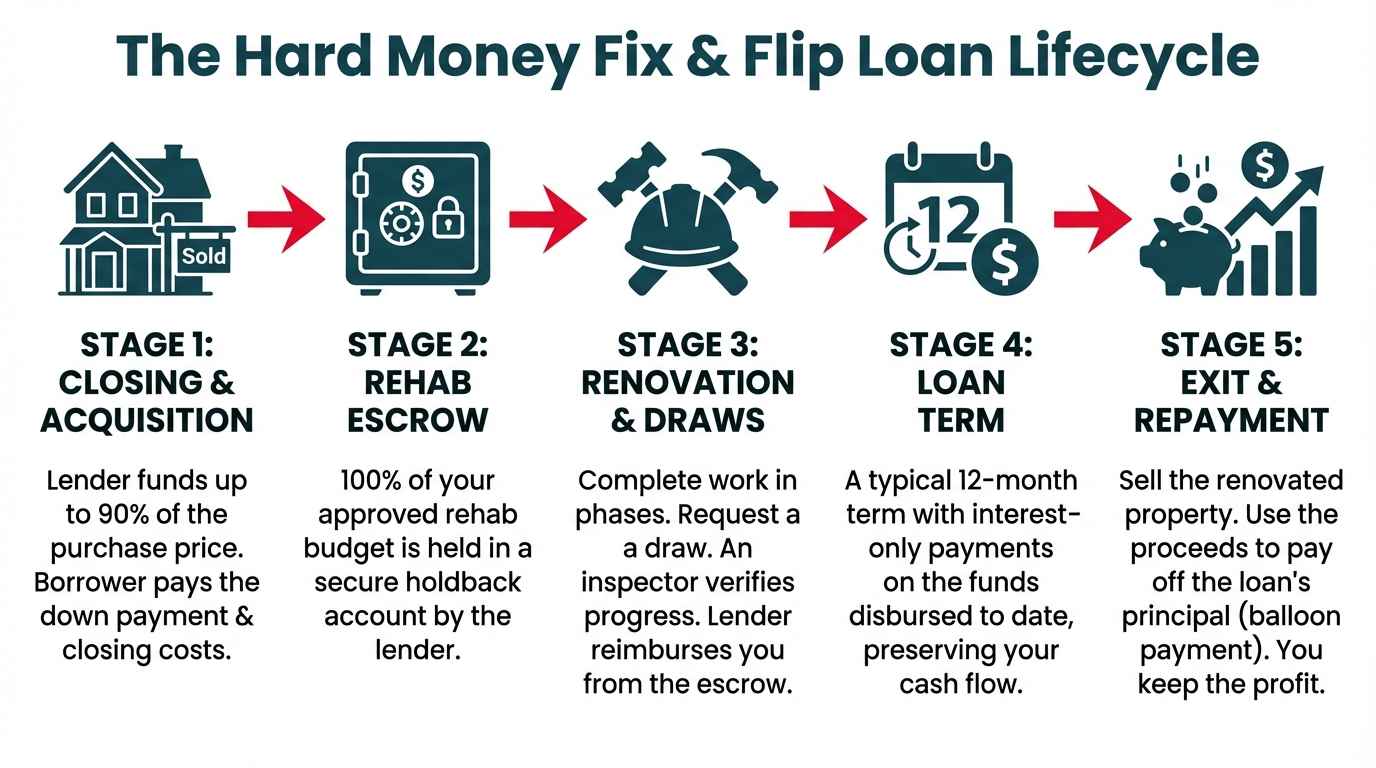
Below are common builder's risk insurance guidelines for fix and flip loans (otherwise known as hard money loans). These coverage limits are generally considered best practice from a risk management perspective, and if a Kentucky fix and flip loan or construction loan is funding your project, the policy has to clear this checklist before closing.
Property Coverage
| Mandatory | Yes |
| AM Best Rating | A- VIII or greater |
| Term | 1 Year |
| Limits | Replacement Cost (appraisal or estimator), or Loan Amount. If loan is less than Replacement Cost, use an Agreed Value Policy or zero coinsurance |
| Deductible | $5,000 |
| Accepted Policy Types | Dwelling Fire (Special Form), or Commercial Property (Basic or Special Form) |
| Cancellation | 30-day notice |
| Exclusions | No windstorm, hail or named storm exclusion |
| Lender's Designation | Mortgagee |
General Liability Coverage
| Mandatory | Yes |
| AM Best Rating | A- VIII or greater |
| Term | 1 Year |
| Limits | $1,000,000 per occurrence / $2,000,000 aggregate |
| Deductible | $1,000 |
| Coverage Details | Occurrence basis for losses (not claims-made) |
| Cancellation | 30-day notice |
| Lender's Designation | Additional Insured |
Flood Insurance
If the property is in a FEMA special flood hazard area, your lender may require flood insurance.
| Mandatory | If in a flood zone (Flood Zone Determination required) |
| Term | 1 Year |
| Limits | The greater of $250,000 or the loan balance |
| Cancellation | 30-day notice |
| Lender's Designation | Mortgagee |
Additional Details
| Mortgagee Clause (OfferMarket Capital loans) | OfferMarket Capital LLC ISAOA/ATIMA627 S Hanover StBaltimore, MD 21230Borrowing from another lender? Use that lender's exact clause. |
| Condos | - Blanket policy may be used if it allows the individual Unit to be included in coverage.- Homeowner association maintains an "all risk" coverage for common areas, fixtures, personal property, equipment at 100% of their insurable value on a replacement cost basis. |
| PUDs | - Project's blanket policy may be used if it allows the individual Unit to be included in coverage.- Homeowner association maintains an "all risk" coverage for common areas, fixtures, personal property, equipment at 100% of their insurable value on a replacement cost basis. |
| Instructions | - Use ACORD form to ensure compliance- Send insurance certificates, invoices or paid receipts, no later than 24 hours before closing.- Send final policy documents, no later than 60 days after closing.- Borrower must notify carrier if property becomes vacant or unoccupied and obtain a vacancy permit for the entire period of vacancy. |
Once the project becomes a rental. Refinancing into one of our DSCR loans changes the requirements: a dwelling limit of at least 80% of replacement cost or the loan amount, whichever is greater, liability of $500,000 per occurrence and $1,000,000 aggregate, and 12 months of rent loss coverage.
The mortgagee clause should always end with ISAOA/ATIMA, lenders require an AM Best rating of A- VIII or better, and the name on the certificate has to match the name on the deed. If you signed the contract personally and plan to assign it to an LLC, tell us before we bind.
What You Need for a Kentucky Builders Risk Quote
Our quote request takes a few seconds. Have this ready:

- Coverage type: Builders Risk for ground-up or a major addition, Fix and Flip for a renovation
- Subject property address: the full Kentucky address
- Insured entity name: how you'll hold title, matching the deed
- Dwelling coverage: your estimate of what it would cost to rebuild the finished property
- Effective date: usually your closing date
- Claims filed: property claims in the last 5 years
- Mailing address
- Date of birth: standard carrier identity verification
Every request is quoted the same day, usually within 2 to 3 hours. For Fix and Flip and Builders Risk requests, upload your scope of work to your OfferMarket Insurance File right after you submit. The scope of work is your rehab budget including completed work, and a PDF, Excel file or photos all work. If you report a claim in the last 5 years, we'll ask for the claim amount and a loss run report. We can't quote accurately without these documents.
Choosing Among Kentucky Builders Risk Insurance Companies
Plenty of agencies write builders risk insurance in Kentucky. Five tests separate them:
- Verifiable Kentucky license. The agency should hold one you can look up, and a non-admitted carrier should be placed properly through a surplus lines broker.
- A- VIII or better. That's the floor most lenders set.
- Built for your project type. An agency that writes commercial ground-up may not have a form that fits a vacant 1 to 4 unit rehab.
- Reviewed against your loan. Somebody should check named insured, mortgagee clause, deductibles and liability limits before you bind, not after the lender rejects the certificate.
- Fast enough to close. A quote that lands after your clear-to-close costs you the deal.
How OfferMarket Insurance Works in Kentucky
OfferMarket Insurance LLC (NPN 20545557) is a licensed agency built for 1 to 4 unit residential real estate investors, licensed in Kentucky under number DOI-1490008. We quote the coverage, bind it and service it after closing.
You send the property once. Before binding we check the quote against your project and your lender's guidelines: policy form, limit, wind and hail terms, every deductible in dollars, the earthquake question in western Kentucky, flood, vacancy, freeze conditions, minimum earned premium, liability and the mortgagee clause. Certificates go directly to your lender or title company. At lease-up we arrange Kentucky landlord insurance so there's no gap between policies.
Speed and claims help. Quotes come back the same day, usually within 2 to 3 hours. If you have a loss, our licensed agent works the claim with you on an urgent basis, from first report through the adjuster's inspection.
⚡ Get my instant Kentucky quote
Frequently Asked Questions
Is Builders Risk Insurance Required in Kentucky?
No Kentucky law requires it on a private project. Lenders do, and so do most construction contracts, which is why nearly every financed build or rehab in the state carries it. If you're paying cash with no contract requirement, it's optional, and skipping it means you're self-insuring the full completed value against fire, storm and theft.
How Much Does Builders Risk Insurance Cost in Kentucky?
Builders risk ranges run about $1,000 to $3,500 a year on properties valued $150,000 to $500,000. Industry estimates put the cost at roughly 1% to 5% of total construction cost, and US Assure lists a $375 starting minimum premium for its Zurich-backed plan. Your actual number depends on completed value, county, construction type, project length and whether the carrier is admitted. Remember to add Kentucky's surplus lines tax, premium surcharge and local government premium tax when comparing totals.
Does Builders Risk Insurance Cover Earthquakes in Kentucky?
Usually not without an endorsement. Earth movement is excluded on most builders risk forms, and earthquake coverage has to be added where the carrier offers it. This matters in western Kentucky near the New Madrid Seismic Zone. Ask whether the carrier writes earth movement at your address, what the separate earthquake deductible is, and whether your lender requires the coverage.
Does Builders Risk Cover Flooding in Kentucky?
No. Flood needs its own flood policy. After the July 2022 eastern Kentucky flood and the February 2025 statewide flooding, this is the exclusion Kentucky investors ask about most. We place private flood on 1 to 4 unit investment properties in Kentucky, with building limits to $15,000,000 against the NFIP's $250,000 cap, loss of rental income included, and no waiting period on a real estate closing or a rollover from another flood policy. Select Flood in your quote request and we'll quote it alongside your property coverage so you can bind both before closing.
Who Buys the Builders Risk Policy, the Owner or the Contractor?
Either can, and the answer should come from the construction contract. The property owner buying it is common on investor projects, because the owner has the capital at risk and controls the lender relationship. Whoever buys it, name the owner, the general contractor and the lender appropriately so a claim payment doesn't get held up over who has an insurable interest.
Does Builders Risk Cover Theft of Materials From the Job Site?
Generally yes, for materials intended to become part of the finished structure, often with sublimits for property in transit or temporary storage. It does not cover your contractor's own tools and heavy equipment, which belong on their equipment policy. Copper, appliances and HVAC units are the usual targets, so store them behind a locked door until installation.
Does Builders Risk Insurance Cover Faulty Workmanship?
No, and this trips people up. The policy excludes the cost of correcting defective work. It generally does pay for resulting damage from that work: if a bad connection causes a fire, the fire damage is covered and redoing the connection isn't. Claims against a contractor for defective work are a contract and liability question, not a builders risk one.
Do I Need a Contractor License to Flip Houses in Kentucky?
Kentucky issues no statewide general contractor license and licenses only electrical, plumbing and HVAC at the state level. Cities and counties set their own rules, so Louisville, Lexington and Bowling Green may require a local license. Check the jurisdiction where the property sits before work starts, and verify your trades' state licenses either way.
When Does Builders Risk Coverage End?
Typically at project completion, occupancy, or issuance of a certificate of occupancy, whichever the policy names first. That cutoff catches people: move a tenant in before you switch to a landlord policy, and you can be uninsured on a technicality. Bind the permanent policy first, then cancel the builders risk and request the refund.
What Is a Minimum Earned Premium?
The portion of premium a carrier keeps even if you cancel early, plus fees that are often fully non-refundable. On a flip that sells in four months under a twelve-month policy, this decides how much you get back. OfferMarket fix and flip premiums are generally refunded pro rata for unused months, but some new construction forms are fully earned at binding. Get it in writing before you pay.
How Fast Can I Get a Builders Risk Quote in Kentucky?
Same day, usually within 2 to 3 hours, once the quote request is complete and your scope of work is uploaded to your OfferMarket Insurance File. Structural work, older multifamily buildings and surplus lines placements can bring underwriter follow-up questions, so send those documents early.
Is OfferMarket Licensed in Kentucky?
Yes. OfferMarket Insurance LLC (NPN 20545557) holds Kentucky license number DOI-1490008 and quotes, binds and services coverage here. Our licenses page lists every state.
Protect Your Project and Your Capital
Kentucky rewards builders and investors who move fast, from Louisville rehabs to West Kentucky new construction. The margin lives in details most quotes skip: the wind deductible in dollars, earthquake in the Jackson Purchase, flood on a creekside lot, the vacancy clause, the local premium tax on your address, and a certificate your lender will actually accept.
Settle all of it before you bind, with a policy reviewed against both the project and the loan.
☂️ Investor Insurance rate shopping platform specialized in fix and flip, builder's risk and landlord insurance that meets fix and flip and DSCR loan guidelines. 🏚️ Off Market Properties marketplace featuring hundreds of exclusive and off market deals posted by wholesalers, tired landlords and distressed sellers. 💰 Private Lending featuring instant quotes and a simple, low cost, transparent borrowing experience for DSCR loans, Fix and Flip loans and Low Balance DSCR loans. 💡 Insights regularly published to provide you with a knowledge advantage.


OfferMarket Loans
Check your rate
60 seconds · no credit pull