Builders Risk Insurance Texas
OfferMarket Insurance
Compare 40+ carriers for builder's risk insurance in Texas
Fast quotes · 100% free · no obligation
Last updated: November 18, 2026
"The first rule in investment is don't lose and the second rule in investment is don't forget the first rule." - Warren Buffett
Builders risk insurance in Texas protects a house while it is being renovated or built: the structure, the work in place and the materials on site, until the property is sold, leased or refinanced. If you are flipping a ranch in Garland, gutting a bungalow in Houston's Second Ward or framing a spec home outside Austin, you need to know three things before closing: which policy fits the project, what it will really cost, and which Texas weather risks the policy leaves to you.

Here is our position, and the rest of this guide explains it: "buying a standard, off-the-shelf policy for a Texas project is a serious risk." In Texas, the biggest risks usually sit outside the standard form. Hail claims run into percentage deductibles. Coastal wind goes to a separate state pool that has its own inspection rules. Flood is never included. Permit delays can quietly trip a vacancy clause. Your lender also has requirements that a generic quote does not check. OfferMarket Insurance is built to close those gaps for Texas investors, and we explain how below.
Insurance disclosure: A portion of the insurance inquiries submitted on OfferMarket are quoted, bound and serviced by OfferMarket Insurance LLC (NPN 20545557), which is licensed in Texas (license number 3583146) and in a number of other states. View the full list at offermarket.us/licenses.
Key Takeaways
- Texas has led the nation in major hail events for a decade, so the wind and hail deductible is often the most important number on your quote. Convert it to dollars before you bind.
- In the 14 coastal counties and parts of Harris County, wind coverage may come from the Texas Windstorm Insurance Association (TWIA). That coverage depends on a windstorm inspection, and a roof replaced without one can cost you eligibility.
- Flood is never included. In Houston, a rehab in the floodplain can trigger elevation rules once it counts as a substantial improvement.
- Permit backlogs can leave a house sitting idle, and vacancy clauses can shrink your coverage after 60 days. Keep a vacancy permit in force for the whole project.
- Texas has no statewide general contractor license, and workers' compensation is optional for most employers. Verify every contractor yourself.
- Ask for the minimum earned premium before you bind, so selling early does not cost more than you planned.
The Short Answer: Which Policy Do You Need?
Most Texas investors renovating a 1 to 4 unit property need a fix and flip policy. It combines builder's risk property coverage with vacancy protection and general liability. Standalone builder's risk fits ground-up construction. On the coast, you will often add a separate windstorm policy, and anywhere in the state, flood is a separate policy.
| Policy | Use it for | What it covers | What it leaves out |
|---|---|---|---|
| Fix and flip (renovation) policy | Renovating an empty 1 to 4 unit property | The existing house, the work, materials, vacancy and liability | Flood, foundation movement, coastal wind in many cases |
| Standalone builder's risk | New homes and major additions | The structure and materials during construction | Liability, flood, earth movement |
| TWIA windstorm policy | Properties in the 14 coastal counties and parts of Harris County | Wind and hail where the private policy excludes them | Flood and every non-wind peril |
| Flood insurance (NFIP or private) | Any lot in or near a floodplain | Rising water, storm surge and flash flooding | Wind, fire and theft |
| Landlord policy (DP-3) | The finished, leased rental | The building, liability and lost rent | An active renovation |
Why an Off-the-Shelf Policy Fails Texas Investors
We see the same five gaps on Texas quotes over and over. A generic policy usually contains at least one of them.

- A wind or hail deductible nobody priced. A 2% wind and hail deductible on a $450,000 limit is $9,000 out of pocket per storm. That is within the 5% maximum most renovation lenders allow, but it is still $9,000 your rehab budget has to absorb. A 5% deductible on the same house is $22,500, right at the ceiling, and anything above 5% will not pass a lender's review.
- A coastal wind exclusion with no TWIA policy behind it. The private policy excludes wind, and nobody bound the windstorm coverage or checked the inspection paperwork.
- No flood policy on a Houston rehab, because the buyer assumed an "all risk" policy included water.
- A vacancy clause that runs out during a permit delay. The house sits idle waiting on the city, and theft or vandalism coverage shrinks.
- A policy the lender rejects. The wrong named insured, the wrong mortgagee clause, liability below $1,000,000 or a carrier below an A- rating. Any one of these can delay closing.
Our view is simple. A Texas investor should not have to find these gaps alone. OfferMarket Insurance is licensed in Texas and focuses on 1 to 4 unit residential investors. Before you bind, we check every quote against the project and against your lender's guidelines. When the loan comes from OfferMarket Capital, one team checks the policy and the loan together.
Which Policy Fits Your Texas Project
| Texas project | What usually fits | Settle this before you bind |
|---|---|---|
| Cosmetic flip in DFW suburbs (Garland, Mesquite, Arlington) | Fix and flip policy | The wind and hail deductible in dollars |
| Hail-damaged house bought for a new roof (Plano, Frisco, McKinney) | Fix and flip policy, disclosing the existing damage | Existing roof damage is never covered |
| Houston rehab in or near the floodplain | Fix and flip policy plus flood | Whether the scope counts as a substantial improvement |
| Coastal rehab (Galveston, Corpus Christi, Rockport, Port Aransas) | Renovation policy plus TWIA windstorm or private wind, plus flood | Windstorm inspection plan for roof and structural work |
| 2 to 4 unit with tenants in place (San Antonio, Austin, Waco) | Renovation form allowing partial occupancy, plus landlord coverage | Which units are leased, and loss of rent |
| Ground-up infill or spec home (Houston, Austin, Fort Worth) | Builder's risk new construction plus general liability | Policy bound before the first delivery |
What Is and Is Not Covered
Builder's risk is usually written on an open perils form. If a cause of loss is not excluded, it is generally covered. US Assure, puts it simply: unless a peril or risk is specifically excluded, it is likely covered. The details matter, so here is how the coverage usually breaks down.

| Usually included | Usually an add-on | Needs a separate policy | Not covered |
|---|---|---|---|
| Fire and lightning | Soft costs (interest and carrying costs during a delay) | Flood | Damage that existed before you bought |
| Theft, vandalism and arson | Sewer, drain or sump backup | Coastal windstorm where the private policy excludes it | Foundation movement from shifting soil |
| Wind and hail, unless excluded | Earthquake or earth movement, where available | General liability, on standalone builder's risk | Faulty workmanship itself |
| Collapse | Ordinance or law, where not included | Workers' compensation | Contractor tools and theft by workers |
| Materials in transit and in storage | Higher theft or materials limits | Contractor's equipment coverage | Wear, mold and slow leaks |
US Assure's Texas page lists theft, vandalism, collapse, fire, materials in transit, debris removal and ordinance or law as standard on that plan, and treats soft costs, sewer backup, earthquake and flood as optional coverages "where available". Other carriers draw these lines differently. Ordinance or law, for example, is excluded entirely on some renovation forms. That is exactly why a quote has to be read line by line instead of assumed.
Covering the house you already own. On a rehab, make sure the policy insures the existing structure as well as the new work. Certain builder's risk policies insure the new work alone. OfferMarket's Texas renovation coverage insures the structure, the foundation, and materials and equipment at the property or within 100 feet.
Texas Perils: What the Weather Can Do to Your Project

Hail and Tornadoes in North and Central Texas
Texas has recorded more major hail events, meaning hailstones over one inch, than any other state for 10 years in a row. The count was a record 1,123 events in 2023 and 878 in 2024, according to the Insurance Institute for Business & Home Safety using Storm Prediction Center data (Roofing Contractor). The Dallas-Fort Worth area, the I-35 corridor and the Panhandle all see severe spring storms.
- The deductible decides the claim. Many Texas quotes carry a separate wind and hail deductible written as a percentage of the limit. See the dollar table in the cost section below.
- Existing hail damage is excluded. If you buy a house with a damaged roof, document it at closing and plan the replacement. The policy covers new damage, not old damage.
- Get the roof on early. A house with the roof off during hail season is the most exposed house on the street.
Gulf Coast Hurricanes, TWIA and the Windstorm Inspection
Hurricane Beryl made landfall near Matagorda as a Category 1 storm on July 8, 2024, and more than 2.3 million Texas customers lost power (Insurance Journal). On the coast, private carriers often exclude wind, and the Texas Windstorm Insurance Association (TWIA) fills the gap.
Where TWIA Applies
TWIA covers the 14 first-tier coastal counties:
- Aransas
- Brazoria
- Calhoun
- Cameron
- Chambers
- Galveston
- Jefferson
- Kenedy
- Kleberg
- Matagorda
- Nueces
- Refugio
- San Patricio
- Willacy
It also covers parts of Harris County, including areas east of State Highway 146 in Seabrook, La Porte, Shoreacres, Pasadena and Morgan's Point (Texas Department of Insurance).
Coastal Wind Coverage, Coordinated for You
On the coast, many renovation policies exclude wind, and lender guidelines do not accept a wind exclusion. When that happens, wind coverage has to come from TWIA or a private wind carrier and line up with your renovation policy before closing. Our team checks that the wind coverage, the windstorm inspection plan and the lender requirements all match, so you are not stitching two policies together on your own.
The Inspection Is the Trap
In the catastrophe area, most new construction, roof replacements, major repairs and other alterations require a windstorm inspection. To buy a TWIA policy, most properties must have a certificate of compliance. The inspection can happen during construction, through a TDI-appointed engineer or TDI inspector, or afterward through a licensed engineer, which may cost more (TDI). If your roofer replaces a Galveston roof without the inspection, you may struggle to insure the house for wind at the exit.
TWIA Can Require Flood
If any part of the property is in a V, VE or V1-V30 flood zone and the structure was built, altered, remodeled or enlarged after September 1, 2009, TWIA requires flood insurance. A substantial coastal rehab can bring the property under that rule.
Flood Beyond the Coastline
Hurricane Harvey dropped 60.58 inches of rain near Nederland in 2017, the largest tropical cyclone rainfall total on record in the United States (National Weather Service). Much of the flooding happened far from any beach.
Mapped flood zones. If the property is in a FEMA special flood hazard area, expect your lender to require flood insurance at the greater of $250,000 or the loan balance.
Houston's elevation rules. After Harvey, Houston required new construction and substantial improvements in the 500-year floodplain to be built two feet above the 500-year flood elevation.
The 50% rule. Under the federal floodplain rules, an improvement costing 50% or more of the structure's market value is a substantial improvement, and the building must then meet current floodplain standards. A heavy gut rehab of a Meyerland or Kingwood house can cross that line. Ask the city before you set the budget.
Bind flood at closing. NFIP coverage usually has a 30-day waiting period, but the wait is waived when the policy is bought in connection with a loan.
Hard Freezes
The February 2021 winter storm showed that Texas pipes freeze too. Many policies cover freeze damage in a vacant house only if heat was maintained or the water was shut off and the lines drained. If the HVAC system is being replaced in January, drain the lines. Our Texas landlord insurance page covers the 2021 storm's insurance impact in more detail.
Expansive Clay Soil
Much of Houston, Dallas-Fort Worth and Central Texas sits on clay that swells when wet and shrinks when dry, which cracks slabs and walls. Foundation movement is earth movement, and builder's risk excludes it. Inspect the slab before you buy, and treat foundation repair as part of the budget, not a possible claim.
Texas Coastal vs. Inland Risk Checklist
Use this before you request a quote. It covers what an underwriter will ask about, and what you should settle yourself.
| Check | Coastal (first-tier counties and east Harris County) | Inland (DFW, Austin, San Antonio, Hill Country, West Texas) |
|---|---|---|
| Wind coverage | Is wind excluded? If so, bind TWIA or a private wind policy | Confirm wind and hail are not excluded |
| Deductible | Named storm or windstorm deductible in dollars | Wind and hail deductible in dollars |
| Inspection | Windstorm inspection scheduled for roof and structural work | Roof condition documented at closing |
| Flood | Flood zone, TWIA flood rule for V zones, NFIP at closing | Floodplain status, nearby creeks and bayous, local elevation rules |
| Roof timing | Dried in before hurricane season, June 1 to November 30 | Dried in before spring hail season |
| Foundation | Elevation and piers | Slab movement from expansive clay |
| Vacancy | Vacancy permit for the full project | Vacancy permit for the full project, including permit delays |
| Exit policy | Certificate of compliance ready for a TWIA dwelling policy | Newer roof to support the landlord quote |
What Builders Risk Insurance Costs in Texas
There is no honest single Texas rate. A Frisco cosmetic flip, a Galveston rehab and a ground-up home in Austin are priced on different math. What you can do is build the estimate the same way an underwriter does, then replace each line with a real quote.

How a Texas Premium Is Built
| Line item | Inland project | Coastal project |
|---|---|---|
| Base premium | Completed value times the carrier's rate | Completed value times the carrier's rate, often with wind excluded |
| Minimum premium | Applies to small or short projects | Applies to small or short projects |
| Windstorm | Usually included in the base premium | Separate TWIA or private wind premium |
| Flood | Separate policy if in or near a floodplain | Separate policy, often required |
| Taxes and fees | 4.85% surplus lines tax if non-admitted, plus fees | 4.85% surplus lines tax if non-admitted, plus fees |
| Deductibles | Wind and hail deductible in dollars | Named storm or windstorm deductible in dollars |
Minimum premiums are real. US Assure lists a minimum premium starting at $375 in Texas for the Zurich Builders Risk Plan, with no minimum volume commitment. Short flips often end up paying a minimum premium rather than a rate-based one. The surplus lines tax is set by statute at 4.85% of gross premium (Tex. Ins. Code §225.004), and surplus lines policies are not backed by the state guaranty fund.
The Hail Deductible in Dollars
| Policy limit | 1% wind and hail deductible | 2% wind and hail deductible | 5% wind and hail deductible |
|---|---|---|---|
| $300,000 | $3,000 | $6,000 | $15,000 |
| $450,000 | $4,500 | $9,000 | $22,500 |
| $600,000 | $6,000 | $12,000 | $30,000 |
Under our lending guidelines, a percentage deductible can be no more than 5% of the coverage limit on the building, and a flat dollar deductible can be no more than $5,000. Every figure in the 1% and 2% columns passes, and the 5% column sits at the maximum. On the coast, windstorm or named storm deductibles can run higher where the local wind market requires it, so confirm with your lender before you bind. Passing the guideline is only half the test. The other half is whether your reserves can cover the deductible after a storm.
Short Projects and the Minimum Earned Premium
Texas builder's risk terms usually run 3, 6 or 12 months. If you sell early, the refund depends on the minimum earned premium, the share the carrier keeps no matter when you cancel, and on which fees are fully earned. OfferMarket fix and flip premiums are generally returned pro rata for unused months when you sell or refinance into a DSCR loan. Some new construction policies are fully earned when bound, so get the cancellation terms in writing.
What Factors Influence Builder's Risk Insurance Cost in Texas?
US Assure groups builder's risk pricing into five factors: project type, location, construction material type, optional coverages, and fees and taxes. Here is how each one plays out in Texas, followed by three more we weigh on investor deals.
1. Location
- Coastal county or east Harris County, which brings TWIA and the windstorm inspection
- Hail exposure in North Texas, the I-35 corridor and the Panhandle
- Flood zone, nearby bayous and creeks, and Houston's floodplain rules
- Fire protection class and theft on the block
2. Project Type
- New construction tends to price lowest, since no existing house is exposed
- Rehabs cost more to insure, since the original house is at risk from day one
- Roof replacements, foundation work and structural changes price above cosmetic work
3. Construction Material Type
- Brick veneer and masonry over a wood frame, which is common across Texas
- Elevated coastal homes on piers
- Roof material and age, which drive most hail pricing
4. Optional Coverages
- Flood, which is never included
- Soft costs for interest and carrying costs during a delay
- Loss of rent on units with tenants
- Higher theft limits for appliances and HVAC equipment on site
- Ordinance or law, on forms that offer it
5. Fees and Taxes
- Admitted carriers are licensed by the Texas Department of Insurance and backed by the guaranty fund
- Surplus lines carriers add the 4.85% tax and often charge policy fees that are not refunded
Three More Factors We Weigh for Investors
- Vacancy and permit timing. A project stalled at the permit office is a vacant house with no work underway, and underwriters price for that.
- The limit. Set it on rebuild cost, not purchase price or after-repair value.
- The deductible. A higher deductible lowers the premium, but lenders cap it to protect the collateral: no more than 5% of the properties coverage limit, or $5,000 when the deductible is a flat dollar amount.
The Cost of a Permit Delay
A delay can cost more than the premium. Say your Dallas rehab waits an extra two months for a permit. At 11% on a $300,000 loan, interest alone runs about $2,750 a month, or $5,500 for the delay, before taxes, utilities and insurance. If a covered loss causes the delay instead, soft cost coverage can pay those carrying costs.
Ways to Pay Less Without Opening a Gap
- Set the limit on rebuild cost and leave out land
- Pick the largest deductible that both your lender and your cash reserves can handle
- Match the term to a realistic schedule, and check the minimum earned premium
- Schedule the roof before hail or hurricane season
- Lock the house, add cameras and store appliances and HVAC equipment in a locked space until installation
Never save money by accepting a wind or hail exclusion without replacement coverage, skipping flood on a Houston or coastal lot, or letting vacancy coverage lapse.
Turn This Into a Real Number
The fastest way to turn this section into a number is to request a quote with your address, limit and timeline. Our team returns the premium, every deductible in dollars and every fee, so you can enter the real cost into your deal analysis.
⚡ Calculate my real Texas premium with a quote
Permit Delays and the Vacancy Clause: The Risk Nobody Mentions
Texas investors plan for weather. Fewer plan for the permit office, and that is where the vacancy problem starts.

Backlogs are real. In 2023, Dallas homeowners described waiting as long as three months for permits that once took days. That year Texas passed House Bill 14, which lets builders hire a third-party reviewer when a city misses a 45-day review deadline (FOX 4).
Idle is not the same as under construction. Many residential forms cut theft, vandalism and glass coverage after 60 consecutive days of vacancy, and some after 30. Courts tend to ask whether construction was substantial and continuous (Merlin Law Group). A house waiting two months on a permit usually does not pass that test.
The policy term keeps running. A delay that pushes the project past the policy's expiration date needs an extension requested before the policy lapses.
The fix. Keep a vacancy permit or vacant property endorsement in force for the whole project, as our lending guidelines require. Keep the permit application dates, the city correspondence, invoices and weekly photos.
Getting Bound Without Delaying Closing

Send this as soon as the contract is signed:
- Named insured, spelled the way it will read on the deed, which is usually your LLC
- Address, closing date and purchase price
- Rehab budget and scope, especially roof, foundation and structural work
- Estimated rebuild cost of the finished property
- Roof age and material, and any existing hail damage
- Coastal status: first-tier county or east Harris County, and any windstorm certificate of compliance
- Flood zone and the city's floodplain rules
- Occupancy, with lease end dates for any tenants
- Permit status and expected start date
- Lender's mortgagee clause and loan number
Inland rehabs with complete information move fastest. Coastal files, structural work and surplus lines placements take longer, so start those first. If you signed the contract personally and are assigning it to an LLC, tell us before we bind, because the named insured has to match the entity taking title.
Texas Contractor and Liability Rules Investors Should Know

No statewide general contractor license. The Texas Residential Construction Commission was abolished in 2009, and Texas has no state license for general residential contractors today. Plumbers, electricians and HVAC contractors are still licensed by the state, and some cities require registration. Check references, licenses for the trades, and insurance certificates yourself.
Workers' compensation is optional. The Texas Department of Insurance says private employers can choose to carry workers' compensation, but it is not required in most cases. Many crews have no coverage. If a worker is hurt on your site, your general liability policy and your contract terms are what stand between that claim and you. Ask every contractor for proof of workers' compensation or an occupational accident policy.
Defect claims have a notice process. Under the Residential Construction Liability Act, a homeowner must give the contractor written notice by certified mail at least 60 days before filing suit. The contractor then has 35 days to inspect and 45 days to make a settlement offer. The Act's definition of contractor includes a person who sells a new residence built by them or on their behalf.
How long you can be sued. Claims against those who build or repair an improvement to real property are generally barred 10 years after substantial completion. For residences, including alterations and repairs, the period drops to six years when the contractor provides a written warranty that meets the statute's minimums: one year for workmanship and materials, two years for plumbing, electrical and HVAC systems, and six years for major structural components.
Liability that follows the sale. If you sell what you build or renovate, carry products and completed operations coverage on your general liability policy. Fix and flip lenders typically require $1,000,000 per occurrence and $2,000,000 aggregate, on an occurrence basis, with the lender as additional insured.
⚡ Ask our team to review your Texas quote
Setting the Right Limit

The limit should be what it would cost to rebuild the finished property, not including land. In parts of Austin and Houston, land is a large share of the sale price. On an elevated coastal home, rebuilding to current wind and flood standards can cost more than buyers would guess. A limit set too low can trigger a coinsurance penalty on every claim.
- Rebuild cost of the existing structure
- The full rehab budget, labor and materials
- The builder's overhead and profit, as much as 20% of completed value on some jobs
- Any addition or new unit
- Code, wind and floodplain upgrades
Run the deal through the ARV calculator, then size the limit from a replacement cost estimate. Our fix and flip guidelines also allow the limit to equal the loan amount, on an agreed value basis or with zero coinsurance, when the loan is below replacement cost.
Builder's Risk Insurance Guidelines
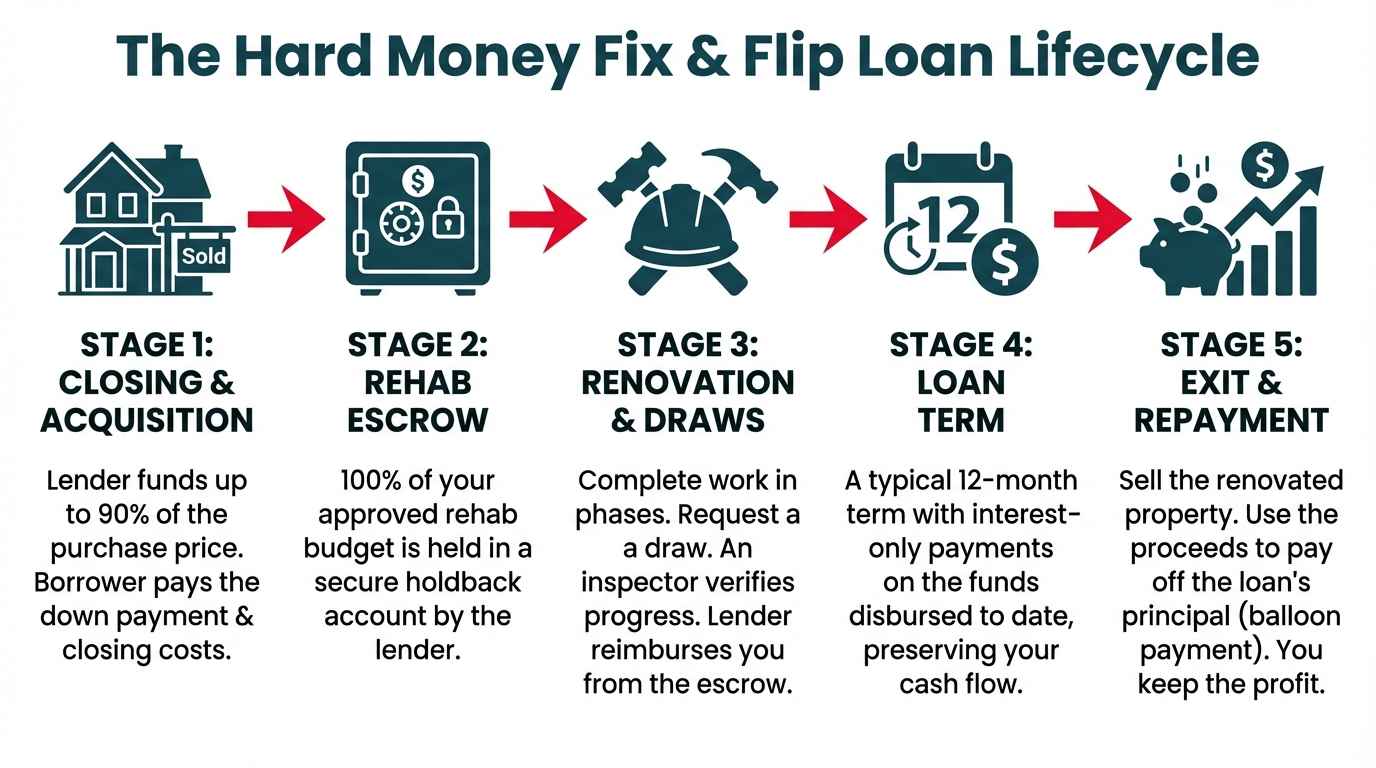
Below are common builder's risk insurance guidelines for fix and flip loans (otherwise known as hard money loans). These coverage limits are generally considered best practice from a risk management perspective.

Property Coverage
| Mandatory | Yes |
| AM Best Rating | A- VIII or greater |
| Term | 1 Year |
| Limits | Replacement Cost (appraisal or estimator), or Loan Amount. If loan is less than Replacement Cost, use an Agreed Value Policy or zero coinsurance |
| Deductible | $5,000 |
| Accepted Policy Types | Dwelling Fire (Special Form), or Commercial Property (Basic or Special Form) |
| Cancellation | 30-day notice |
| Exclusions | No windstorm, hail or named storm exclusion |
| Lender's Designation | Mortgagee |
General Liability Coverage
| Mandatory | Yes |
| AM Best Rating | A- VIII or greater |
| Term | 1 Year |
| Limits | $1,000,000 per occurrence / $2,000,000 aggregate |
| Deductible | $1,000 |
| Coverage Details | Occurrence basis for losses (not claims-made) |
| Cancellation | 30-day notice |
| Lender's Designation | Additional Insured |
Flood Insurance
If the property is in a FEMA special flood hazard area, your lender may require flood insurance.
| Mandatory | If in a flood zone (Flood Zone Determination required) |
| Term | 1 Year |
| Limits | The greater of $250,000 or the loan balance |
| Cancellation | 30-day notice |
| Lender's Designation | Mortgagee |
Additional Details
| Mortgagee Clause (OfferMarket Capital loans) | OfferMarket Capital LLC ISAOA/ATIMA627 S Hanover StBaltimore, MD 21230Borrowing from another lender? Use that lender's exact clause. |
| Condos | - Blanket policy may be used if it allows the individual Unit to be included in coverage.- Homeowner association maintains an "all risk" coverage for common areas, fixtures, personal property, equipment at 100% of their insurable value on a replacement cost basis. |
| PUDs | - Project's blanket policy may be used if it allows the individual Unit to be included in coverage.- Homeowner association maintains an "all risk" coverage for common areas, fixtures, personal property, equipment at 100% of their insurable value on a replacement cost basis. |
| Instructions | - Use ACORD form to ensure compliance- Send insurance certificates, invoices or paid receipts, no later than 24 hours before closing.- Send final policy documents, no later than 60 days after closing.- Borrower must notify carrier if property becomes vacant or unoccupied and obtain a vacancy permit for the entire period of vacancy. |
On the coast. Our guidelines do not accept a windstorm, hail or named storm exclusion. If the private policy excludes wind, a TWIA or private wind policy has to fill that gap before closing, with the lender listed as mortgagee on both.
Once it becomes a rental. When you refinance into one of our DSCR loans, the rental policy needs a property limit at the greater of 80% of replacement cost or the loan amount, liability of at least $500,000 per occurrence and $1,000,000 aggregate, and a full year of loss of rent. Every mortgagee clause should end with ISAOA/ATIMA, and lenders require an AM Best rating of A- VIII or better.

From Rehab to Rental
- Put the landlord policy in force before move-in day, then cancel the rehab policy and ask for the unused premium back. Our Texas landlord insurance page covers dwelling policies, the Texas FAIR Plan and rental deductibles.
- Finish what underwriters check first: the roof, the HVAC system, the electrical panel and any foundation repair.
- On the coast, keep the certificate of compliance for every inspected item. It is the document that keeps the rental eligible for TWIA.
- Keep the file: permits, contractor invoices, inspection reports and before and after photos. Then test the refinance with the DSCR calculator.
Texas Market Notes

- Houston. Bayous, floodplain rules and hurricane rain. Check the floodplain status and the 50% rule before you set the rehab budget, and bind flood at closing.
- Dallas-Fort Worth. Hail, tornadoes and permit backlogs. Get the hail deductible in dollars, schedule the roof before spring and keep vacancy coverage in force through permit waits.
- Austin. High land values and ground-up infill. Set the limit on rebuild cost, not price, and bind builder's risk before the first delivery.
- San Antonio. BRRRR and small multifamily. Plan partial occupancy and loss of rent on 2 to 4 unit rehabs.
- Galveston and the Bay Area. TWIA, windstorm inspections and flood. Schedule inspections during the work and price wind and flood together.
- Corpus Christi and the Coastal Bend. Elevated homes, wind exposure and V zones. Check whether the TWIA flood requirement applies.
- Rio Grande Valley. Cameron and Willacy are first-tier counties, so the same TWIA rules apply as in Galveston.
- Lubbock, Amarillo and the Panhandle. Severe hail and wind. Roof age and the hail deductible decide most of the quote.
- El Paso. Lower hurricane and hail exposure than the east, but flash flooding in arroyos. Check flood on low lots.
- New construction anywhere. Use ground-up construction financing and builder's risk on completed value, and carry completed operations coverage if you will sell. Estimate the loan with the construction loan calculator.
Texas Builder's Risk Checklist
- ✅ The right form for the scope of work and who is living there
- ✅ Existing house covered, not just the new work
- ✅ Wind and hail included, or TWIA or private wind bound on the coast
- ✅ Each deductible written in dollars, within 5% of the limit (or $5,000 if flat) and covered by your reserves
- ✅ Windstorm inspection planned for coastal roof and structural work
- ✅ Flood zone confirmed, with flood coverage bound at closing when needed
- ✅ Houston floodplain and 50% rule reviewed for heavy rehabs
- ✅ Vacancy permit in force through permit delays and the full project
- ✅ Minimum earned premium and fees confirmed in writing
- ✅ Certificate names the same LLC that takes title
- ✅ Trade licenses, liability and workers' compensation or occupational accident certificates collected
- ✅ Liability at the lender's limits, plus completed operations for any sale
How OfferMarket Insurance Works in Texas
OfferMarket Insurance LLC is a licensed insurance agency (NPN 20545557) built for 1 to 4 unit residential real estate investors, and it is licensed in Texas (license number 3583146). We quote, bind and service the policy ourselves.
You send the property once. Before you bind, we check the quote against the project and against your lender's guidelines: the policy type, the limit, wind and hail terms, TWIA and the windstorm inspection on the coast, every deductible in dollars, the minimum earned premium, flood, vacancy, liability and the mortgagee clause. We send the certificate to your lender or title company. When the property is ready to lease, we move you to landlord insurance without a gap.
That is the case for OfferMarket in one paragraph. Texas weather, Texas coastal rules and lender requirements all meet on one policy, and that policy should be checked by people who do this every day for investors. A generic quote will not do that for you. We will. Our license list is at offermarket.us/licenses.
⚡ Start my instant Texas quote
Frequently Asked Questions
Is Builder's Risk Insurance Required in Texas?
No Texas statute requires it on a private residential project. Lenders and most construction contracts do, so nearly every financed rehab or new build carries it.
How Much Does Builders Risk Insurance Cost in Texas?
It depends on completed value, location, roof, scope and carrier type, and small projects often pay a minimum premium. Coastal properties may need a separate windstorm premium, flood is separate everywhere, and surplus lines policies add a 4.85% tax. A quote with every deductible in dollars is the number to use.
Does Builder's Risk Cover Hail Damage in Texas?
Yes, when wind and hail are not excluded. Check the separate wind and hail deductible, and remember that hail damage present before you bought is not covered.
How Is Wind Covered on a Coastal Texas Rehab?
In the 14 first-tier coastal counties and parts of Harris County, many renovation policies exclude wind, and lender guidelines do not accept a wind exclusion. We check whether your renovation policy covers wind, and if it does not, we line up the wind coverage before closing. Plan a windstorm inspection for any roof or structural work, because most coastal properties need a certificate of compliance to stay insurable for wind.
Does Builder's Risk Cover Flooding From a Hurricane?
No. Wind damage can be covered, but rising water and storm surge need a separate flood policy. Bind it at closing to avoid the 30-day wait.
What Happens if My Permit Is Delayed?
The house may count as vacant while it sits idle, and some coverage can shrink after 30 or 60 days. Keep a vacancy permit in force, and request any policy extension before the expiration date.
Do Texas Contractors Need a License?
There is no statewide general contractor license, though plumbers, electricians and HVAC contractors are licensed. Verify trade licenses and insurance certificates, including workers' compensation, which is optional for most Texas employers.
Is OfferMarket Licensed in Texas?
Yes. OfferMarket Insurance LLC (NPN 20545557) is licensed in Texas (license number 3583146) and quotes, binds and services coverage. See our licenses page.
Protect and Grow Your Portfolio With OfferMarket
Texas rewards investors who move fast, and it punishes the ones who insure on autopilot. The hail deductible, coastal wind, flood, the permit wait and the lender's checklist are the places where a Texas project can turn from profit to loss. Settle them before closing, with a policy that was checked against your project and your loan.
Protect your capital. Protect your reputation. Protect your future in Texas real estate.
OfferMarket serves Texas investors at every stage, from a first flip in Garland to BRRRR rentals in San Antonio and new construction in Austin.
☂️ Investor Insurance rate shopping platform specialized in fix and flip, builder's risk and landlord insurance that meets fix and flip and DSCR loan guidelines. 🏚️ Off Market Properties marketplace featuring hundreds of exclusive and off market deals posted by wholesalers, tired landlords and distressed sellers. 💰 Private Lending featuring instant quotes and a simple, low cost, transparent borrowing experience for DSCR loans, Fix and Flip loans and Low Balance DSCR loans. 💡 Insights regularly published to provide you with a knowledge advantage.


OfferMarket Loans
Check your rate
60 seconds · no credit pull