Maximum Allowable Offer Calculator For Real Estate Investors
When you're diving into fix-and-flip or wholesale real estate deals, one number matters more than any other: your Maximum Allowable Offer (MAO). Get this wrong, and you'll either overpay for properties or miss out on profitable opportunities. Get it right, and you're setting yourself up for consistent, healthy returns.
That's exactly why we've built this comprehensive guide and interactive MAO calculator—to give you the tools and knowledge you need to make confident, data-driven offers on every investment property.
![**Task:** Create a professional hero image featuring a modern calculator interface overlaid on a background of residential property photos, symbolizing the intersection of data analysis and real estate investment.
**Visual Structure:** Split-screen composition with left side showing a sleek digital calculator display with MAO calculation elements, right side showing a collage of 3-4 residential properties in various conditions (distressed to renovated).
**ASCII Layout Reference:**
```
+------------------+------------------+
| | |
| CALCULATOR | PROPERTIES |
| INTERFACE | COLLAGE |
| (Clean, Modern)| (Real Estate) |
| | |
| MAO = $XXX,XXX | [House 1] |
| ARV × 70% | [House 2] |
| - Costs | [House 3] |
| | |
+------------------+------------------+
```
**Image Section Breakdown:**
- Left panel: Digital calculator interface with](https://firebasestorage.googleapis.com/v0/b/offer-market-us.appspot.com/o/generated_images%2Fgenerated_1771453047818_obh6hu.jpg?alt=media&token=2caef2ae-c66f-4f1c-9c41-1cd43c7f1206)
Understanding Maximum Allowable Offer (MAO) in Real Estate Investing
If you're diving into fix-and-flip or wholesale deals, getting your purchase price right can make or break your profits. That's where the Maximum Allowable Offer (MAO) comes in—a straightforward calculation that tells you exactly how much you can pay for a property and still walk away with the returns you're after.
What is MAO?
Think of your Maximum Allowable Offer as your hard ceiling—the absolute most you can offer on a property while keeping your profit margins intact. It's your built-in safeguard against overpaying and a reliable way to keep your deals in the green.
The math behind MAO is refreshingly simple: your purchase price plus every cost involved needs to leave enough breathing room for profit when you sell or refinance.
Why MAO Matters for Investors
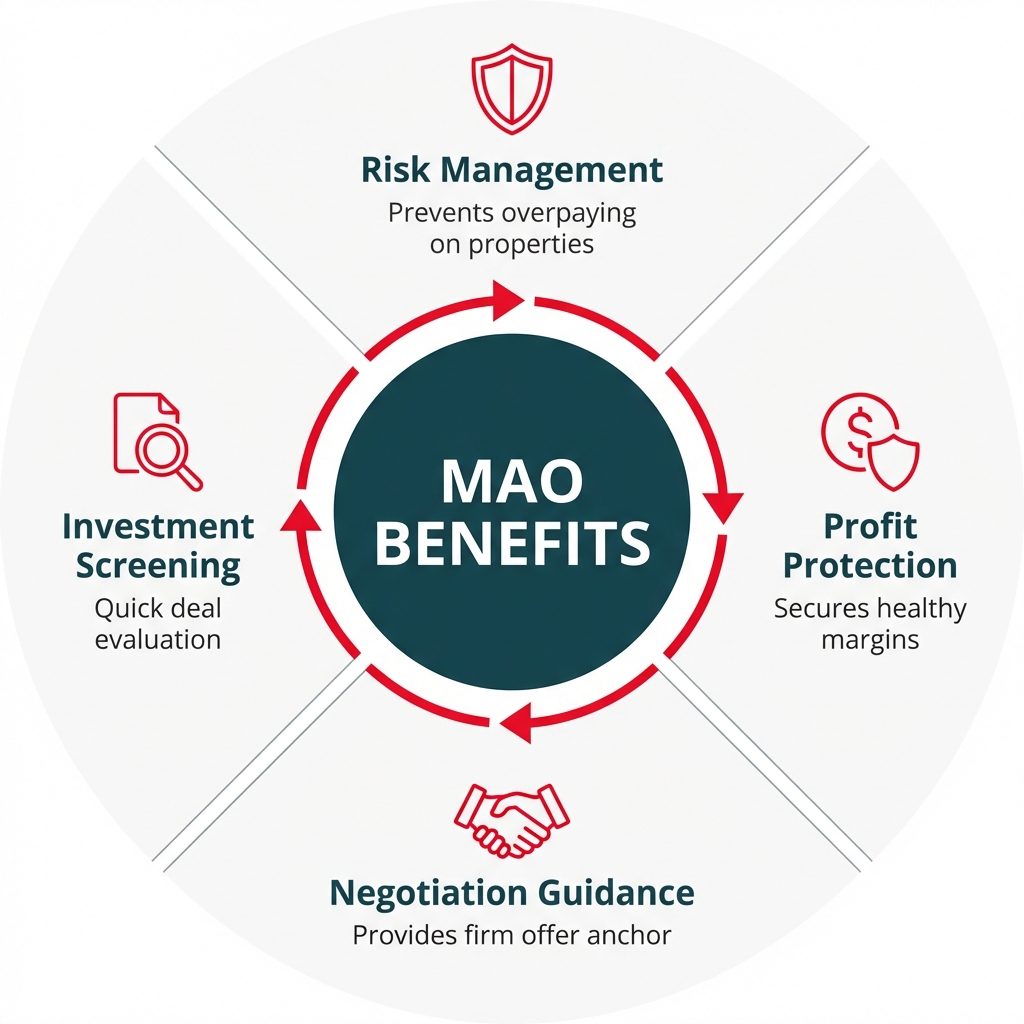
Getting your MAO right isn't just helpful—it's essential. Here's why:
- Risk management - Keeps you from overpaying on properties that won't deliver solid returns
- Profit protection - Locks in healthy margins after every expense is covered
- Negotiation guidance - Gives you a firm number to anchor your offers
- Investment screening - Lets you size up deals quickly and confidently
Here's the reality: "Incorrect ROI calculations can give a false sense of profitability and lead to poor investment decisions" (N Properties). Your MAO is the bedrock of accurate ROI projections.
Introducing Our Interactive MAO Calculator
We've built an interactive MAO calculator to take the heavy lifting out of this essential step—you'll find it right at the top of this article. Here's what you can do with it:
- Input your estimated After Repair Value (ARV)
- Add projected renovation costs
- Account for closing and holding expenses
- Adjust profit margin requirements
- Calculate your maximum offer instantly
No more guesswork. Just a clear, data-driven number that shows you exactly where your offer should land.
Understanding the 70% Rule in Real Estate Investing
The 70% Rule is one of the most important guidelines you'll use as a real estate investor, especially if you're focused on fix-and-flips or wholesaling. Think of it as your quick-check formula for figuring out the maximum you should offer on a property while still protecting your profit margin.
The 70% Rule Formula Explained
Here's the formula in its simplest form:
MAO = (ARV × 70%) - Repair Costs - Closing costs(buying) - Closing costs(selling) - Holding costs
Let's break that down:
- MAO (Maximum Allowable Offer) is the highest price you should pay for a property
- ARV (After Repair Value) is what the property will be worth once renovations are complete
- 70% is your target for total acquisition and renovation costs as a percentage of ARV
- Repair Costs are your estimated renovation expenses
![**Task:** Create a clean, professional infographic breaking down the 70% Rule formula with visual representation of how the percentages allocate across different cost categories.
**Visual Structure:** Horizontal bar chart showing 100% ARV broken into segments, with the formula prominently displayed above and detailed breakdown below.
**ASCII Layout Reference:**
```
THE 70% RULE FORMULA
MAO = (ARV × 70%) - Repair Costs
[====70% MAO Zone====][==30% Buffer==]
(Your Offer) (Profit+Costs)
BREAKDOWN:
Purchase Price: 50-55%
Repair Costs: 15-20%
Your Profit: 15-20%
Selling Costs: 10-15%
```
**Image Section Breakdown:**
- Header section:](https://firebasestorage.googleapis.com/v0/b/offer-market-us.appspot.com/o/generated_images%2Fgenerated_1771463311215_8zod3q.jpg?alt=media&token=6d8aa33c-95d0-497f-a092-888dff6236ce)
Breaking Down the Components
After Repair Value (ARV)
The ARV is simply the property's market value after you've completed all the renovations. Determining an accurate ARV requires analyzing comparable properties ("comps") that have recently sold in the same neighborhood with similar characteristics (square footage, bedrooms, bathrooms, etc.).
Repair Costs
This covers everything you'll spend to get the property market-ready, including:
- Materials and labor for structural repairs
- Cosmetic upgrades (paint, flooring, fixtures)
- Mechanical systems (HVAC, electrical, plumbing)
- Permits and inspection fees
- Contractor overhead and profit
Closing Costs
Closing costs are the fees you'll pay when buying and eventually selling the property:
Purchase closing costs: 2-5% of purchase price
- Loan origination fees
- Title search and insurance
- Attorney fees
- Recording fees
- Transfer taxes
Selling closing costs: 8-10% of ARV
- Real estate agent commissions (5-6%)
- Title insurance
- Transfer taxes
- Potential concessions to buyers
Holding Costs
Holding costs are what you'll pay to keep the property running until it sells:
- Mortgage payments
- Property taxes
- Insurance
- Utilities
- HOA fees (if applicable)
- Lawn care/snow removal
Plan on these adding up to about 1-2% of the ARV each month. The longer your renovation timeline and selling period, the higher these costs will be.
Why Investors Use the 70% Rule
The 70% Rule has become a go-to tool in real estate investing because it builds in a safety net for both profit and those surprise expenses that always seem to pop up. Here's how that 30% margin typically breaks down:
- 15-20% for your profit
- 10-15% for selling costs and unforeseen expenses
Experienced fix-and-flip investors embraced this rule after learning the hard way that even small miscalculations in ARV or repair costs can take a serious bite out of profitability. The 70% Rule gives you a systematic way to evaluate deals quickly, so you can make confident offers even when the market gets competitive.
Here's the bottom line: while the 70% Rule is an excellent starting point, experienced investors know it sometimes needs tweaking based on your specific market conditions, property characteristics, and investment goals—all topics we'll dig into in the sections ahead.
Practical Example
Let's put this formula to work with a real-world scenario:
- ARV: $300,000
- Rehab Costs: $45,000
- Closing Costs: $15,000
- Holding Costs: $10,000
MAO = ($300,000 × 70%) - ($45,000 + $15,000 + $10,000) MAO = $210,000 - $70,000 MAO = $140,000
![**Task:** Create a detailed example calculation infographic showing the MAO formula applied to a real property scenario with clear visual breakdown of all costs and the final maximum offer.
**Visual Structure:** Vertical flow diagram starting with inputs at top, showing calculation steps in middle, and final MAO result at bottom, with visual cost breakdown pie chart on the right side.
**ASCII Layout Reference:**
```
EXAMPLE MAO CALCULATION
+---------------------------+
| ARV: $300,000 |
| × 70% = $210,000 |
+---------------------------+
MINUS
+---------------------------+
| Rehab Costs: $45,000 |
| Closing Costs: $15,000 |
| Holding Costs: $10,000 |
| TOTAL COSTS: $70,000 |
+---------------------------+
EQUALS
+---------------------------+
| MAXIMUM OFFER: $140,000 |
+---------------------------+
[PIE CHART: Cost Breakdown]
```
**Image Section Breakdown:**
- Top section:](https://firebasestorage.googleapis.com/v0/b/offer-market-us.appspot.com/o/generated_images%2Fgenerated_1771463425955_07xuvz.jpg?alt=media&token=5031f4d2-52ba-479d-b4fe-8e04a1b5280b)
In this example, $140,000 is your ceiling—the absolute maximum you should offer to keep your profit margins healthy. Research shows that accurately estimating rehab costs is one of the most challenging aspects of this calculation, so don't hesitate to bring in a contractor or experienced investor for guidance.
When you understand each piece of the MAO formula, you're making decisions based on solid numbers—not hunches or market buzz. This disciplined approach is exactly what sets thriving real estate investors apart from those who struggle to see returns.
How to Use the MAO Calculator Effectively
Getting the most out of a Maximum Allowable Offer calculator comes down to using it the right way. Here's your step-by-step guide to making this tool work for you.
Step 1: Gather Your Input Values
Before you dive in, make sure you have solid estimates for:
- After Repair Value (ARV): What the property will be worth once renovations are complete
- Rehab Costs: Everything from materials and labor to permits and unexpected fixes
- Closing Costs: Plan for 2-5% of the purchase price
- Holding Costs: Think insurance, taxes, utilities, and loan payments while you're renovating
- Desired Profit Margin: The minimum return that makes this deal worth your time
Step 2: Enter Values into the Calculator
Plug each number into the right field. Here's a pro tip: stay conservative. It's always smarter to overestimate your costs and underestimate your ARV than the other way around.
Step 3: Understand the Calculator Outputs
Once you run the numbers, your MAO calculator delivers the insights you need to move forward with confidence:
- Maximum Allowable Offer: The ceiling price that keeps your deal profitable
- Total Project Costs: Your purchase price plus every expense along the way. Aim for this number to be around 70% of the ARV.
- Expected Profit: What you'll pocket when the dust settles
Another Sample Calculation Walkthrough
Let's break down a real-world example together:
- ARV: $250,000
- Rehab Costs: $40,000
- Closing Costs: $5,000
- Holding Costs: $5,000
- Desired Profit: $30,000
Here's how the 70% rule works in action: MAO = (ARV × 70%) - (Rehab + Closing + Holding Costs) MAO = ($250,000 × 0.70) - ($40,000 + $5,000 + $5,000) MAO = $175,000 - $50,000 MAO = $125,000
Bottom line? $125,000 is your ceiling on this property. Stay at or below this number, and you've built in a healthy profit margin plus a cushion for those surprises that always seem to pop up.
Interpreting the Results
Think of your calculator as a trusted guide, not a rulebook set in stone. As one study on investment tools points out, "Financial calculators rely on fixed assumptions, which don't always align with real-life scenarios" (LinkedIn, 2023). That's exactly why you'll want to tweak your inputs based on what you're seeing on the ground.
Here's the good news: calculators dramatically cut down on math mistakes and sharpen your key metrics (Shriram Finance, 2026). Just remember—they're here to support your decision-making, not replace your investor instincts.
Master these steps, understand what the calculator can and can't do, and you'll be making investment decisions that truly align with your wealth-building goals.
Adjusting the MAO for Market Conditions
Market conditions matter—a lot. When you're calculating your Maximum Allowable Offer (MAO), the percentage of After Repair Value (ARV) you use should shift based on what's happening in your local market.
While the standard 70% rule provides a solid baseline, savvy investors understand that market dynamics may require adjustments to remain competitive.
Competitive Markets: Going Beyond the 70% Rule
In highly competitive real estate markets, you'll often need to adjust your calculations upward to 75-80% of ARV to secure deals. According to recent market analysis, "Sellers are more likely to accept lower offers, cover closing costs, or agree to more favorable terms in buyer's markets" - but the opposite is true in seller's markets where you're facing intense competition for limited inventory (Henderson Properties).
Buyer's vs. Seller's Markets
The type of market you're operating in significantly impacts your MAO calculations:
In a buyer's market: You can often stick closer to the traditional 70% rule since sellers have less negotiating power. As Gatsby Investment notes, "A buyer's market is a great time to expand your real estate portfolio. You can take advantage of lower buyer competition to control negotiations and buy properties at better prices" (Gatsby Investment).
In a seller's market: You may need to adjust to 75-80% of ARV to stay in the game. In these conditions, "buyers need to act fast and make a strong offer to stand a chance of securing their desired property" (AMRES).
![**Task:** Create a comparison infographic showing how MAO calculations adjust between buyer's markets and seller's markets, with visual representation of the different percentage rules.
**Visual Structure:** Side-by-side comparison layout with two columns, each showing market type, recommended ARV percentage, and visual gauge indicator.
**ASCII Layout Reference:**
```
MARKET CONDITIONS & MAO ADJUSTMENTS
+------------------+------------------+
| BUYER'S MARKET | SELLER'S MARKET |
+------------------+------------------+
| [GAUGE: 70%] | [GAUGE: 75-80%] |
| | |
| • More leverage | • Less leverage |
| • Lower offers | • Higher offers |
| • Better terms | • Quick action |
| • Less urgency | • Competition |
+------------------+------------------+
ADVANTAGES CHALLENGES
```
**Image Section Breakdown:**
- Header:](https://firebasestorage.googleapis.com/v0/b/offer-market-us.appspot.com/o/generated_images%2Fgenerated_1771463752626_tis17m.jpg?alt=media&token=b7a48371-1ee7-41ff-989b-2b99261a494b)
Regional Variations
The right ARV percentage varies significantly by location:
- Hot urban markets: May require 75-80% ARV calculations to win deals
- Rural or declining markets: Might allow for 65-70% ARV to protect your profit margins
- Emerging neighborhoods: Often require careful analysis of future appreciation potential
Seasonal Considerations
Real estate market activity fluctuates throughout the year, and that affects your MAO calculations:
- Spring/Summer: Typically more competitive, potentially requiring higher ARV percentages (75-80%)
- Fall/Winter: Often less competitive, giving you room for more conservative offers (closer to 70%)
- Holiday seasons: Can present unique opportunities where you have more negotiating power
By adjusting your MAO calculations based on these market factors, you'll be better positioned to make competitive offers while still protecting your bottom line. Remember that the goal is to find the sweet spot that allows you to secure deals without sacrificing your investment returns.
Adjusting the 70% Rule for Complex Renovation Projects
When calculating your Maximum Allowable Offer (MAO), the standard 70% rule may not always apply—especially for properties requiring extensive renovations. For complex projects, experienced investors often reduce the percentage to 65% or even lower to create a larger buffer against unexpected costs.
When to Use the 65% Rule
Complex renovation projects typically involve:
- Structural repairs (foundation issues, roof replacement, load-bearing wall modifications)
- Complete system overhauls (electrical, plumbing, HVAC)
- Major layout changes requiring permits and architectural plans
- Properties with environmental issues (mold, asbestos, lead paint)
- Historic homes requiring specialized restoration work
These projects carry significantly higher risk of cost overruns and complications. Here's something worth noting: recent data from JBREC shows that 45% of house flippers would spend less on renovations if material costs suddenly rose by just 10%. That tells you just how sensitive renovation budgets are to market fluctuations .
Assessing Renovation Difficulty
Before finalizing your MAO calculation, take time to thoroughly assess the property's condition:
- Inspection Reports: Invest in comprehensive professional inspections
- Contractor Estimates: Get multiple detailed bids, not just ballpark figures
- Permit Research: Check local requirements and potential delays
- Property History: Research previous renovations and potential hidden issues
- Comparables Analysis: Examine similar renovation projects in the area
Common Renovation Pitfalls
The 65% rule exists because renovation projects frequently exceed budgets. A recent study found that approximately 78% of home renovation projects go over budget, with around two-thirds of homeowners taking on debt to cover these unexpected costs [](https://www. nasdaq.com/articles/renovation-trap-why-78-home-projects-go-over-budget).
Common causes of budget overruns include:
- Scope Creep: Expanding the project beyond initial plans
- Hidden Damage: Issues discovered only after demolition begins
- Material Price Fluctuations: Especially relevant in today's volatile market
- Labor Shortages: Causing delays and increased costs
- Permit Delays: Extending holding times and financing costs
![**Task:** Create an infographic highlighting the statistic that 78% of renovation projects go over budget, with a visual breakdown of common causes of budget overruns.
**Visual Structure:** Large prominent statistic at top, followed by horizontal bar chart showing five main causes of budget overruns with relative frequency/impact indicators.
**ASCII Layout Reference:**
```
+----------------------------------+
| 78% |
| OF RENOVATION PROJECTS |
| GO OVER BUDGET |
+----------------------------------+
TOP CAUSES OF BUDGET OVERRUNS:
[████████████] Scope Creep
[███████████] Hidden Damage
[██████████] Material Price Changes
[█████████] Labor Shortages
[████████] Permit Delays
```
**Image Section Breakdown:**
- Top section: Large](https://firebasestorage.googleapis.com/v0/b/offer-market-us.appspot.com/o/generated_images%2Fgenerated_1771463805691_je85fv.jpg?alt=media&token=d85bd588-f378-4283-9dbd-f84bdaa46746)
Building a Contingency Buffer
For complex renovation projects, smart investors typically build these safeguards into their numbers:
- 15-25% Contingency: Added to the estimated renovation costs
- Extended Holding Period: Calculate 1.5-2x the expected timeline
- Increased Carrying Costs: Account for potential delays in materials and labor
- Exit Strategy Alternatives: Plan for rental or wholesale options if the flip doesn't work out
By adjusting your MAO calculation to 65% for complex projects, you give yourself the breathing room to handle surprises while still walking away with a solid return on your investment.
Impact of Extended Holding Periods on Your MAO
Here's something every investor needs to understand: when calculating your Maximum Allowable Offer, holding time is often the sneaky factor that catches people off guard. The longer you hold a property, the more your carrying costs chip away at your profit margins.
Realistic Holding Time Expectations
Let's be honest—most investors underestimate how long a flip actually takes. The numbers tell us that the average fix-and-flip project runs about 4-6 months from purchase to sale, though your mileage may vary depending on project scope and market conditions.
"On average, most fix and flip investors take 4-6 months to flip a house. This industry-standard timing includes everything: from purchasing through renovation to final sale." Express Capital Financing
Calculating Monthly Carrying Costs
To nail down an accurate MAO, you'll want to tally up your monthly carrying costs and multiply by your expected holding period. These typically include:
- Loan payments/interest
- Property taxes
- Insurance premiums
- Utilities
- HOA fees (if applicable)
- Security/maintenance costs
Let's put this into perspective: if your monthly holding costs add up to $2,000 and you're looking at a 5-month project timeline, you'll want to budget $10,000 for holding costs in your MAO calculation.
Opportunity Cost Considerations
Here's something many investors overlook—extended holding periods come with opportunity cost. That's the money you could be making if your capital was working for you somewhere else. Every month your funds sit in one project is a month you might be missing out on other solid investments.
Smart investors factor this opportunity cost into their numbers, especially when they're weighing multiple deals at once.
Seasonal Selling Considerations
Timing matters more than you might think. When you list your property can affect both how long it sits on the market and what price you ultimately get. Spring and early summer are typically your sweet spots—properties tend to move faster and fetch better prices during these months.
According to BiggerPockets, "the average holding cost for a flip is $500 to $1,000 per month, depending on location. In hot markets like California or New York, these costs can be substantially higher." AH Lend
Adjusting Your MAO for Holding Time
Here's your game plan for factoring holding time into your MAO:
- Calculate your monthly carrying costs
- Multiply by a realistic timeline (pro tip: add a 1-2 month cushion)
- Subtract this total from your initial MAO calculation
For projects where you're expecting a longer hold, consider dropping your offer by an extra 3-5% to cover the added risk and carrying costs.
When you account for holding time properly in your MAO calculations, you're setting yourself up for protected profit margins and smarter investment decisions that reflect what each project truly costs.
Understanding ARLTV Caps Based on Experience
Here's the deal: lender guidelines shift based on your track record, and that directly affects how much you can offer on a property:
- Novice Investors (0-2 properties): Most lenders cap After-Repair-Loan-to-Value (ARLTV) at 70-75%, meaning you'll need more conservative MAO calculations
- Experienced Investors (3+ properties): You can often access up to 80% ARLTV on stabilized properties, giving you room for higher purchase offers
Common Mistakes When Calculating Maximum Allowable Offer
When using a Maximum Allowable Offer (MAO) calculator, even experienced real estate investors can stumble into costly traps that eat into their profits. Let's walk through these common pitfalls so you can sharpen your calculations and make smarter investment decisions.
Underestimating Rehabilitation Costs
Here's a mistake we see all the time: investors lowball their renovation estimates. It's easy to get optimistic about repair costs, but those unexpected surprises during rehab? They're practically guaranteed to show up.
According to Investopedia, "The cost of repairs is often the most misjudged aspect of real estate investing. Investors should add a 10-20% buffer to their renovation budget to account for unforeseen problems that may arise during the rehabilitation process."
Overestimating After Repair Value (ARV)
This one can really hurt your bottom line. When you inflate what a property will be worth post-renovation, your entire MAO calculation gets thrown off course.
"Amateur investors often make the mistake of buying with emotion rather than numbers, leading them to overestimate the property's potential value after repairs," notes Gold House Accounting. "This emotional attachment can blind investors to market realities and comparable sales data."
Ignoring Carrying Costs
Don't make the mistake of only crunching purchase price and renovation numbers. Those holding costs while you're rehabbing and selling? They add up fast.
Here's what you need to factor in:
- Mortgage payments
- Property taxes
- Insurance
- Utilities
- HOA fees
- Property management fees
These expenses can snowball quickly, especially when projects run long or properties sit on the market longer than you planned.
Failing to Account for Market Changes
Real estate markets don't stand still, and conditions can shift while your project is underway. A calculation that made sense when you purchased might not hold true by the time you're ready to sell or rent.
"Not understanding the market is a fundamental mistake that can derail even the most promising investment. Market conditions can change rapidly, affecting both property values and rental rates," according to Gold House Accounting.
Miscalculating Profit Margins
Here's something that trips up a lot of investors: not accounting for all the costs that chip away at your profits. These include:
- Closing costs (both buying and selling)
- Realtor commissions
- Financing costs and loan origination fees
- Capital gains taxes
- Marketing expenses
These expenses can take a serious bite out of your bottom line, turning what looked like a solid deal into a break-even scenario—or worse, a loss.
![**Task:** Create a warning-style infographic listing the five most common MAO calculation mistakes with icons and brief descriptions, designed to serve as a quick reference checklist for investors.
**Visual Structure:** Five-row layout with warning icons on left, mistake titles in center, and brief descriptions on right, all contained within a bordered frame with prominent header.
**ASCII Layout Reference:**
```
+----------------------------------------+
| AVOID THESE MAO MISTAKES |
+----------------------------------------+
| [!] Underestimating Rehab Costs |
| Add 10-20% buffer for surprises |
+----------------------------------------+
| [!] Overestimating ARV |
| Use conservative comps analysis |
+----------------------------------------+
| [!] Ignoring Carrying Costs |
| Include all holding expenses |
+----------------------------------------+
| [!] Failing to Account for Markets |
| Markets shift during projects |
+----------------------------------------+
| [!] Miscalculating Profit Margins |
| Factor in ALL transaction costs |
+----------------------------------------+
```
**Image Section Breakdown:**
- Header section:](https://firebasestorage.googleapis.com/v0/b/offer-market-us.appspot.com/o/generated_images%2Fgenerated_1771463931109_bg7kza.jpg?alt=media&token=30b90423-74f2-420e-8598-ae3fa7983bdd) mistake title > description
- Professional, authoritative appearance
- Easy to scan and read quickly
- Suitable for printing as reference material
**Alt text:** Warning-style infographic with red header reading "Avoid These MAO Mistakes" followed by five rows each containing a red warning triangle icon and listing common calculation errors: underestimating rehab costs (add 10-20% buffer), overestimating ARV (use conservative comps), ignoring carrying costs (include all holding expenses), failing to account for markets (markets shift during projects), and miscalculating profit margins (factor in all transaction costs), all presented in Deep Teal and black text on white background with Deep Teal border." loading="lazy" style="max-width: 100%; height: auto; border-radius: 8px;">
mistake title > description
- Professional, authoritative appearance
- Easy to scan and read quickly
- Suitable for printing as reference material
**Alt text:** Warning-style infographic with red header reading "Avoid These MAO Mistakes" followed by five rows each containing a red warning triangle icon and listing common calculation errors: underestimating rehab costs (add 10-20% buffer), overestimating ARV (use conservative comps), ignoring carrying costs (include all holding expenses), failing to account for markets (markets shift during projects), and miscalculating profit margins (factor in all transaction costs), all presented in Deep Teal and black text on white background with Deep Teal border." loading="lazy" style="max-width: 100%; height: auto; border-radius: 8px;">
The good news? By steering clear of these common calculation pitfalls, you'll be equipped to use the MAO calculator with confidence and make investment decisions that actually put money in your pocket.
Advanced MAO Calculation Techniques for Experienced Investors
Once you've mastered the basics, it's time to level up. Seasoned investors often tweak the standard MAO formula to capture the finer details that can make or break your returns. These adjustments help you nail down more precise valuations, especially in tricky or competitive markets.
Risk-Adjusted Calculations
Smart investors build risk premiums right into their MAO calculations based on what they're dealing with. Got a property in a transitional neighborhood or one with serious structural headaches? Consider dropping down to a 65% rule instead of the standard 70% to give yourself more cushion.
As [Quant Investing](https://www. quant-investing.com/blog/magic-formula-investment-strategy-back-test) points out, "Investment strategies built on simple formulas often require modification to account for varying risk profiles across different asset classes" . This principle applies directly to real estate MAO calculations.
Portfolio-Based Approaches
When building a real estate portfolio, experienced investors often adjust their MAO calculations based on how a specific property complements their existing holdings:
- Diversification Value: Properties that reduce overall portfolio risk (by diversifying across neighborhoods or property types) may justify a higher MAO.
- Economies of Scale: If you own multiple properties in one area, you can often increase your MAO to account for management efficiencies.
- Cash Flow Balancing: A property with strong cash flow potential might warrant a higher MAO if it balances out properties with stronger appreciation but weaker cash flow.
Appreciation Potential Factors
Standard MAO calculations focus mainly on immediate value-add opportunities through renovation. But smart investors also factor in long-term appreciation potential:
- Infrastructure Development: Keep an eye on upcoming transportation improvements, commercial developments, or school renovations.
- Population Growth Trends: Areas with consistent population increases often see stronger appreciation.
- Employment Diversity: Regions with diverse employment sectors tend to have more stable long-term growth.
Neighborhood Analysis Adjustments
Morningstar research indicates that "Investors using formula-based strategies should be prepared to adapt and update their approaches" based on specific market conditions . For real estate MAO calculations, this means looking at:
- School District Performance: Properties in improving school districts may justify a higher MAO percentage.
- Crime Rate Trends: Areas with declining crime statistics often signal upcoming neighborhood revitalization.
- Rental Demand Metrics: Low vacancy rates and rising rents point to strong investment potential.
- Walkability Scores: These are increasingly valued by both buyers and renters, affecting future marketability.
By incorporating these advanced techniques into your MAO calculations, you'll develop a more nuanced approach that accounts for both the hard numbers and the qualitative factors that drive long-term investment success.
Real-World Examples: The Impact of MAO Calculations on Investment Outcomes
Getting your Maximum Allowable Offer right can make or break your investment. Let's walk through some real scenarios that show exactly why this matters.
Success Story: The Strategic Underbidder
One of our OfferMarket clients in Dallas spotted a distressed property with an estimated ARV of $350,000. They stuck to the 70% rule, factored in $45,000 for renovations, and landed on an MAO of $200,000 ($350,000 × 70% - $45,000). The market was competitive, and there was pressure to go higher. They didn't budge. Eventually, they locked in the property for $195,000.
Renovations came in under budget at $42,000, and they sold for $355,000 just eight weeks later. That disciplined MAO approach? It delivered a $78,000 profit after all holding and closing costs.
Cautionary Tale: Exceeding the MAO
Here's the flip side. Another investor calculated their MAO at $175,000 on a property with a $280,000 ARV. But the market was hot, and they wanted to win. They offered $195,000—$20,000 over their MAO. Their $30,000 renovation budget? It jumped to $45,000 when unexpected electrical and foundation problems surfaced.
When market conditions cooled slightly, the property sold for $270,000 instead of the projected $280,000. The final profit was just $8,000—significantly below the expected return and not worth the time and risk invested.
The 80/20 Rule in Action
Here's something seasoned investors know well: roughly 80% of your profits will come from just 20% of your deals—the ones you've carefully vetted and conservatively underwritten. As industry experts put it, "If you focus on the right 20%, you can work less and achieve more. In multifamily real estate, this rule is gold" source.
Lessons Learned from OfferMarket Customers
After analyzing hundreds of transactions, we've spotted three key patterns that set successful investors apart:
Conservative ARV Estimates: The top performers pull comparable sales from the last 90 days and adjust downward for market uncertainty. Smart move.
Detailed Renovation Budgets: They build in a 15-20% contingency buffer. Because surprises happen—and they usually cost money.
Realistic Holding Costs: They account for everything—insurance, taxes, utilities, and financing costs—for at least 1.5× the expected project timeline.
These real-world examples show why disciplined MAO calculations aren't just textbook theory. They're practical tools that directly impact your bottom line. Follow these principles, and you'll position yourself among the successful 20% who consistently profit in real estate investing.
The OfferMarket Advantage: Integrated Real Estate Investment Platform
Let's be honest: real estate investing has traditionally meant juggling multiple service providers—lenders, insurance agents, property listing platforms. This fragmented approach leads to inefficiencies, higher costs, and slower decision-making. OfferMarket changes this paradigm by offering an integrated platform that combines lending, insurance, and listings expertise under one roof.
Streamlined Decision-Making Process
With OfferMarket's integrated platform, you get access to critical financial, operational, and property data in real time. This comprehensive view helps you make faster, smarter investment decisions—especially when you're calculating your maximum allowable offer. As industry experts point out, "With real-time access to financial, operational, and property data, investors can make faster, more informed decisions" .
Cost Efficiencies Through Vertical Integration
OfferMarket's vertically integrated model puts real cost advantages in your pocket. By controlling multiple aspects of the investment process, the platform cuts uncertainty, boosts efficiency, and passes those savings directly to you. Real estate investment analysts put it simply: "When one company can control a project from conception to completion, uncertainty is reduced, efficiency is increased and the relative cost savings can be passed on to investors" .
Enhanced Risk Management
The combination of lending expertise, insurance knowledge, and property listings gives you a unique edge in risk assessment. The platform delivers a complete picture of potential investments, so you can run more accurate MAO calculations that factor in everything—from financing terms to insurance costs to property conditions. This comprehensive approach helps you sidestep costly miscalculations and submit offers with confidence.
Simplified Investment Process
Instead of juggling multiple platforms and relationships, you get a streamlined experience where you can:
- Calculate your maximum allowable offer using our calculator
- Access competitive loan products tailored to your investment strategy
- Obtain insurance quotes specific to your property type
- Find off-market properties with investment potential
This integrated approach removes traditional barriers to efficient real estate investing, making it easier for you to build a successful portfolio—whether you're just starting out or adding to an established one.
Conclusion: Making Disciplined Offers for Long-Term Investment Success
Calculating your Maximum Allowable Offer (MAO) isn't just about crunching numbers—it's about building the kind of investment discipline that keeps your profits healthy over time. As the real estate market shifts and changes, investors who stick to a structured approach when making offers consistently come out ahead of those who let emotions or impulse drive their decisions.
The data backs this up: disciplined investors see stronger ROI in real estate compared to reactive investors who jump on deals without doing their homework. According to a study highlighted by Mortar Group, "disciplined real estate investing is the primary differentiator between successful long-term investors and those who experience significant losses" in their investment journey.
Key Takeaways:
- The 70% Rule is a starting point, not a hard-and-fast formula. Adjust it based on market conditions, property specifics, and your investment strategy.
- Factor in all your costs when calculating MAO—rehab, closing, holding, and those surprise expenses—to make sure you stay profitable.
- Stay on top of market analysis to sharpen your ARV estimates and keep your offers both competitive and profitable.
- Your experience level affects your lending terms, so build that into your maximum offer calculations.
The MAO calculator above is your go-to tool for staying disciplined. Plug in accurate numbers and tweak the parameters for your specific situation, and you'll have a clear ceiling price that protects your returns.
Keep in mind that successful real estate investing comes down to consistently applying proven strategies, and MAO calculation is one of the most essential.
![**Task:** Create a call-to-action style infographic with three distinct sections promoting next steps for readers: trying the calculator, exploring lending products, and signing up for the platform.
**Visual Structure:** Three equal-width vertical panels, each with an icon, header, description, and call-to-action button, arranged horizontally.
**ASCII Layout Reference:**
```
YOUR NEXT STEPS TO INVESTMENT SUCCESS
+-------------+-------------+-------------+
| [CALC] | [LOAN] | [SIGNUP] |
| | | |
| Try the | Explore | Sign Up |
| Calculator | Lending | for Full |
| | Products | Platform |
| | | |
| Calculate | Competitive | Free |
| your MAO | DSCR & Flip | listings & |
| instantly | loans | insurance |
| | | |
| [BUTTON] | [BUTTON] | [BUTTON] |
+-------------+-------------+-------------+
```
**Image Section Breakdown:**
- Header:](https://firebasestorage.googleapis.com/v0/b/offer-market-us.appspot.com/o/generated_images%2Fgenerated_1771464412346_xa9hvo.jpg?alt=media&token=5e82361d-335e-4d77-b23b-e50bf18d9a13)
The OfferMarket Advantage
Here's what makes OfferMarket different—we bring deep expertise across three key areas that matter most to real estate investors:
Lending Knowledge: We've been in the trenches with DSCR and fix-and-flip loans, so we understand exactly how financing costs and lender requirements affect your MAO.
Insurance Expertise: We know how property condition, location, and other factors drive insurance costs—an expense that too many investors overlook when running their MAO calculations.
Listings Experience: Our marketplace gives us real-world data on ARVs and renovation costs across diverse markets, so you're working with numbers that reflect reality.
According to industry analysis, successful investors rely on multiple metrics to evaluate potential deals, with ROI being a critical factor that "compares various investment opportunities, making identifying the most profitable properties easier" (Gifford Property Management). Our calculator incorporates these best practices to deliver accurate, actionable results.
When you combine all three areas of expertise, you get MAO calculations that account for real-world variables other calculators simply miss.
Next Steps:
- Try the interactive calculator at the top of this page to figure out your MAO for current and future investment opportunities.
- Explore OfferMarket's lending products designed with investors like you in mind. Our competitive DSCR and fix-and-flip loans can help stretch your purchasing power further.
- Sign up for OfferMarket's platform to unlock free property listings, insurance quotes, and expert guidance—tools that give you a real advantage in today's fast-moving market.
When you pair smart offer calculations with OfferMarket's full suite of investor services, you're setting yourself up for success. That's how you build a real estate portfolio that grows your wealth for years to come.


OfferMarket Loans
Check your rate
60 seconds · no credit pull