*Quote takes 1 minute, no credit pull
Insurance*1 quote from 40+ carriers
Listings*New listings daily
Non Warrantable Condo
Last updated: July 12, 2026
For investors, a non-warrantable condo is one of those phrases that quietly kills deals. You find a well-priced unit with strong rent, you run the numbers, and then a lender tells you the building is non-warrantable and conventional financing is off the table. Many investors walk away at that point, assuming the deal is dead. It is not. Non-warrantable simply means the building does not fit the conventional box, and for an investor using Fix and Flip and DSCR financing, that box was never the right fit anyway. Here is what non-warrantable actually means, why it happens, and how to finance these properties.
What "Warrantable" Means
A condo is warrantable when it meets the eligibility guidelines set by Fannie Mae and Freddie Mac, the two government-sponsored enterprises that buy most conventional mortgages. When a building meets those standards, lenders can originate a conventional loan on a unit and then sell that loan to the GSEs, which keeps rates low and financing easy.
A non-warrantable condo is simply a unit in a project that fails one or more of those guidelines. When that happens, Fannie Mae and Freddie Mac will not purchase the loan, so conventional lenders either decline the deal or the loan has to be held in a lender's own portfolio. The important thing to understand is that non-warrantable is a financing classification, not a statement about the quality or safety of the unit itself. Plenty of perfectly good, well-located, cash-flowing condos are non-warrantable for reasons that have nothing to do with the individual unit.
Why a Condo Becomes Non-Warrantable
The determination is made at the project level, meaning the entire building, not just your unit. Fail any single criterion and every unit in the building becomes non-warrantable. The most common triggers include the following.
High investor concentration or low owner-occupancy. Buildings with a large share of renter-occupied units have historically been flagged. This is the classic reason investor-heavy buildings, which are often exactly the ones investors want, end up non-warrantable.
Single-entity ownership. When one person or entity owns too large a share of the units, generally more than 20 to 25 percent in larger projects, the concentration risk makes the building non-warrantable.
Weak HOA financials and reserves. If the homeowners association does not set aside enough of its annual budget for reserves, the building fails. This threshold has tightened recently, which we will get to.
Litigation. If the HOA is involved in a lawsuit, particularly one related to the structure or safety of the building, lenders will not touch it until the litigation resolves.
Excessive commercial space. Mixed-use projects where commercial or non-residential space exceeds roughly 35 percent of the project are non-warrantable.
Short-term rental or condotel operation. Buildings that operate like hotels, with daily or nightly rentals and hotel-like amenities, fall outside conventional guidelines.
Insurance shortfalls. Inadequate master insurance, or a per-unit deductible above the allowed limit, can push a project into non-warrantable status.
New construction and presale. New projects that have not sold enough units, or that are still under developer control, may not yet qualify.
The 2026 Rule Changes Investors Should Know
The warrantability landscape shifted meaningfully in 2026, and it is worth understanding because it is pushing more buildings into non-warrantable territory. On March 18, 2026, Fannie Mae and Freddie Mac released coordinated updates that tightened condo standards.
Two changes stand out. First, the minimum reserve allocation is rising from 10 percent to 15 percent of an HOA's annual budget, phasing in for loan applications dated on or after January 4, 2027. Many associations currently operate right at the old 10 percent floor, which means a meaningful number of buildings will lose warrantable status unless they raise dues or reserves. Second, the agencies are retiring the streamlined review pathways (Limited Review and Streamlined Review), so more condo purchases will face full project scrutiny.
There is one change that actually helps investors: the old 50 percent investor-concentration cap for full reviews was removed effective March 18, 2026. But note the single-entity ownership rule still applies and is separate, so do not confuse the two.
The net effect is that more buildings, not fewer, are becoming non-warrantable, which makes knowing how to finance them more valuable than ever.
Why Non-Warrantable Is Often Fine for Investors
Here is the reframe that matters. The entire warrantability framework exists to serve conventional, owner-occupied lending. As an investor using business-purpose loans, you were never going to use a conventional owner-occupied mortgage in the first place. Your financing tools, Fix and Flip loans and DSCR loans, are underwritten on entirely different criteria: the property's value and the deal's economics for a Fix and Flip, and the property's rental cash flow for a DSCR loan.
That means many of the factors that make a building non-warrantable, high investor concentration, short-term rental activity, a renter-heavy tenant base, are simply not disqualifying for the loans investors actually use. A building full of investors is a problem for a conventional owner-occupied lender and a non-issue for a DSCR lender focused on your unit's rent. The classification that scares off retail buyers can be a source of opportunity for an investor who knows how to finance around it, because non-warrantable units often sell at a discount precisely because conventional buyers cannot finance them.
Financing Non-Warrantable Condos with OfferMarket
OfferMarket Capital LLC funds both Fix and Flip loans and DSCR loans for non-warrantable condos, which covers the two most important phases of an investor's strategy.
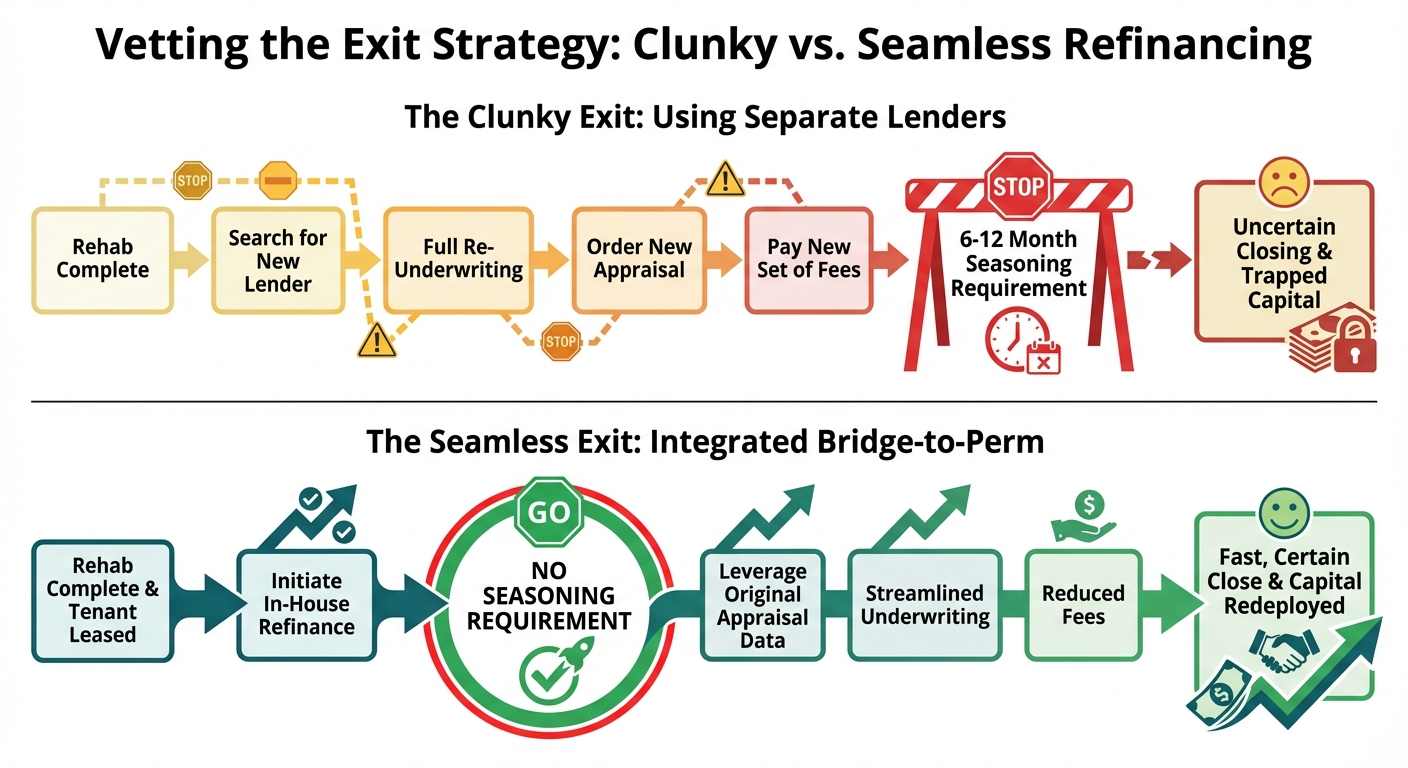
For acquisition and renovation, a Fix and Flip loan lets you purchase and rehab a non-warrantable condo using short-term, business-purpose financing that is underwritten on the deal rather than the building's GSE warrantability. For long-term holds, a DSCR loan lets you finance or refinance the unit based on its rental cash flow. This is the natural pairing for a BRRRR strategy on a non-warrantable unit: acquire and stabilize with the Fix and Flip loan, then refinance into a DSCR loan for the long-term hold.
Non-Warrantable Condos Are Financed as Single-Asset DSCR Loans
One important structural point to understand up front. While OfferMarket offers portfolio DSCR loans that bundle multiple properties into a single mortgage for many property types, non-warrantable condos do not qualify for portfolio structuring. A non-warrantable condo must be financed as a single-asset DSCR loan, meaning one loan per property rather than several units combined under one mortgage.
For a condo investor, this simply means planning your financing on a per-unit basis. If you are acquiring or refinancing several non-warrantable condos, each one is underwritten and closed as its own DSCR loan. The table below summarizes how these deals are structured.
| Non-Warrantable Condo Financing | Detail |
|---|---|
| Loan structure | Single-asset DSCR loan (one loan per property) |
| Portfolio DSCR eligibility | Not available for non-warrantable condos |
| Transaction types | Purchase and refinance |
| Acquisition and rehab | Fix and Flip loan |
| Long-term hold | DSCR loan based on rental cash flow |
| Ideal strategy | BRRRR: Fix and Flip to acquire, then DSCR to hold |
How to Evaluate a Non-Warrantable Condo Deal
A few habits will keep you out of trouble. Confirm why the building is non-warrantable before you commit, since the reason matters. A building that is non-warrantable due to high investor concentration is a very different risk than one that is non-warrantable due to active structural litigation or a severely underfunded HOA. The former is often a non-issue for your strategy; the latter can signal real financial exposure through future special assessments.
Review the HOA's financials and reserves regardless. Even though your loan does not hinge on GSE warrantability, a chronically underfunded HOA can hit you with special assessments and rising dues that erode your cash flow, which directly affects your DSCR. Check for litigation and understand its nature. And factor the non-warrantable discount into your analysis, because the harder these units are for retail buyers to finance, the more room there often is to buy well.
The Bottom Line
A non-warrantable condo is simply a unit in a building that does not meet Fannie Mae and Freddie Mac guidelines, whether because of investor concentration, HOA financials, litigation, commercial space, short-term rentals, or the tightened 2026 reserve and review rules. For conventional owner-occupied buyers, that classification is a roadblock. For an investor using business-purpose financing, it is often irrelevant, and sometimes an opportunity, because your loans are underwritten on the deal and the cash flow rather than the building's GSE status. OfferMarket Capital LLC funds both Fix and Flip loans and DSCR loans for non-warrantable condos, financed as single-asset DSCR loans rather than portfolio loans, for both purchases and refinances. Confirm why a building is non-warrantable, review the HOA's health, and the right financing turns a category that stops other buyers into one that works for you.

Join 25,000+ Real Estate Investors
Sign up for your free OfferMarket account and join 25,000+ residential real estate investors. Membership is free and includes the following benefits:
- Low cost private lending
- Off market deal flow
- Insurance rate shopping
- Weekly market insights


OfferMarket Loans
Check your rate
60 seconds · no credit pull