Opendoor Competitors
When selling your home, an offer from Opendoor can seem like a convenient shortcut, but that convenience comes at a steep price! Their business model relies on purchasing your home below market value, charging a high service fee (typically 5%), and deducting additional costs for repairs they deem necessary. This process often leaves sellers with significantly less cash than they deserve. The best alternative is a model that creates competition for your property, forcing buyers to pay true market value without charging you, the seller, a fee.
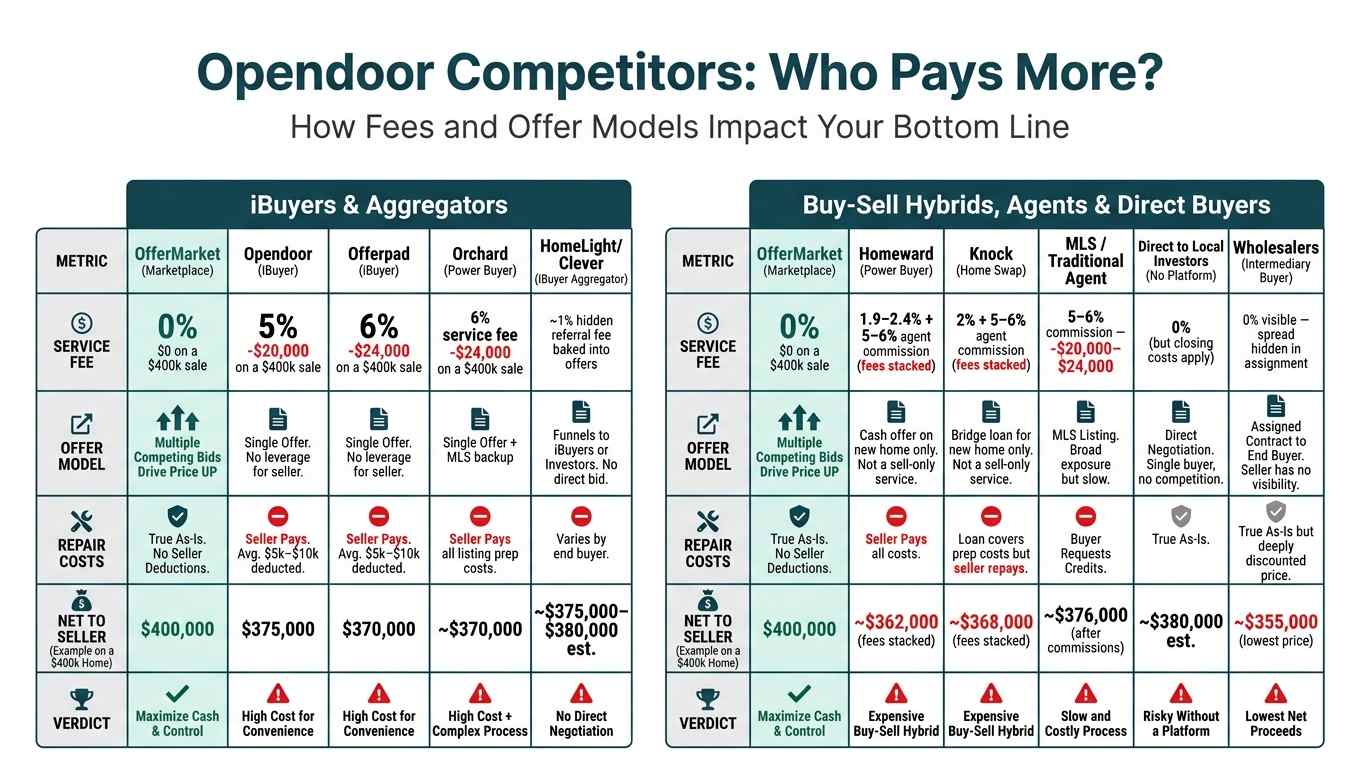
OfferMarket provides this solution. As a free marketplace, OfferMarket connects you with a network of thousands of verified cash buyers who compete for your home. This bidding environment naturally drives up the sale price. With a 0% listing fee, no hidden charges, and a true "as-is" sale where buyers budget for their own renovations, OfferMarket ensures you keep the maximum amount of equity from your sale. Don't settle for a single, lowball offer from a corporation; let the open market determine the true value of your home.
Opendoor Competitors at a Glance: A Side-by-Side Comparison
Choosing the right way to sell your home is the most critical factor in determining your net proceeds. While iBuyers like Opendoor promise speed, their high-fee, single-offer model is fundamentally different from a competitive marketplace. Understanding these differences is key to maximizing your profit. Below is a direct comparison of the top home-selling platforms and methods.
Comparison Table: Opendoor vs. OfferMarket vs. Offerpad vs. Orchard vs. Other Top Alternatives
| Feature | OfferMarket (Marketplace) | Opendoor (iBuyer) | Offerpad (iBuyer) | Orchard (Power Buyer) | HomeLight / Clever (Aggregator) | Homeward (Power Buyer) | Knock (Home Swap) | MLS / Traditional Agent | Direct to Local Investors | Wholesalers (Intermediary) |
|---|---|---|---|---|---|---|---|---|---|---|
| Service Fee | 0% | 5% | 6% | 6% + program fees | ~1% hidden referral fee (baked into offers) | 1.9–2.4% + 5–6% agent commission | 2% + 5–6% agent commission | 5–6% commission | 0% (closing costs apply) | 0% visible (spread hidden in assignment) |
| Repair Policy | True As-Is — no deductions | Seller pays — deducted from offer | Seller pays — deducted from offer | Seller pays — all listing prep costs | Varies by end buyer | Seller pays all costs | Loan covers prep costs — seller repays at close | Negotiable — buyer often requests credits | True As-Is | True As-Is — but price deeply discounted to cover it |
| Offer Model | Multiple competing offers drive price UP | Single offer — no leverage for seller | Single offer — no leverage for seller | Single guaranteed backup offer + MLS listing | Funnels to iBuyers or investors — no direct bid | Cash offer on new home only — not a sell-only service | Bridge loan for new home only — not a sell-only service | Multiple retail offers over time — slow process | Direct negotiation — single buyer, no competition | Assigned contract to end buyer — seller has no visibility |
| House Types | Any condition, any type — optimized for 1–4 unit non-rural residential | Strict criteria — newer homes, good condition, specific zip codes | Strict criteria — newer homes, good condition, specific markets | Must qualify — good condition homes only | Depends on end buyer in their network | Must qualify for their program — buy and sell simultaneously | Must qualify for the loan — buy and sell simultaneously | Any type | Any condition | Any condition — specializes in highly distressed properties |
| Closing Time | 15–45 days | 14–60 days | 10–90 days | Varies — complex multi-step process | Varies — depends on end buyer | Varies — dependent on old home selling | Varies — dependent on old home selling | 30–90+ days | 7–30 days (fast and flexible) | 7–21 days (fast — but contingent on finding end buyer) |
| Availability | Nationwide | ~50 markets | ~25 markets | ~20 markets | Varies by partner network | Limited markets | Limited markets | Nationwide | Varies — depends on local investor activity | Varies — depends on local wholesaler networks |
| Net to Seller (on a $400k home) | $400,000 | ~$375,000 | ~$370,000 | ~$370,000 | ~$375,000–$380,000 est. | ~$362,000 (fees stacked) | ~$368,000 (fees stacked) | ~$376,000 (after commissions) | ~$380,000 est. (but risky without competition) | ~$355,000 (lowest — worst outcome) |
| Best For | Maximizing net cash — any seller, any property | Speed at a high cost | Speed with flexible closing date | Homeowners buying and selling simultaneously | Getting a quick baseline cash offer | Homeowners buying a new home before selling | Homeowners buying a new home before selling | Maximizing gross price (pre-fees) on retail market | Sellers willing to do legwork — no platform safety net | Sellers in extreme distress needing the fastest possible exit |
iBuyer vs. Marketplace: The Fundamental Difference in Net Cash to Seller
The core difference between an iBuyer and a marketplace lies in who holds the power.
iBuyer Model (e.g. Opendoor, Offerpad): The company is the single buyer. They present one take-it-or-leave-it offer. Their goal is to buy your house for the lowest possible price, make minor repairs, and resell it for a profit. They profit from the acquisition margin (buying low) and the high service fees they charge you. You are paying a corporation to buy your house from you.
Marketplace Model (OfferMarket): The platform is a conduit, not the buyer. It connects you to a large pool of competing buyers. This competition forces buyers to submit their highest and best offers to win the deal. The platform's goal is to facilitate a transparent and competitive environment. With OfferMarket, this service is completely free for sellers, ensuring the highest offer goes directly into your pocket. This model puts the seller in control and uses market dynamics to their advantage.
Deep Dive: Top 10 Opendoor Alternatives for Home Sellers
While Opendoor is one of the most recognized names in the iBuying space, numerous competitors offer different models, fee structures, and benefits. Exploring these alternatives is essential for any homeowner who wants to ensure they are not leaving money on the table. Here is a detailed analysis of the top 10 alternatives to selling your house to Opendoor.
1. OfferMarket: The Free Marketplace Model
OfferMarket fundamentally changes the power dynamic of a cash sale. Instead of a single corporation dictating the price, OfferMarket creates a competitive ecosystem where thousands of vetted local and institutional cash buyers bid on your property. This is the only model designed from the ground up to serve the seller's best interest: maximizing the final sale price.
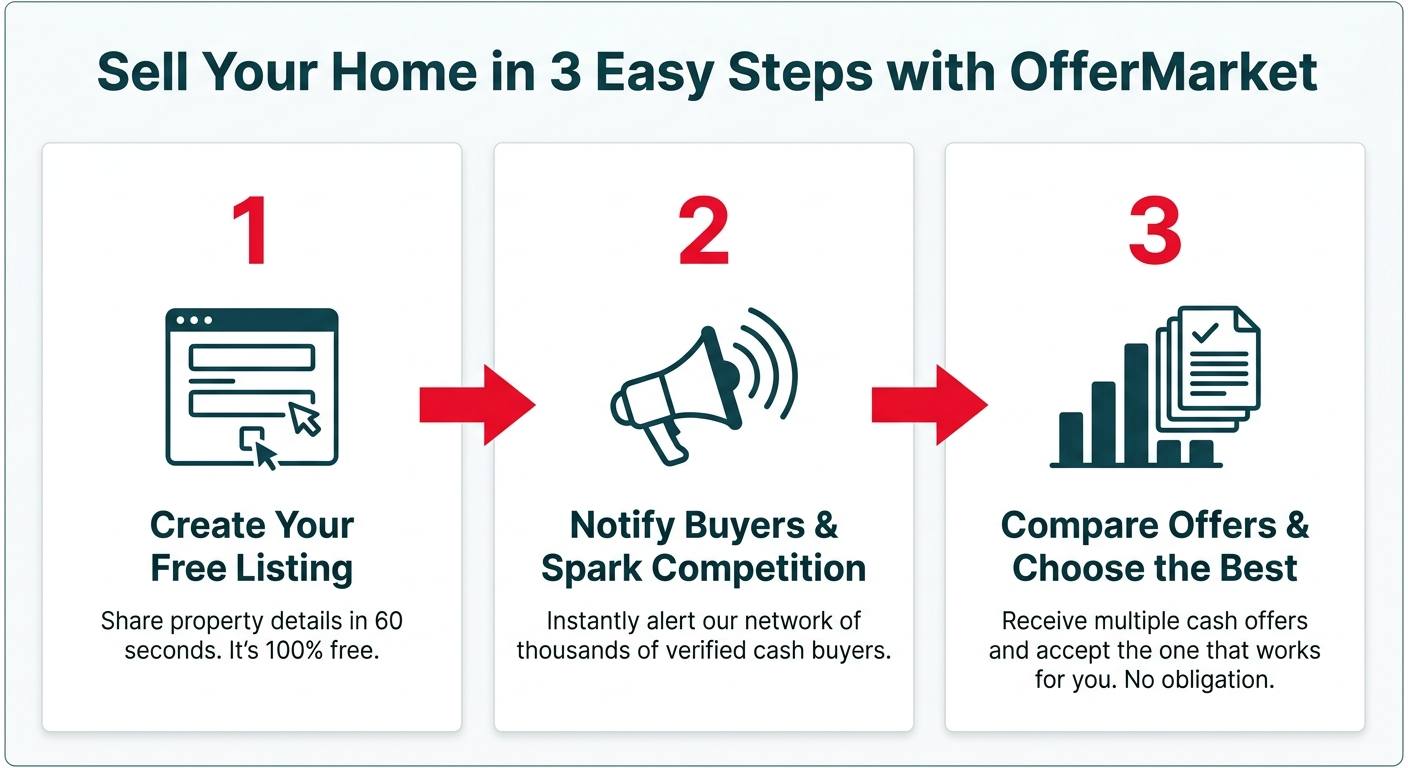
How OfferMarket Marketplace works
You create a free property listing in minutes. You can then use the platform's tools to notify a vast nationwide network of thousands of verified local flippers, institutional cash buyers, and buy-and-hold rental investors.
These buyers review your listing and submit their cash offers directly to you. You can compare all offers side-by-side, communicate with buyers, and choose the one with the best price and terms. There is no obligation to accept any offer.
When multiple investors want your property, they cannot rely on lowballing. To win the deal, they are forced to sharpen their pencils, tighten their own profit margins, and submit their absolute highest and best cash offer. Competition naturally drives your sale price up to its true, maximum as-is market value.
The "Zero Fee" Reality: Keeping Your Hard-Earned Equity
iBuyers market themselves as a hassle-free alternative to traditional real estate agents, yet they still charge you a massive fee just for the privilege of selling your own home to them. An iBuyer’s baseline 5% "service fee" is, frankly, a tax on your convenience. On a $350,000 home, that is $17,500 stripped directly from your net proceeds before you even account for repair deductions.
0% Listing Fees: OfferMarket operates on a radically different financial philosophy. It is completely free to list your property. There are no commissions, no hidden service charges, and no mandatory platform fees deducted from your payout.
How OfferMarket Makes Money: It is natural to ask, "If it is free for the seller, what is the catch?" There isn't one; the transparency lies in the business model. OfferMarket monetizes the buyer side of the transaction. OfferMarket acts as a direct lender, providing specialized hard money and DSCR loans to the investors buying the properties. The platform makes its revenue through loan origination fees and interest paid by the buyers. The highest offer you see on your dashboard is the money that goes toward your bottom line.
Get Your Instant Loan Quote
See rates, terms, and max LTV for your investment property in minutes — no credit check required.
Get Your Quote →Direct Messaging & Offer Transparency
The standard iBuyer process is a notorious "black box." You submit your address, wait for a faceless algorithm to spit out a number, and you are left completely in the dark. You cannot negotiate, you cannot ask questions, and you cannot look the buyer in the eye.
Direct-to-Buyer Messaging: OfferMarket strips away the corporate middleman. Through the platform’s direct messaging system, you communicate directly with the investors submitting offers. Want to know their exact timeline? Ask them. Need a flexible move-out date or a temporary leaseback agreement so you have time to move? Negotiate it directly with the person buying your home.
Offers Directly on the Listing: Every listing you post includes a prominent "Offer" button for buyers. To ensure absolute security and eliminate unqualified "tire-kickers," OfferMarket has automated the verification process using advanced AI. Before an investor can even submit an offer, they must first verify their liquidity.
They do this instantly by uploading their proof of funds documents or by securely linking their account via Plaid for instant verification. Our AI system instantly reviews and approves their financial capability in real time. Once approved, the buyer can submit their cash offer. The OfferMarket team then reviews the complete offer details and immediately relays the verified, actionable offer directly to you, giving you complete peace of mind that every bid you receive is backed by real, verified capital.
- Total Control and Zero Obligation: You are never locked in. If you receive multiple offers and none of them align with your financial goals, you can simply walk away. You have the final say, entirely pressure-free.
The True "As-Is" Sale: Stopping the Repair Fee Double-Dip
The most predatory bait-and-switch in the iBuyer industry is the "repair deduction." A corporation will issue an initially attractive cash offer to get you hooked. Once you sign, they send out an inspector and nickel-and-dime you for "estimated repairs." They deduct these inflated, retail-priced repair costs directly from your final payout.
You are effectively funding the remodel they are going to execute to sell the house for a profit. Even if they offer a "profit share" on the resale, it is usually a smokescreen to distract from the fact that they bought your home well below market value using your own equity to fix it up.
Priced Into the Initial Bid: OfferMarket buyers are professional real estate investors. They factor their specific renovation costs into their competitive bid before they make it.
No Out-of-Pocket Fixes: You will never be asked to fix a leaky roof, replace a water heater, or pay a corporate middleman to do it for you. You take what you want, leave the rest behind, and sell the property in its exact current condition.
Pros and Cons of OfferMarket Marketplace
Pros:
- Maximizes Sale Price: Buyer competition naturally drives the price to its true market value.
- Zero Seller Costs: No fees or commissions means you keep 100% of the sale price.
- Full Seller Control: You review all offers and have the final say. No pressure, no obligation.
- True As-Is Sales: Buyers on the platform are investors who factor renovation costs into their offers. You are not asked to make or pay for any repairs.
- Nationwide Coverage: Unlike iBuyers who are limited to specific metro areas, OfferMarket is available to sellers across the United States.
- Any Property, Any Condition: From pristine turnkey homes to major fixer-uppers and distressed assets, there are buyers on OfferMarket looking for exactly what you have. Our marketplace is optimized specifically for 1–4 unit residential properties in non-rural markets. (Please note: To ensure the highest level of buyer demand and fast closings, we currently do not support listings for rural land or rural properties).
Cons:
- Requires Seller Review: The platform empowers you with multiple offers, which means you need to take the time to compare them (e.g., price, closing date). However, the platform organizes this information to make it simple.
2. Offerpad: The Direct iBuyer Competitor
Offerpad operates on a business model nearly identical to Opendoor's. As a direct iBuyer, they aim to provide a fast, convenient sale by making a single cash offer on your home. They are one of the largest and most well-known Opendoor competitors, often competing for the same properties in the same markets.
How it Works: You submit your property information on their website. If your home meets their strict purchasing criteria (typically newer homes in good condition within specific zip codes), they will conduct an analysis and send you a cash offer within about 24 hours. If you accept, they will perform an in-person inspection and present you with a list of required repairs, the cost of which will be deducted from your offer.
Fees: Offerpad's service fee is typically 6%, which is even higher than Opendoor's standard 5%. On top of this, sellers are responsible for standard closing costs (1-2%) and the cost of all repairs identified during the inspection. These costs can quickly add up to 8-10% of your home's value.
Pros:
- Speed and Certainty: Like Opendoor, they provide a quick, guaranteed offer, removing the uncertainty of a traditional sale.
- Flexible Closing: Sellers can often choose their closing date, ranging from as little as 10 days to as long as 90 days.
- Free Local Move: Offerpad often includes a free local moving service, which can be a convenient perk.
Cons:
- High Service Fees: At 6%, their fee is one of the highest in the iBuyer industry.
- Below-Market Offers: Their business model requires them to buy low. The initial offer is almost always less than what you could get on the open market.
- Expensive Repair Deductions: The post-inspection repair list can be extensive and non-negotiable, significantly lowering your final net proceeds.
- Limited Availability: Offerpad operates in fewer than 30 markets nationwide, so they are not an option for most sellers.
3. Orchard: The "Buy Before You Sell" Innovator
Orchard is not a direct iBuyer in the same vein as Opendoor. Instead, they are a "Power Buyer" that has carved out a niche by solving a common homeowner problem: how to buy a new home before you've sold your old one. Their "Move First" program is their flagship service.
How it Works: The process is more complex than a simple cash sale. First, Orchard qualifies you for their program and gives you an "Orchard Equity Advance," allowing you to make a strong, non-contingent offer on a new home. Once you move into your new house, Orchard's team will handle cleaning, listing, and showing your old home on the MLS. You receive a guaranteed backup cash offer from Orchard in case the home doesn't sell on the market after a certain period.
Fees: Orchard charges a 6% service fee, identical to a traditional real estate agent's commission. This is on top of any closing costs, listing preparation costs (like painting and staging), and potential carrying costs for your old home. While they front the money, you ultimately pay for everything.
Pros:
- Solves the Timing Dilemma: Eliminates the stress of having to sell your home before you can buy another.
- Stronger Buying Position: Making a non-contingent offer with their cash can make you a more attractive buyer in a competitive market.
- Potential for Market Upside: Since your home is listed on the MLS, there is a chance it could sell for more than Orchard's guaranteed offer.
Cons:
- Very High Costs: The 6% fee plus all the associated costs of a traditional sale make this one of the most expensive options.
- Complex and Lengthy Process: The "Move First" program involves multiple steps, contracts, and potential financing components.
- Niche Audience: This service is only for people who are both selling and buying a home in one of the limited markets Orchard serves. It is not an option for sellers simply looking for a cash exit.
4. HomeLight Simple Sale / Clever Offers: The iBuyer Aggregator
HomeLight and Clever are primarily real estate agent matching services that have expanded to include cash offer platforms, often called "iBuyer aggregators." Instead of buying your home themselves, they act as a middleman, connecting you to their network of cash buyers.
How it Works: You submit your property information through a single form on their website. They then blast this information to various cash buyers in their network, which may include iBuyers like Opendoor and Offerpad, as well as smaller local investors. They collect any resulting offers and present them to you.
Fees: These platforms typically don't charge a direct fee to the seller. Instead, they make money through referral fees paid by the agent or cash buyer who ultimately closes the deal. While this seems "free," this referral fee (often 1% or more) is baked into the buyer's calculations, meaning the final offer you receive is lower than it would be if you connected with the buyer directly.
Pros:
- Convenience of a Single Submission: You can access multiple potential cash offers by filling out just one form.
- Comparison Point: It can be a quick way to get a baseline understanding of what cash buyers might be willing to pay.
Cons:
- Middleman Costs: The referral fee model reduces the final offer price for the seller. You are not getting a direct offer.
- Lack of Transparency: It's often unclear who the end-buyer is or what their specific criteria are. The quality and reliability of offers can vary dramatically.
- No Control or Negotiation: You are dealing with the aggregator, not the end-buyer, which limits your ability to communicate and negotiate terms directly. They are incentivized to close a deal quickly, not necessarily get you the highest price.
5. Homeward: Another "Buy With Cash" Service
Similar to Orchard, Homeward is a Power Buyer focused on the "buy before you sell" market. Their primary service helps you make an all-cash offer on your next home, giving you a competitive edge, and then assists with selling your existing home.
How it Works: Homeward approves you for a specific amount, allowing you to make a cash offer on a new home. Once your offer is accepted, you rent the new home from Homeward until your old one sells. After your old home closes, you buy the new home back from Homeward using the proceeds and traditional financing.
Fees: Homeward charges a convenience fee that is typically 1.9% to 2.4% of the new home's purchase price. This is in addition to the standard 5-6% real estate agent commission you'll pay to sell your old home, plus all other closing costs.
Pros:
- Win Bidding Wars: An all-cash offer is significantly more attractive to sellers and can help you win in a multiple-offer situation.
- Removes Home Sale Contingency: You can shop for a new home with confidence, knowing your purchase doesn't depend on your old home selling first.
Cons:
Only for Concurrent Transactions: This service is not for homeowners who are just looking to sell. You must be buying another home in one of their service areas.
Expensive Layer of Fees: The 1.9-2.4% fee is stacked on top of all the traditional costs of selling, making it a very costly convenience.
Requires Using Their Affiliates: To get the best rate, you may be required to use their mortgage and title services, limiting your ability to shop around.
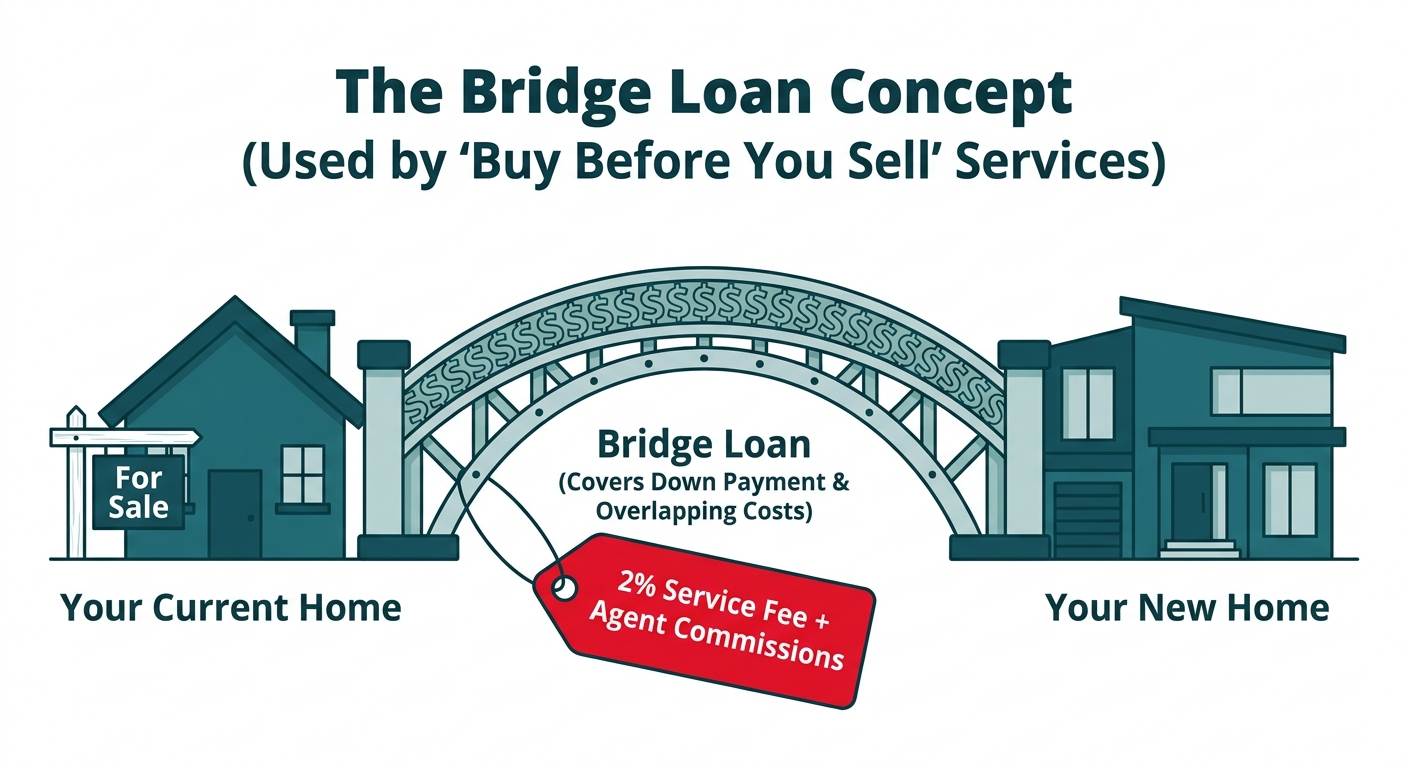
6. Knock: The Home Swap Model
Knock is another major player in the "buy before you sell" space, offering a program they call the "Home Swap." Their model is built around providing a unique type of bridge loan that helps homeowners finance the purchase of a new home before their old one is sold.
How it Works: Knock qualifies you for the Home Swap and provides a bridge loan that covers the down payment on your new home, mortgage payments on your old home, and up to $25,000 for home prep and repairs to get your old house ready for listing. You move into your new home, and they manage the listing and sale of your old one with a traditional agent. Once it sells, you use the proceeds to pay back the loan.
Fees: Knock charges a 2% service fee, which is in addition to the standard 5-6% real estate commission you'll pay to the agent selling your home. You are also responsible for the costs of any home prep and repairs, though they are covered upfront by the loan.
Pros:
- Financial Bridge: Provides the necessary funds to secure a new home without having to sell the old one first.
- Covers Overlapping Costs: The loan can cover the mortgage on the old house for up to six months, reducing the financial burden of owning two homes.
Cons:
- It's a Loan Product: At its core, the Home Swap is a loan with associated fees and interest.
- High Total Cost: When you combine their 2% fee with a 6% agent commission, you could be paying up to 8% of your home's value in fees alone.
- Limited to Qualified Buyers: You must be able to qualify for the loan and be buying and selling in one of their specific markets.
7. Selling on the MLS: The Traditional Agent Route
The most traditional alternative to selling to Opendoor is listing your home on the Multiple Listing Service (MLS) with a licensed real estate agent. This method exposes your property to the largest possible pool of retail buyers and has historically been the path to achieving the highest gross sale price.
How it Works: You hire a real estate agent who will help you price your home, list it on the MLS, market it, coordinate showings and open houses, and negotiate offers on your behalf. The process is managed by the agent from start to finish.
Fees: The standard fee is a 5-6% commission on the final sale price, which is typically split between your agent and the buyer's agent. Sellers are also responsible for their portion of closing costs (1-2%) and are often expected to pay for or provide credits for repairs requested by the buyer after an inspection.
Pros:
Highest Potential Sale Price: Broad exposure on the open market to retail buyers (who pay with a mortgage and plan to live in the home) generally results in the highest top-line price.
- Professional Guidance: A good agent provides expert advice on pricing, marketing, and negotiation.
Cons:
- Slowest Process: The traditional route is by far the slowest, often taking 60-90 days or more from listing to closing.
- Inconvenient and Uncertain: The process requires keeping your home show-ready, dealing with open houses, and facing the uncertainty of offers falling through due to financing or inspection issues.
- High Commission Fees: The 5-6% commission is a significant expense that dramatically reduces your net proceeds. On a $400,000 sale, this amounts to $20,000-$24,000.
- Repair Concessions: Buyers will almost always request repairs or credits after an inspection, adding another layer of cost and negotiation.
- Vulnerability to Manipulation: The MLS system, despite its broad reach, does not protect sellers from predatory tactics by licensed agents and wholesalers who pose as legitimate buyers. The following real-world example illustrates exactly how this plays out.
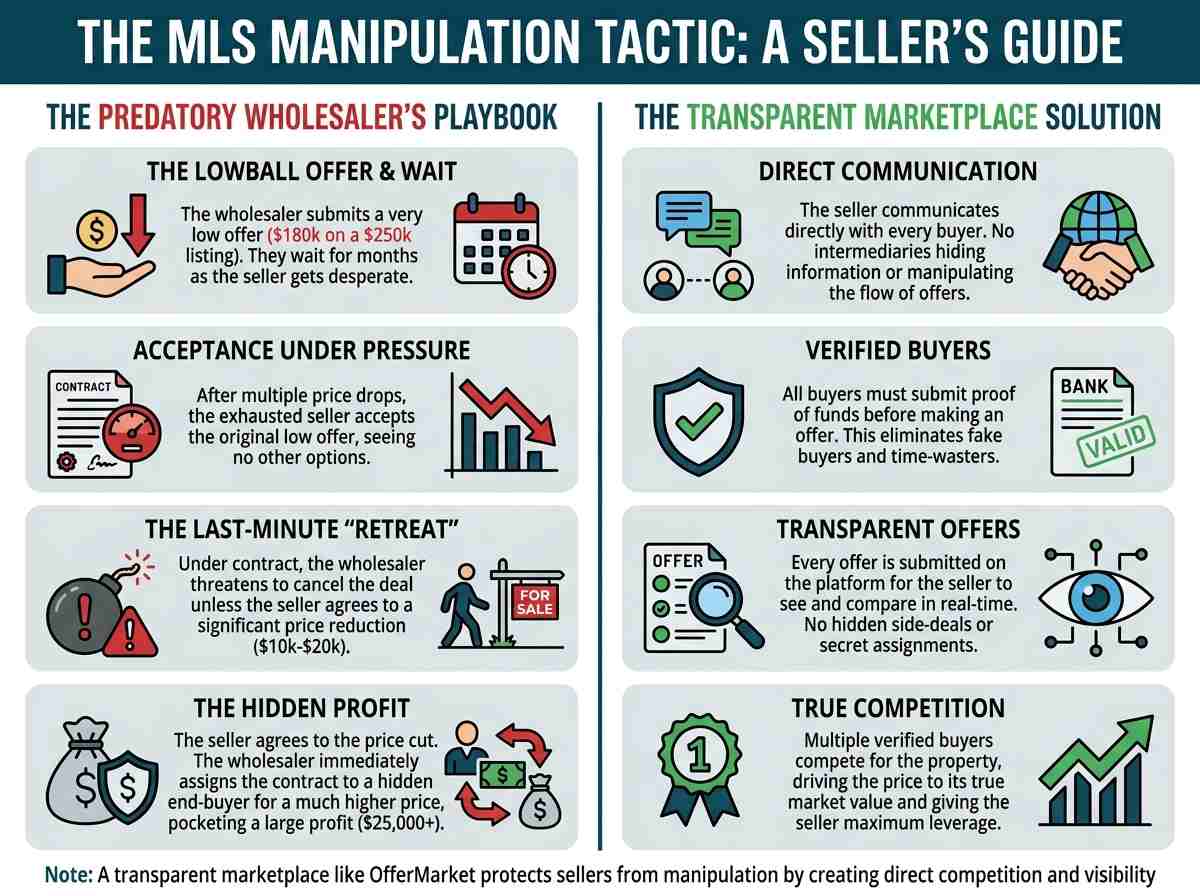
A Real Example: How a Licensed Agent Exploited the MLS to Profit $25,000 at a Seller's Expense
This scenario, which went viral in the real estate investing community, demonstrates a tactic known as "retreating" and it happens far more often than most homeowners realize.
A homeowner listed a fixer-upper on the MLS for $250,000. The property had an estimated after-repair value (ARV) of $320,000 and needed roughly $75,000 in work. A licensed real estate agent submitted an offer of $180,000 with a 3% commission, stating that their company was the buyer. What the seller didn't know was that this agent was actually a wholesaler. Their plan was to assign the contract to an end buyer at $190,000 pocketing $10,000 without ever owning the property.
The listing agent rejected the $180,000 offer as too low. But the wholesaler didn't walk away they waited. Over the next two months, as the property sat on the MLS without a buyer, the listing price dropped from $250,000 to $225,000, and then to $210,000. With each price reduction, the seller grew more desperate and more psychologically invested in just getting the property sold. When the price hit $210,000, the original $180,000 offer was finally accepted.
But the manipulation was only getting started.
While the deal was under contract at $180,000 — and the wholesaler already had their end buyer lined up at $190,000 — the wholesaler called the seller's agent and dropped a bomb: their buyer needed a $20,000 price reduction to move forward, or they would walk away from the deal entirely. To sweeten the pressure, the wholesaler offered to wire the earnest money immediately and waive the remaining due diligence, framing the reduced price as the only way to avoid starting over from scratch.
The seller, now months deep into a stressful process with no other offers in sight, agreed to cut $10,000, bringing the final sale price down to $170,000.
The result: the wholesaler was under contract at $170,000 and sold to their end buyer at $190,000. A $25,000 profit — extracted through a calculated strategy of patience, psychological pressure, and last-minute threats to walk away.
Why the MLS Didn't Protect This Seller
The MLS put the property in front of buyers, but it did nothing to prevent a licensed agent from operating as a predatory wholesaler within the system. The seller had no visibility into the wholesaler's end buyer, no way to know their $180,000 offer was going to be immediately flipped for $190,000, and no leverage once they were months deep with no competing offers.
This is the uncomfortable reality of the traditional agent route: the system works well when honest professionals are involved, but it offers little protection when they aren't. The seller trusted the process, trusted their agent, and still lost roughly $80,000 compared to the property's original $250,000 listing price — with $25,000 of that going directly into the pocket of someone who manipulated the transaction from the start.
On a platform like OfferMarket, this scenario cannot play out the same way. Sellers communicate directly with every buyer on the listing. Every offer is submitted transparently through the platform. Buyers verify their proof of funds before they can engage. And because multiple verified investors see and compete for the same property, a single predatory buyer cannot isolate the seller and control the negotiation. The marketplace creates the competition and transparency that the MLS, on its own, does not guarantee.
8. Direct to Local Investors: Finding Cash Buyers Yourself
For sellers willing to put in some legwork, cutting out all middlemen and selling directly to a local real estate investor can be a viable option. These are the "We Buy Houses" individuals or small companies you often see on local signs or online ads.
How it Works: This method requires you to actively source and vet potential buyers. You might do this by searching online for local home-buying companies, attending real estate investment meetings, or using your personal network. You would then negotiate directly with these investors to reach a sale agreement.
Fees: There are typically no fees or commissions involved, as you are selling directly to the principal buyer. You would still be responsible for your portion of the closing costs.
Pros:
- Save on Commissions: The primary benefit is avoiding the 5-6% agent commission.
- True As-Is Sale: Experienced investors buy properties in any condition and are not deterred by major repair needs.
- Fast and Flexible: Local investors can often close very quickly and on your timeline.
Cons:
- Difficult to Create Competition: It is extremely challenging for an individual seller to find multiple, reliable investors and get them to bid against each other. Without competition, you are likely to receive a lowball offer.
- Risk of Predatory Buyers: The "We Buy Houses" space has its share of inexperienced or unethical operators. It can be difficult to vet buyers and protect yourself from scams or unfavorable contract terms.
- Significant Effort Required: You are responsible for all marketing, negotiation, and due diligence, which can be a full-time job. OfferMarket's marketplace solves this by bringing a pre-vetted network of these buyers to you in a competitive environment.
9. Wholesalers: The Intermediary Buyer
Selling to a wholesaler is another common path in the off-market real estate world. A wholesaler's role is not to buy and hold your property, but to act as an intermediary who finds a deal and then passes it on to another investor for a profit.
How it Works: A wholesaler will get your property "under contract" at an agreed-upon price. However, they have no intention of closing on it themselves. The contract will include a clause that allows them to "assign" it to another buyer. They then market your property to their network of cash buyers at a higher price. The difference between your contract price and the price the end-buyer pays is the wholesaler's profit, known as the "assignment fee."
Fees: There are no direct fees paid by the seller. The wholesaler's profit is the spread they create. For example, they might put your house under contract for $250,000 and assign that contract to another investor for $265,000, making a $15,000 profit.
Pros:
- Fast Cash Sale: Wholesalers work with cash buyers and can facilitate a very quick closing.
- Option for Highly Distressed Properties: They specialize in properties that might be too run-down for even iBuyers or the MLS.
Cons:
- Lowest Sale Price: This method almost always results in the lowest net proceeds for the seller. Because two parties (the wholesaler and the end-investor) both need to profit from the transaction, your initial contract price has to be extremely low.
- Lack of Certainty: If the wholesaler cannot find an end-buyer, the deal can fall through at the last minute, leaving you back at square one.
- Lack of Transparency: You often don't know who the final buyer is or how much profit the wholesaler is making on your home.
The True Cost of Selling to Opendoor: Convenience at a Price
Opendoor's marketing is brilliant. They sell simplicity, speed, and certainty. What they don't advertise as loudly is the significant price you pay for that convenience. To understand why marketplace alternatives are superior, you must deconstruct the Opendoor offer and see how fees and deductions erode your home's equity.
Deconstructing the Opendoor Offer: What 92-93% of Resale Value Really Means
Opendoor often claims their offers are competitive and represent a high percentage of a home's future resale value. However, their internal calculations are based on what they believe they can sell the home for after making repairs. This "After Repair Value" (ARV) is a forward-looking estimate. Your offer is then calculated by subtracting their profit margin, holding costs, selling costs, service fee, and repair costs from that ARV. The initial offer you receive is already significantly below what a retail buyer on the open market would pay.
The 5% Service Fee: Paying a Corporation to Buy Your House
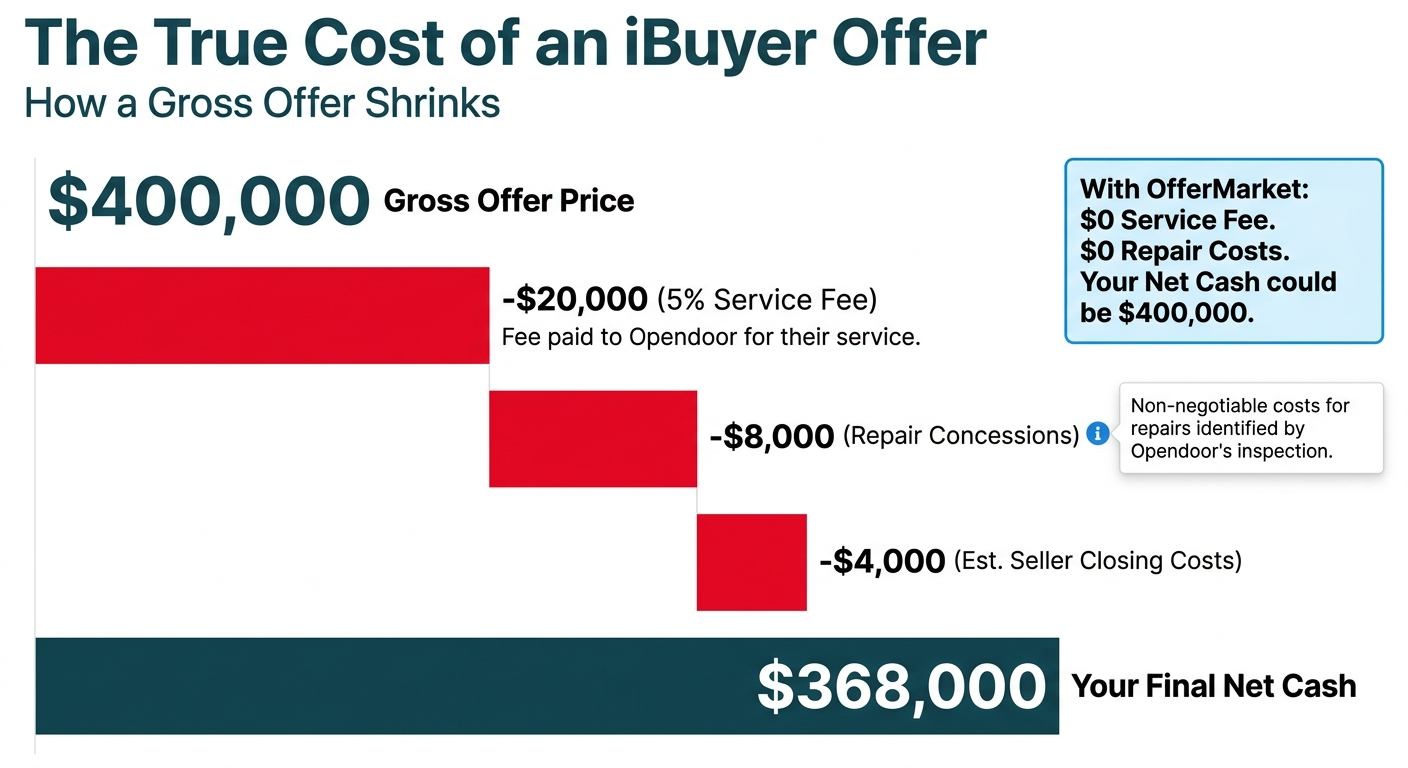
The most significant and unavoidable cost is the service fee, currently advertised at 5%. On a $400,000 home, this is an immediate $20,000 reduction in your proceeds. It's crucial to frame this correctly: you are paying a multi-billion dollar corporation $20,000 for the "privilege" of them buying your house at a discount. This fee is pure profit for Opendoor and provides no direct value to you beyond the transaction itself.
Forced Repair Deductions: Non-Negotiable Costs That Erode Your Equity
After you accept the initial offer, Opendoor conducts a detailed home assessment. They will then provide you with a list of "required" repairs and the exact cost they will deduct from your proceeds to perform them. These costs are non-negotiable. Sellers frequently report that these repair estimates are inflated and cover cosmetic issues that a typical buyer might overlook. This can easily amount to another $5,000 - $15,000 or more, further reducing your final payout.
Stacking the Costs: Calculating Your True Net Proceeds vs. Market Value
Let's use a realistic example:
- Home's True Market Value: $410,000
- Opendoor's Initial Offer: $400,000
- Less 5% Service Fee: -$20,000
- Less Repair Deductions: -$8,000 (a conservative estimate)
- Less Seller Closing Costs (~1%): -$4,000
- Your Final Net Proceeds with Opendoor: $368,000
In this common scenario, you've walked away with over $40,000 less than your home's actual market value. The convenience cost you nearly 10% of your home's worth.
OfferMarket The Superior Choice
After analyzing all the alternatives, it becomes clear that the OfferMarket marketplace model is the superior choice for the vast majority of sellers. It synthesizes the best elements of all other options while eliminating their primary drawbacks.
Combines Speed and Competition: OfferMarket delivers the speed and convenience of a cash sale, similar to an iBuyer, but replaces the single, lowball offer with a competitive bidding environment that drives the price up, similar to the MLS.
Eliminates Fees and Commissions: It provides the cost savings of a For-Sale-By-Owner (FSBO) or direct-to-investor transaction (0% seller fees) without the risk, effort, and lack of competition.
Provides Safe Access to Vetted Buyers: It solves the main problem of finding investors yourself by giving you direct access to a nationwide, pre-vetted network of professional buyers, including local investors and institutional cash buyers.
OfferMarket is the only platform that aligns its success entirely with the seller's success. By fostering a transparent, competitive, and free marketplace, it ensures that you, the homeowner, retain control and walk away with the most money possible.
The OfferMarket Solution: Putting Sellers in Control
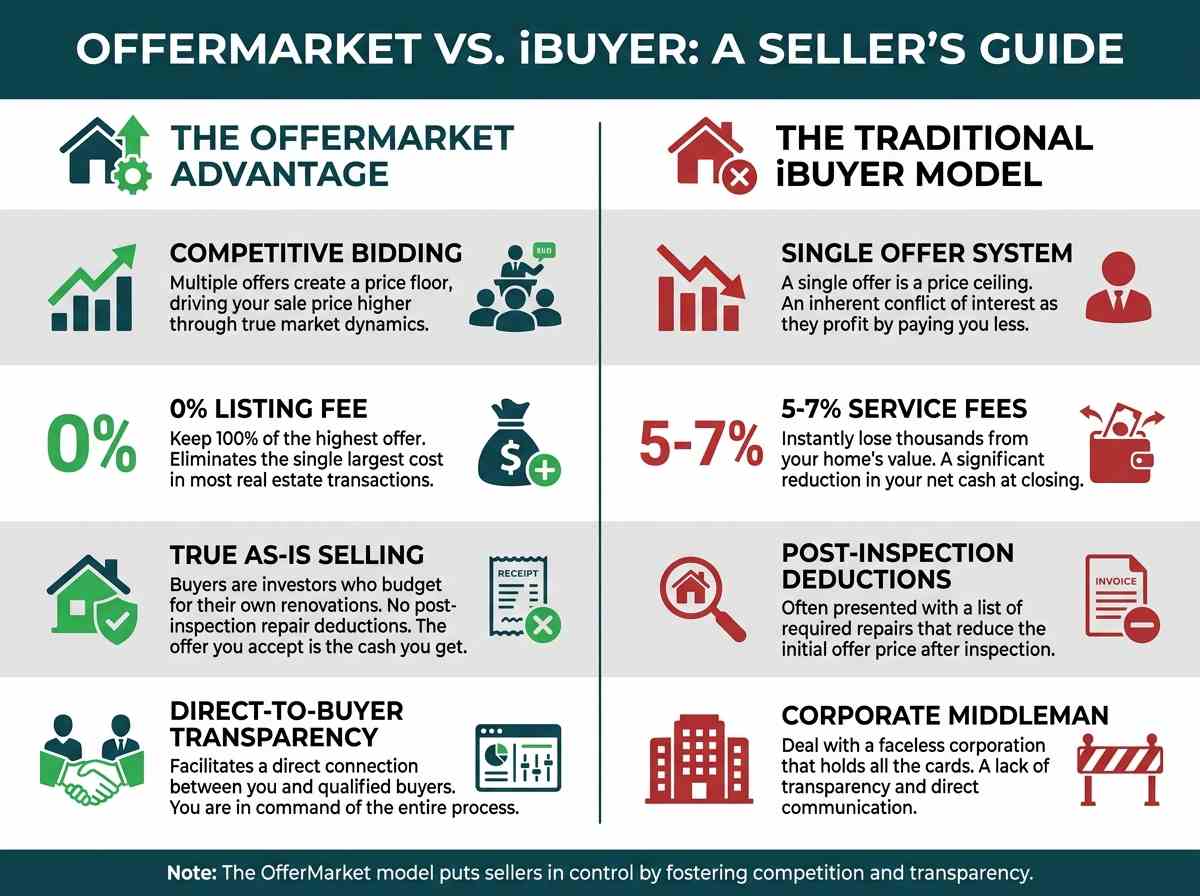
The fundamental flaw in the iBuyer model is the inherent conflict of interest. Opendoor profits by paying you less. The OfferMarket model resolves this by creating an environment where buyers must compete, which forces them to pay you more.
Multiple Buyers, Not One: How competition drives your price up
A single offer is a price ceiling. It's the most that one entity is willing to pay. Multiple offers create a price floor. When qualified buyers know they are competing, they are forced to put their best foot forward. The initial offer one buyer makes is often just a starting point. A bidding war, even a small one, can add thousands or tens of thousands of dollars to your final sale price. This is the power of true market dynamics, and it works entirely in the seller's favor.
0% Listing Fee vs. 5-7% iBuyer Fees: The immediate impact on your net cash
The math is simple and undeniable. A 0% listing fee means you keep 100% of the highest offer. A 5% fee means you instantly lose $5,000 for every $100,000 of your home's value. This is the single largest cost in most real estate transactions, and OfferMarket eliminates it for sellers entirely.
True As-Is Selling: Buyers budget for their own renovations
On the OfferMarket platform, the buyers are real estate investors. Their business model is to buy, renovate, and then sell or rent the property. They are experts at assessing a property's condition and budgeting for repairs. This means they factor renovation costs into their offer price. You are never presented with a list of repair deductions after the fact. The offer you accept is the cash you get. This eliminates the second major way iBuyers reduce your net proceeds.
Direct-to-Buyer Transparency: No corporate middleman
OfferMarket facilitates a direct connection between you and the potential buyers. You can see who is making the offers and can communicate with them directly if needed. This transparency builds trust and removes the feeling of dealing with a faceless corporation that holds all the cards. You are in command of the entire process.
How to Get the Highest Offer on OfferMarket in 4 Steps
Getting started on OfferMarket is free, fast, and designed to put you in control. You can see what the market is willing to pay for your home with no obligation.
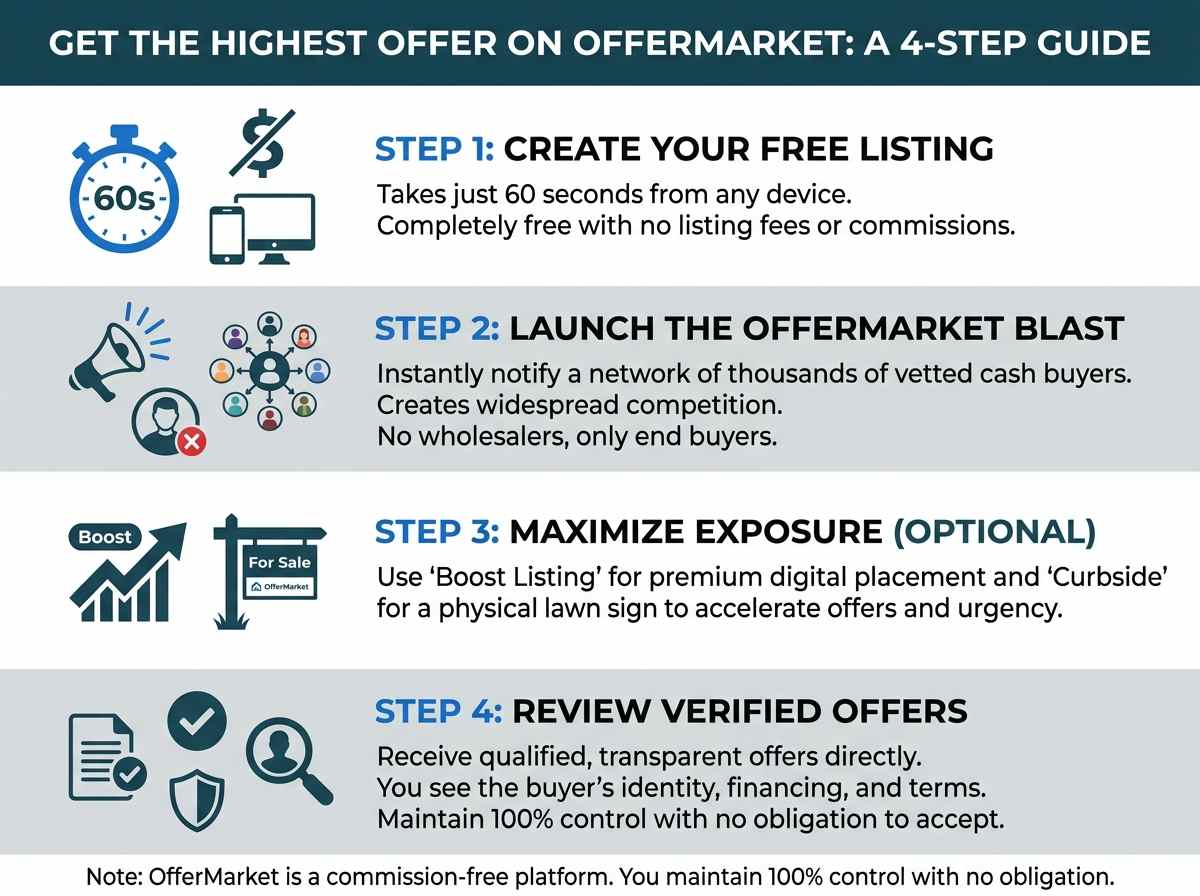
Step 1: Create Your Free Listing in 60 Seconds
Click "Sell" and enter basic information about your property — address, property type, reason for sale, about yourself and your asking price. You can add photos and a description to attract more buyer attention afterwards. The entire process takes about a minute and can be done from your phone or computer. There is no listing fee — ever. OfferMarket is a commission-free platform that makes money through its lending.
Step 2: Use the "OfferMarket Blast" Button to Notify a Network of Vetted Cash Buyers
Once your listing is live, the OfferMarket Blast feature instantly sends your deal to thousands of verified end buyers in your market whose deal flow criteria match your property's location. This is how you create immediate, widespread competition for your property — the kind of competition that does not exist when selling to a single iBuyer like Opendoor. One important distinction: wholesalers are not allowed to submit offers on OfferMarket. Every offer you receive comes from an actual end buyer, not a middleman looking to flip your contract for a hidden assignment fee.
Step 3: Boost and Curbside — Optional Tools to Maximize Exposure
For sellers who want to push their results even further, OfferMarket offers two optional, low-cost tools. Boost Listing gives your listing premium placement on the marketplace, putting it in front of more investor-buyers and driving higher engagement. Curbside puts a physical OfferMarket lawn sign at your property, generating local buyer interest and signaling to the market that your property is available — creating additional urgency and visibility beyond the digital marketplace. Both are entirely optional. Your listing works without them, but they can accelerate how quickly offers come in.
Step 4: Review Offers — You Maintain 100% Control
As buyers submit offers on your listing, OfferMarket's Trust and Safety team reviews each one and relays only qualified, verified offers directly to you via email and text message. You don't have to sort through lowball bids or unverified buyers — that filtering is done for you.
Every qualified offer arrives with full transparency. Here's exactly what you see for each one:
- Offer price and proposed closing date
- Offer expiration date so you know your timeline to respond
- Financing type and whether the buyer's proof of funds has been verified
- Who is paying closing costs (buyer-paid, seller-paid, or split)
- Any contingencies the buyer is requesting (such as inspection)
- The buyer's full identity — their name, company/entity, email, phone number, buyer type (fix and flip investor, rental investor, etc.), and their stated purpose for the property
There are no anonymous offers, no hidden assignment fees, and no middlemen. You see exactly who wants to buy your property, how they plan to use it, and whether they can actually close. You can message any buyer directly on the listing to ask questions, negotiate terms, or request additional information. You decide which offer to accept, when to close, and on what terms. If none of the offers meet your expectations, you simply walk away — you've paid nothing and you're under no obligation.
Final Verdict: Stop Paying a Corporation To Buy Your House
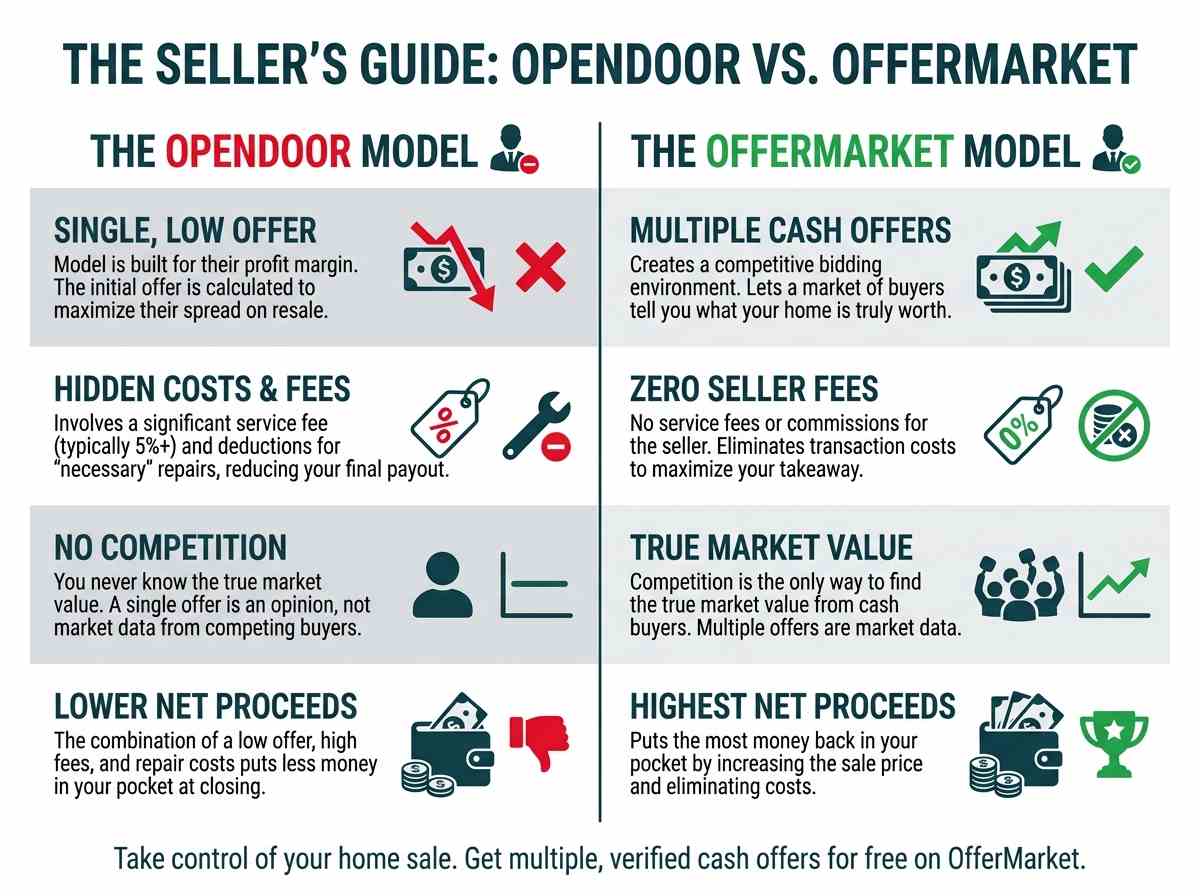
The choice between Opendoor and its competitors comes down to a simple question: Do you want to pay a premium for one company's single, discounted offer, or do you want to let a competitive market of buyers tell you what your home is truly worth for free?
Opendoor's model is built for their profit margin, not your net proceeds. Their entire process, from the initial offer calculation to the service fee and repair deductions, is designed to maximize the spread they can achieve when they resell your home.
The marketplace model is the only way to find the true market value from cash buyers. Without competition, you will never know if you got the best possible price. A single offer is an opinion; multiple offers are market data.
Competition, transparency, and zero seller fees are the keys to maximizing your sale. A successful home sale is one that puts the most money in your pocket at closing. This is only achieved by reducing transaction costs and increasing the sale price.
OfferMarket delivers on all three, putting the most money back in your pocket. By eliminating fees for sellers and creating a competitive bidding environment, OfferMarket has created the most seller-friendly platform on the market today.
Take Control of Your Home Sale Now
The market is waiting. Don't let the allure of convenience from a company like Opendoor or Offerpad cost you tens of thousands of dollars of your hard-earned equity. Don't settle for a single, lowball offer from a corporation whose interests are directly opposed to yours. Empower yourself with real options and let the market work for you.
Take one minute to create your free property listing on OfferMarket. Receive multiple, verified cash offers and see what your home is actually worth in a competitive environment. There is no cost and no obligation.
Click here to list your property for free and get cash offers today.
List Your Property Instantly
Reach qualified investors and sell your property faster with OfferMarket.
List Now →

OfferMarket Loans
Check your rate
60 seconds · no credit pull