Landlord Insurance In Cincinnati Oh
Last updated: July 16, 2026
Add us on GoogleFor Cincinnati real estate investors, the most common and comprehensive type of landlord insurance is the "Dwelling Property 3 (DP-3)" policy. This policy is considered the industry standard for rental properties because it provides "open peril" coverage for the structure itself. This means the building is covered against all forms of damage except for those specifically listed as exclusions in the policy, such as floods, earthquakes, or neglect.
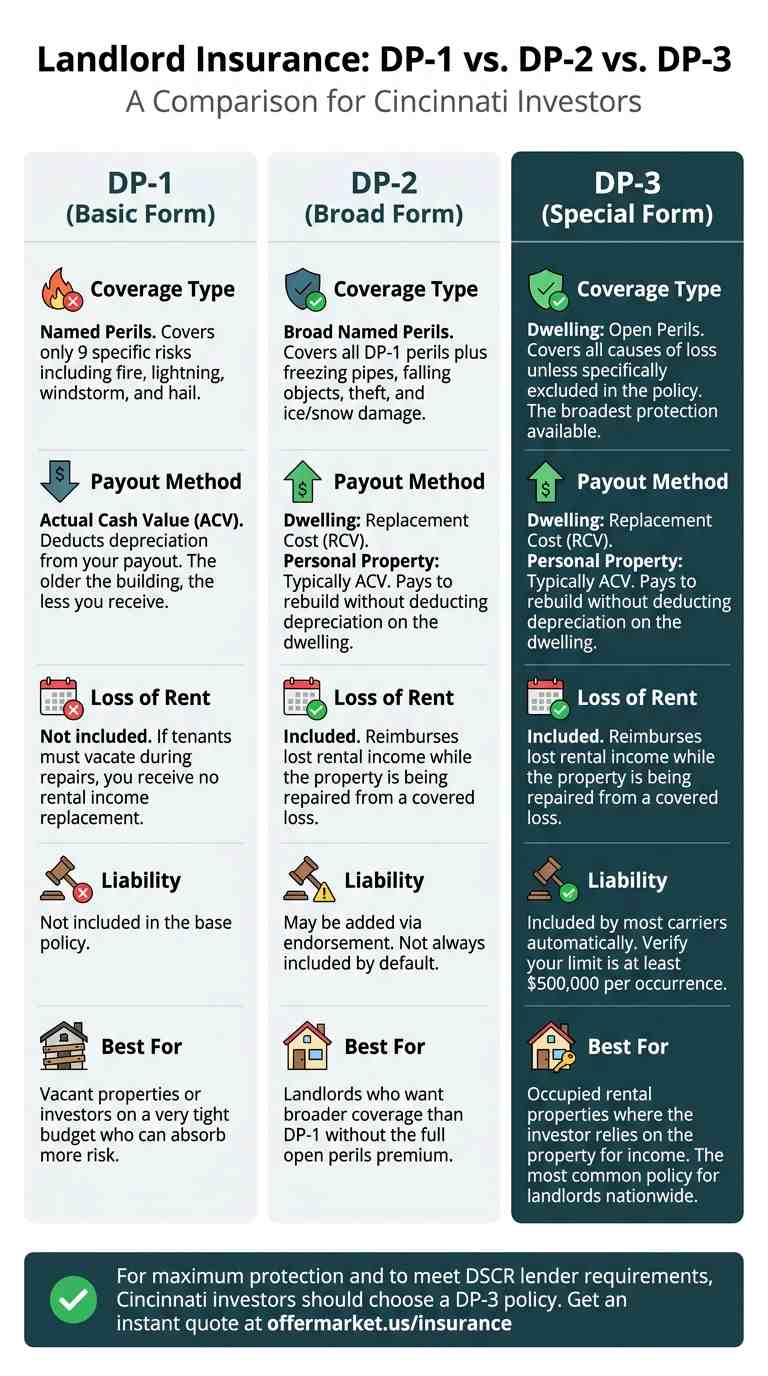
Understanding Landlord Insurance DP-3 Policies for Cincinnati Rentals
A DP-3 policy is significantly different from a homeowners policy. A standard "HO-3 (Homeowners) policy" is designed for owner-occupied properties and includes coverage for personal belongings, which a landlord doesn't need for their tenant's possessions. More importantly, it excludes business activities and renting out a property is a business. A DP-3 policy, on the other hand, is tailored for non-owner-occupied rentals, including crucial coverages like landlord liability and loss of rental income.
It's also a major step up from the more basic "DP-1 (Dwelling Property 1)" policy. A DP-1 is a "named peril" policy, meaning it only covers losses from a specific list of perils, like fire and lightning. It typically pays out claims on an "Actual Cash Value (ACV)" basis, which accounts for depreciation, leaving you with a smaller payout than you'd need to fully rebuild.
The DP-3 policy covers the dwelling on a "Replacement Cost Value (RCV)" basis, providing the funds to rebuild the property to its former state without deducting for depreciation. This is a critical distinction and the primary reason why DSCR lenders and traditional mortgagees almost universally require investors to secure a DP-3 policy to protect their collateral.
Average Cost of Landlord Insurance in Cincinnati for 2026
The average cost of landlord insurance in Ohio typically ranges from $1,205 to $2,046 annually for a standard rental property. As a general rule, landlords can expect their policy to cost about 15-25% more than an equivalent homeowners insurance policy. This price difference is due to the increased risks associated with rental properties, such as a higher likelihood of liability claims and less direct oversight of the property's day-to-day condition.
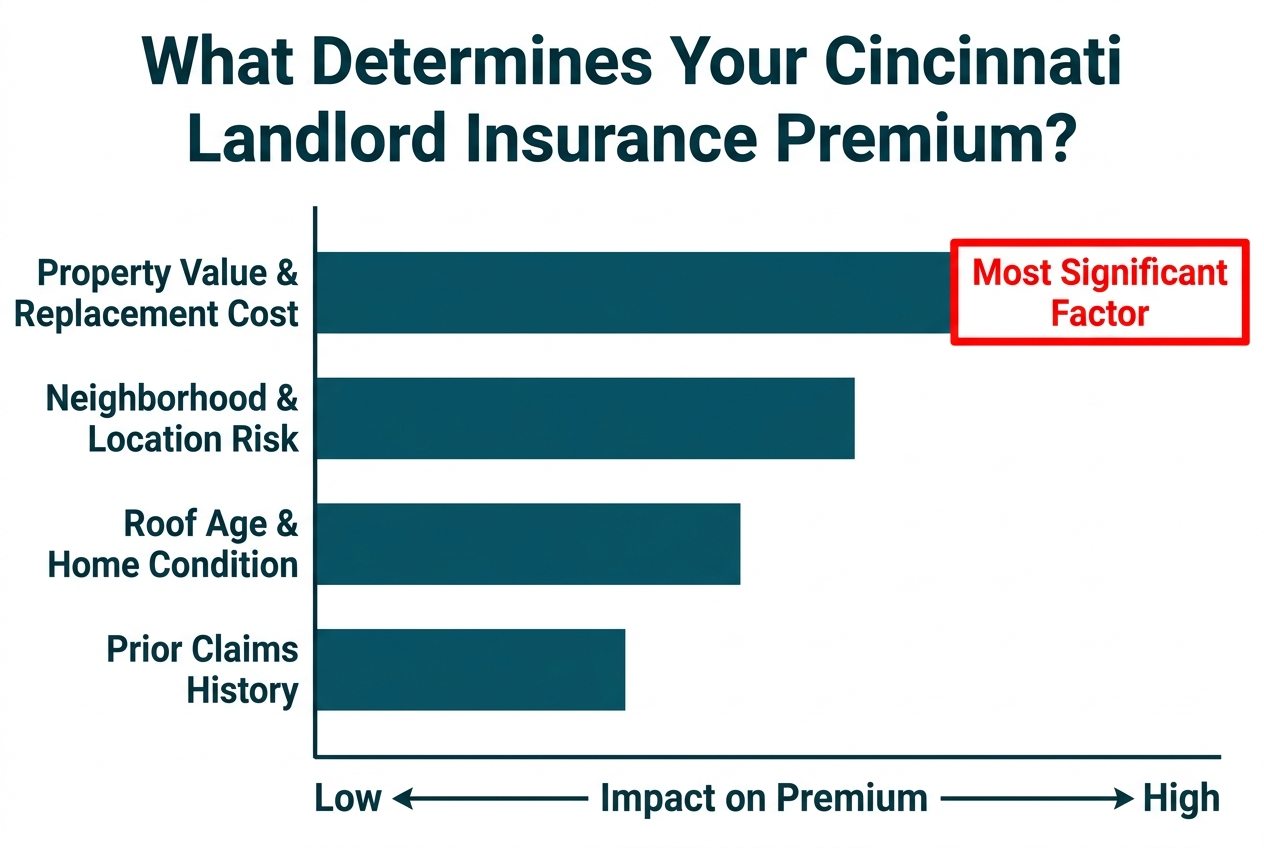
Several key factors directly influence where your Cincinnati property will fall within this range:
Property Value & Replacement Cost: The higher the cost to rebuild your property, the higher the premium. This is the most significant factor.
Location & Neighborhood: Insurance carriers use location-specific data to assess risk. A property in a neighborhood with a higher crime rate, like parts of Price Hill, may have a higher premium than one in a lower-risk area like Hyde Park. Proximity to fire hydrants and fire stations also plays a role.
Age and Condition of the Property: Older homes, especially those with original wiring or plumbing, pose a higher risk. The age and condition of the roof are particularly scrutinized; a roof over 15 years old can significantly increase your premium or even limit your coverage options.
Claims History: If you or the property itself has a history of recent claims (especially water or liability claims), carriers will view it as higher risk and charge a higher premium.
What Cincinnati Landlord Insurance Actually Covers
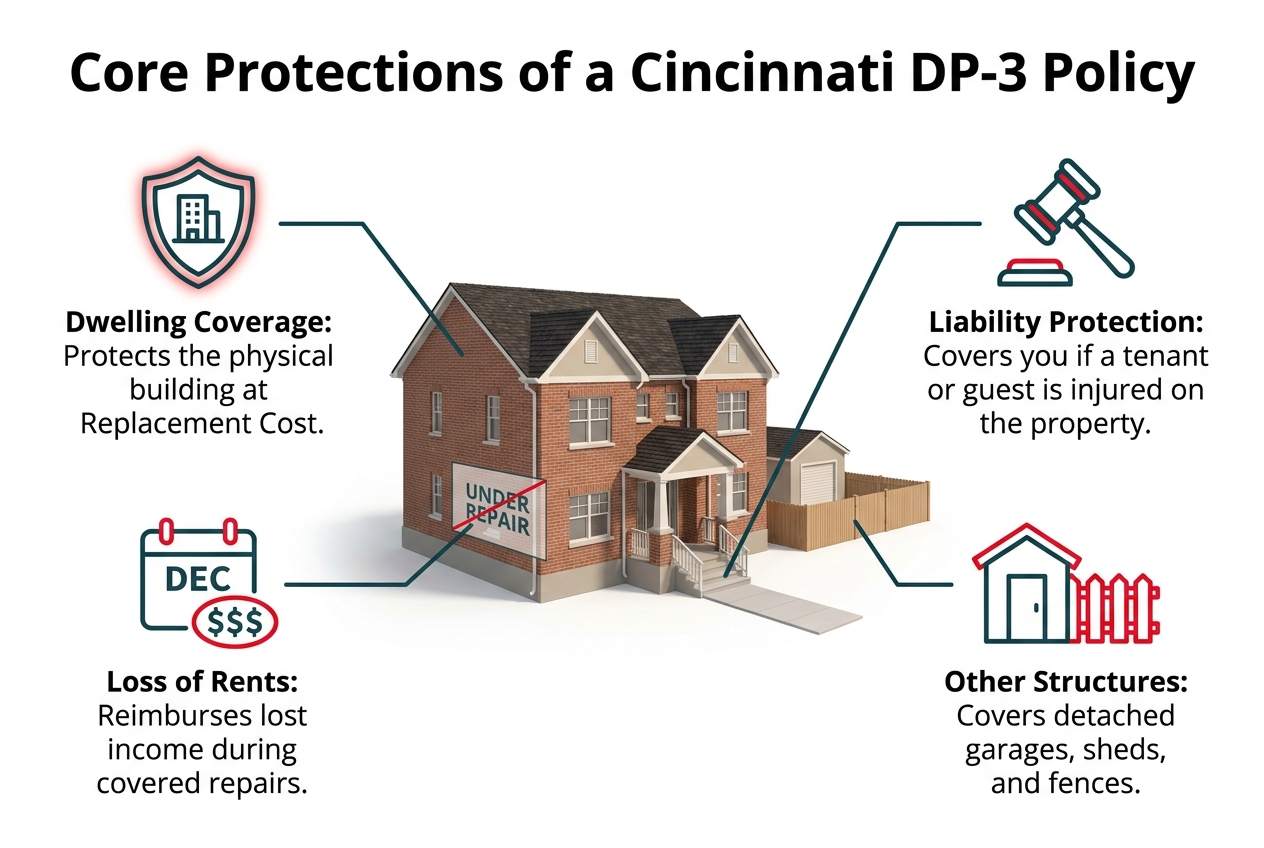
A comprehensive DP-3 policy provides a robust safety net for your investment property. The coverage is broken down into several key areas, each designed to protect you from a different type of financial loss.
Dwelling Coverage
This is the core of your policy. It protects the physical structure of the rental property, including the foundation, walls, roof, and built-in appliances, against damage from covered perils. A DP-3 policy provides this coverage at Replacement Cost Value (RCV), which means if your duplex in Oakley is destroyed by a fire, the policy will pay to rebuild it to its original size and quality using modern materials, without deducting for depreciation.
Landlord Liability Protection
Liability coverage is essential for any landlord. It protects you financially if a tenant or their guest is injured on your property and you are found legally responsible. This coverage can pay for medical bills, legal defense costs, and any settlements or judgments against you, up to your policy limit. For example, if a loose handrail on a staircase causes a tenant to fall and break their arm, your liability coverage would respond to the claim. Most experts recommend a minimum of $500,000 in liability coverage per occurrence.
Loss of Rents
If your rental property becomes uninhabitable due to a covered event (like a fire or a major water pipe burst), you'll lose the rental income you rely on to pay the mortgage and other expenses. Loss of Rents coverage, also known as Fair Rental Value, reimburses you for this lost income while the property is being repaired. This is a critical component that helps maintain your cash flow during a crisis.
Other Structures
This part of the policy covers structures on your property that are not attached to the main dwelling. This includes detached garages, sheds, fences, or gazebos. Coverage for other structures is typically calculated as a percentage of your total dwelling coverage, often around 10%.
Critical Endorsements and Common Exclusions for Cincinnati Landlords
A DP-3 policy covers everything unless it is specifically excluded. That is the advantage of open perils coverage. But the exclusion list is where most Cincinnati investors get caught, not because they did not read the policy, but because they assumed broad coverage meant total coverage. It does not. Understanding what is excluded and which endorsements fill those gaps is the difference between a policy that protects your investment and one that leaves you exposed when you need it most.
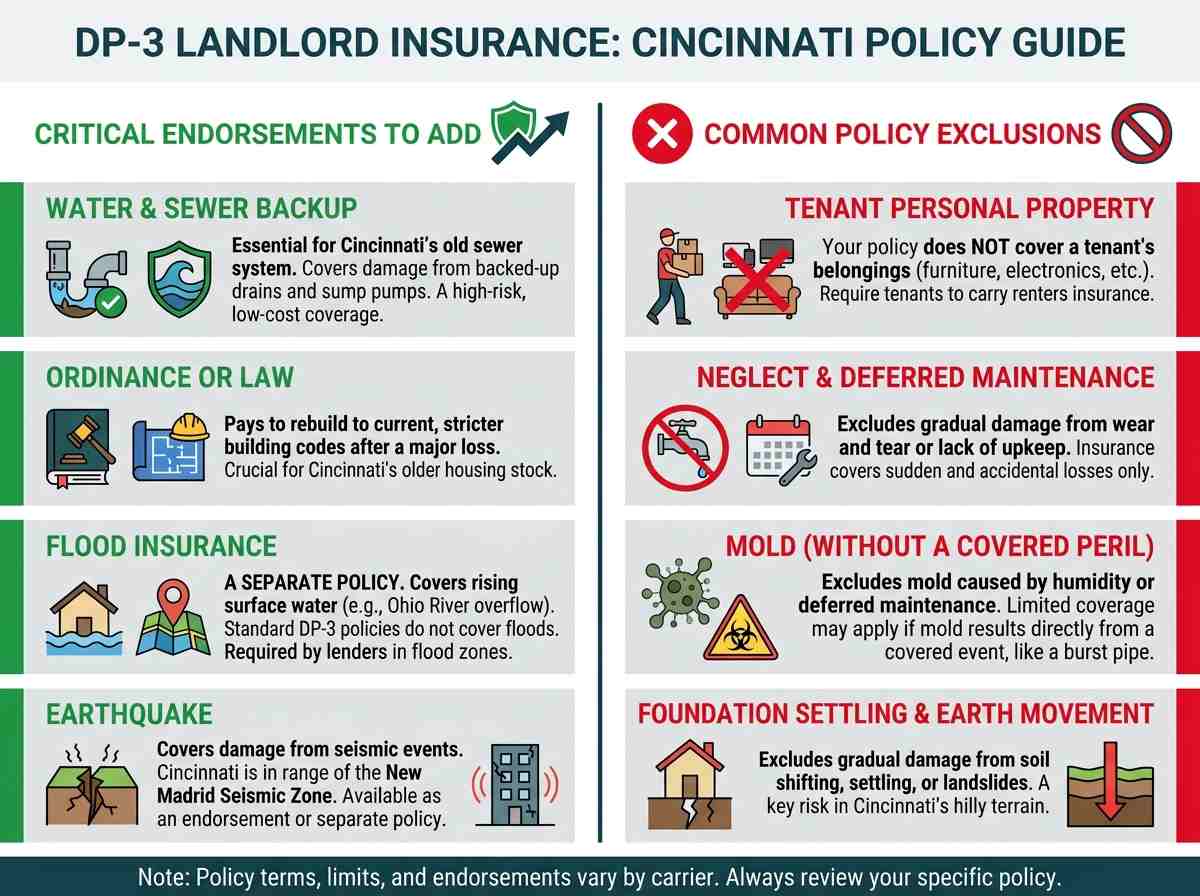
Exclusions Every Cincinnati Investor Must Understand
These are the causes of loss that your DP-3 will not cover without additional endorsements or separate policies.
Water and Sewer Backup
This is the single most important endorsement for Cincinnati landlords. Damage from water that backs up through sewer lines, drains, or sump pumps is excluded from every standard DP-3 policy. Cincinnati's municipal sewer system is one of the oldest in the Midwest, and the city has been under a federal consent decree for decades to address combined sewer overflows. Heavy rainfall routinely overwhelms the system, pushing sewage and stormwater back into basements and lower-level units.
A single backup event can cause $5,000 to $30,000 in damage to finished basements, flooring, drywall, appliances, and HVAC equipment. For investors who own older 1-4 unit properties in neighborhoods like Price Hill, Northside, or Walnut Hills where the housing stock frequently includes basement-level units, this risk is not theoretical. It is seasonal.
The endorsement is inexpensive, typically $50 to $150 per year for $5,000 to $25,000 in coverage. When you get a quote through OfferMarket, the in-house team flags any policy that is missing water backup coverage before the policy is bound.
Flood Insurance
No standard landlord policy, including a DP-3, covers damage from flooding. Flooding is specifically defined as rising surface water from an outside source: overflow from the Ohio River, flash floods from heavy rainfall, or surface water accumulation after storms.
Cincinnati sits along the Ohio River, and several neighborhoods and low-lying areas fall within FEMA-designated flood zones. Properties near the riverfront, in the East End, or in low-lying areas of the Mill Creek Valley corridor may be in a Special Flood Hazard Area (SFHA). If the property is in a mapped flood zone and you are financing with a DSCR loan or any mortgage product, your lender will require a separate flood insurance policy before closing. Even if the property is not in a mapped flood zone, Cincinnati's terrain (steep hillsides, narrow valleys, aging storm drainage) creates flash flood risk in areas that FEMA maps may not capture.
Flood insurance is typically purchased through the National Flood Insurance Program (NFIP) or through a private flood carrier. Premiums vary based on the flood zone designation, elevation, and building type. Budget $500 to $2,500 per year depending on risk level and coverage amount.
Check your rate
See rates, terms, and max LTV for your investment property in minutes — no credit check required.
Check my rate →Ordinance or Law
When an older property is significantly damaged, the local building department does not let you rebuild to the standards that existed when the property was originally constructed. They require the rebuild to meet current Cincinnati building codes: updated electrical, fire-rated materials, egress windows, smoke and CO detectors in every bedroom, and potentially ADA accessibility improvements for multifamily units.
Those code-compliance upgrades can add tens of thousands of dollars to the rebuild cost, and the base DP-3 policy will not pay for any of it. This exclusion hits Cincinnati investors especially hard because the city has a large inventory of pre-1950 homes. A property built in the 1920s that suffers a major fire will face significant code gap costs during reconstruction.
Most carriers that serve landlords, include ordinance or law coverage automatically at 10% of dwelling coverage. On a $200,000 dwelling, that gives you $20,000 toward code-compliance upgrades. When you get a quote through OfferMarket, the in-house team checks that this endorsement is included and set at an adequate limit, because some carriers omit it entirely.
Earthquake and Earth Movement
Standard DP-3 policies exclude damage from earthquakes, landslides, sinkholes, and earth movement. While Cincinnati is not on a major fault line, it is within range of the New Madrid Seismic Zone, one of the most active seismic areas in the central United States. A significant event on the New Madrid fault would affect the entire Ohio River Valley region. Earthquake coverage is available as a separate policy or endorsement. Premiums are typically low for the Cincinnati market due to the relatively lower risk compared to West Coast cities.
Additionally, Cincinnati's hilly terrain and clay soil create foundation and earth movement risks, particularly for properties built on hillsides in neighborhoods like Mount Adams, Price Hill, and the East Side hilltop communities. Foundation settling and earth movement damage are generally excluded from insurance coverage as they are considered gradual deterioration, not sudden and accidental loss.
Mold, Fungus, and Wet or Dry Rot
Most DP-3 policies exclude mold damage unless it results directly from a covered peril. Some carriers include a small sublimit, commonly $5,000, for mold remediation. Cincinnati's humid summers and older housing stock with less-than-modern ventilation make mold a real concern for rental properties, especially in basements and bathrooms. If a covered event (such as a burst pipe) causes water damage that leads to mold, the mold remediation may be covered up to the sublimit. If mold develops from ongoing moisture, condensation, or deferred maintenance, it is excluded. Check your quote for the mold sublimit.
Tenant Personal Property
Your landlord policy does not cover your tenant's personal belongings. If a fire destroys the building, your DP-3 pays to rebuild the structure, but it will not replace your tenant's furniture, clothes, or electronics. This is the most common point of confusion between landlords and tenants. Best practice: require tenants to carry their own renters insurance policy as a condition of the lease. This protects the tenant's belongings, reduces the likelihood of the tenant filing a liability claim against you for lost property, and costs the tenant approximately $10 to $20 per month.
Neglect and Deferred Maintenance
If a covered event damages the property and you fail to take reasonable steps to prevent further damage, the carrier can deny the claim for the additional deterioration. Insurance covers sudden and accidental loss, not predictable, gradual wear. A leaky faucet that drips for six months and eventually rots the subfloor is maintenance, not a covered loss. But if that same pipe suddenly bursts and floods the unit, the water damage to the dwelling is covered (the pipe itself may not be).
For out-of-state investors who own Cincinnati rental properties remotely, this underscores the importance of having a reliable property manager or local contact who can respond quickly: tarp a damaged roof, shut off water to a burst pipe, or board up a broken window before the damage spreads.
Cincinnati's Weather Risks and Your Insurance Policy
Cincinnati's location in the Ohio Valley exposes rental properties to a variety of weather-related risks. Your insurance policy needs to be structured to handle these specific threats.
Tornadoes and Windstorms: Ohio is part of "Tornado Alley," and severe windstorms are a common threat. Your policy will cover wind damage, but you must pay close attention to your wind/hail deductible. Some policies use a separate, higher deductible for wind and hail, often expressed as a percentage (e.g., 1-5%) of your total dwelling coverage. A 2% deductible on a $300,000 property means you'd pay the first $6,000 out-of-pocket. Opting for a flat dollar deductible (e.g., $1,000 or $2,500) provides more predictable financial protection.
Severe Hail Damage: Hail is a frequent cause of claims in the region, primarily damaging roofs, siding, and gutters. Be aware that some carriers are now including "cosmetic damage exclusions," meaning they won't pay to replace a roof that is dented but still functional. It's crucial to understand how your specific policy handles hail claims.
Winter Weather Perils: The cold Cincinnati winters bring risks like frozen pipes bursting, which can cause extensive water damage. Ice dams on roofs can also lead to water seeping into the attic and walls. Your policy will generally cover the resulting water damage from a burst pipe, but not the cost to repair the pipe itself. Proper winterization is your first line of defense.
Ohio River Flooding: As mentioned, flooding is a major exclusion. Properties in neighborhoods like the East End, Sayler Park, or parts of Downtown near the river are particularly vulnerable. Landlords in these areas must view a separate flood insurance policy as a non-negotiable cost of doing business.
Navigating Insurance for Cincinnati's Older Housing Stock
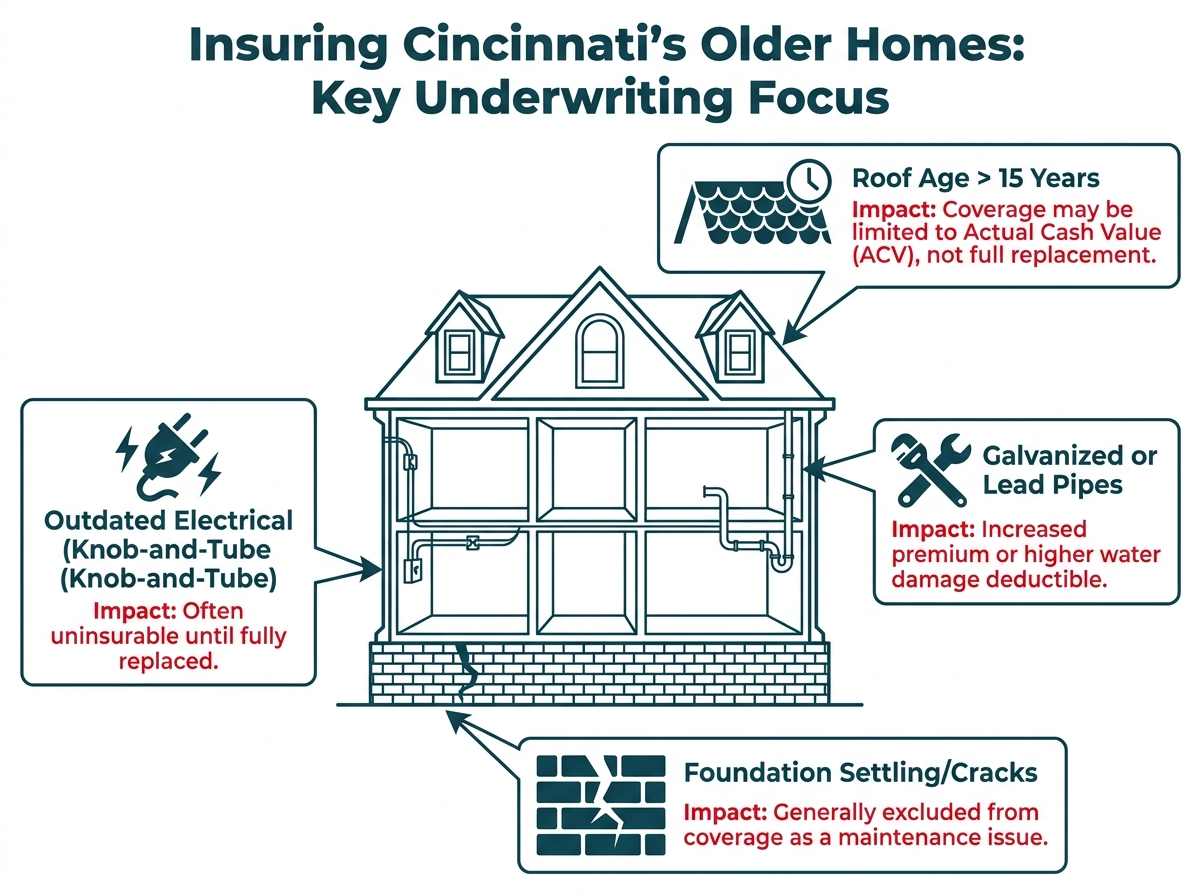
Much of Cincinnati's rental inventory consists of older homes, which present unique challenges for insurance underwriters. Carriers will look closely at the "four-point" systems—roof, electrical, plumbing, and HVAC—before issuing a policy.
Electrical System Underwriting: Homes with outdated electrical systems like knob-and-tube wiring are extremely difficult to insure. Most carriers will require it to be fully replaced. Similarly, homes with Federal Pacific or Zinsco electrical panels may be denied coverage due to their known fire risk.
Plumbing Risks: The presence of galvanized or lead pipes increases the risk of leaks and water damage claims. While some carriers will still write a policy, they may charge a higher premium or impose a higher water damage deductible.
Roof Age and Condition: This is a major sticking point for insurers. Many carriers will not offer Replacement Cost coverage for a roof that is over 15-20 years old. Instead, they will only offer Actual Cash Value (ACV), which means if your 22-year-old roof is damaged, they will only pay a fraction of the replacement cost after factoring in depreciation.
Foundation Issues: Damage from foundation settling, cracking, or bowing is almost always considered a maintenance issue and is excluded from coverage. The policy is designed to cover sudden and accidental losses, not gradual deterioration.
How Cincinnati Real Estate Metrics Impact Your Insurance
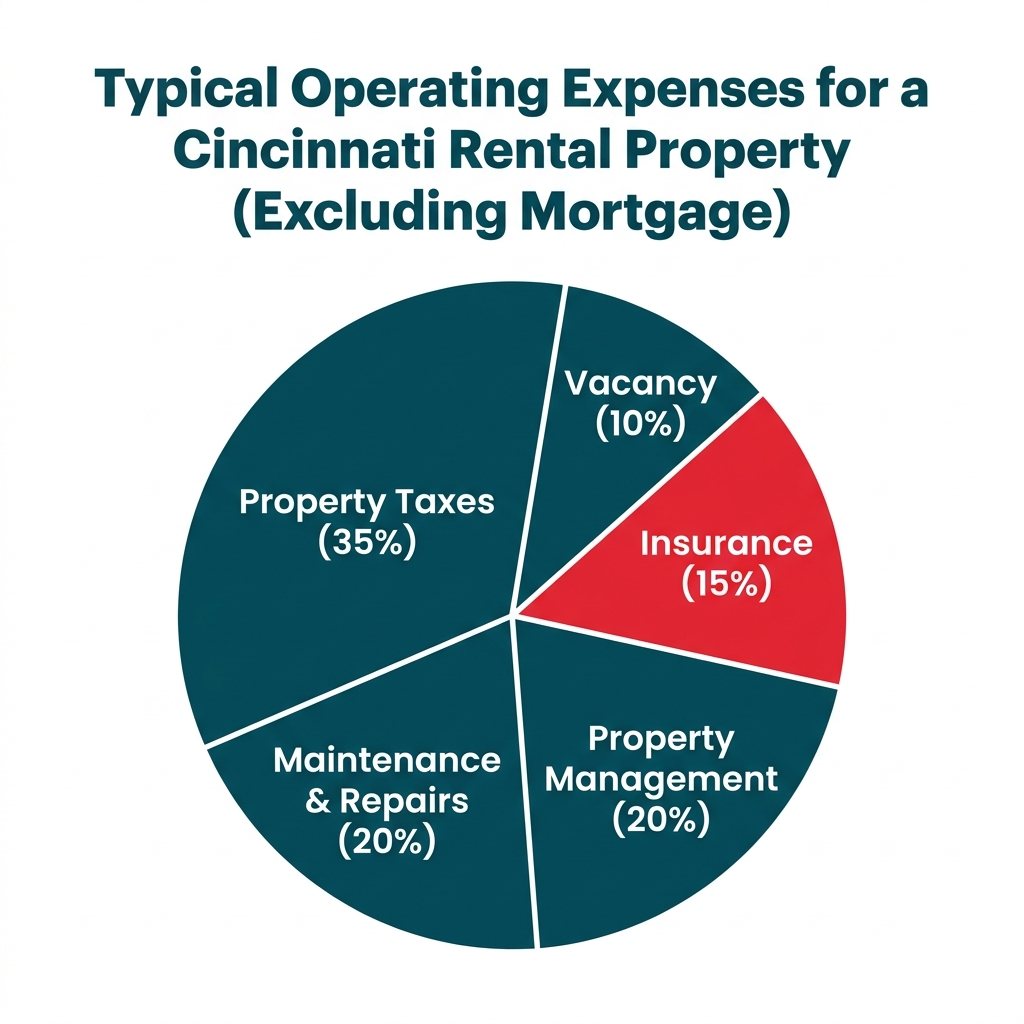
Your landlord insurance policy doesn't exist in a vacuum. It's a key operating expense that is directly influenced by and, in turn, influences your overall investment strategy in the Cincinnati market.
Neighborhood Investment Profiles: Insurance carriers are data-driven. They analyze claims data and risk factors on a ZIP code or even block-by-block basis. This means your premium is a reflection of the perceived risk in a specific neighborhood. An identical property will have a different insurance cost in a stable, high-value area like Hyde Park versus a transitional area like Price Hill, where risks like theft, vacancy, and liability might be statistically higher.
Hamilton County Property Taxes: When calculating your property's debt service coverage ratio, insurance premiums and Hamilton County's high property taxes are two of your largest non-debt expenses. Accurately estimating your insurance cost is crucial for ensuring your investment will cash flow properly.
Impact on DSCR Calculations: For investors using financing like a DSCR loan, the insurance premium is a major component of the "PITI" (Principal, Interest, Taxes, Insurance) used in the calculation. An unexpectedly high premium can lower your Debt Service Coverage Ratio, potentially impacting your ability to qualify for the loan or the terms you receive.
Tenant Screening and Liability: Your liability risk is directly tied to the tenants you place. A thorough tenant screening process that checks for credit history, criminal background, and past evictions can help mitigate the risk of property damage and liability claims, which is a positive signal to insurance carriers over the long term.
Key Ohio Landlord-Tenant Laws Affecting Liability
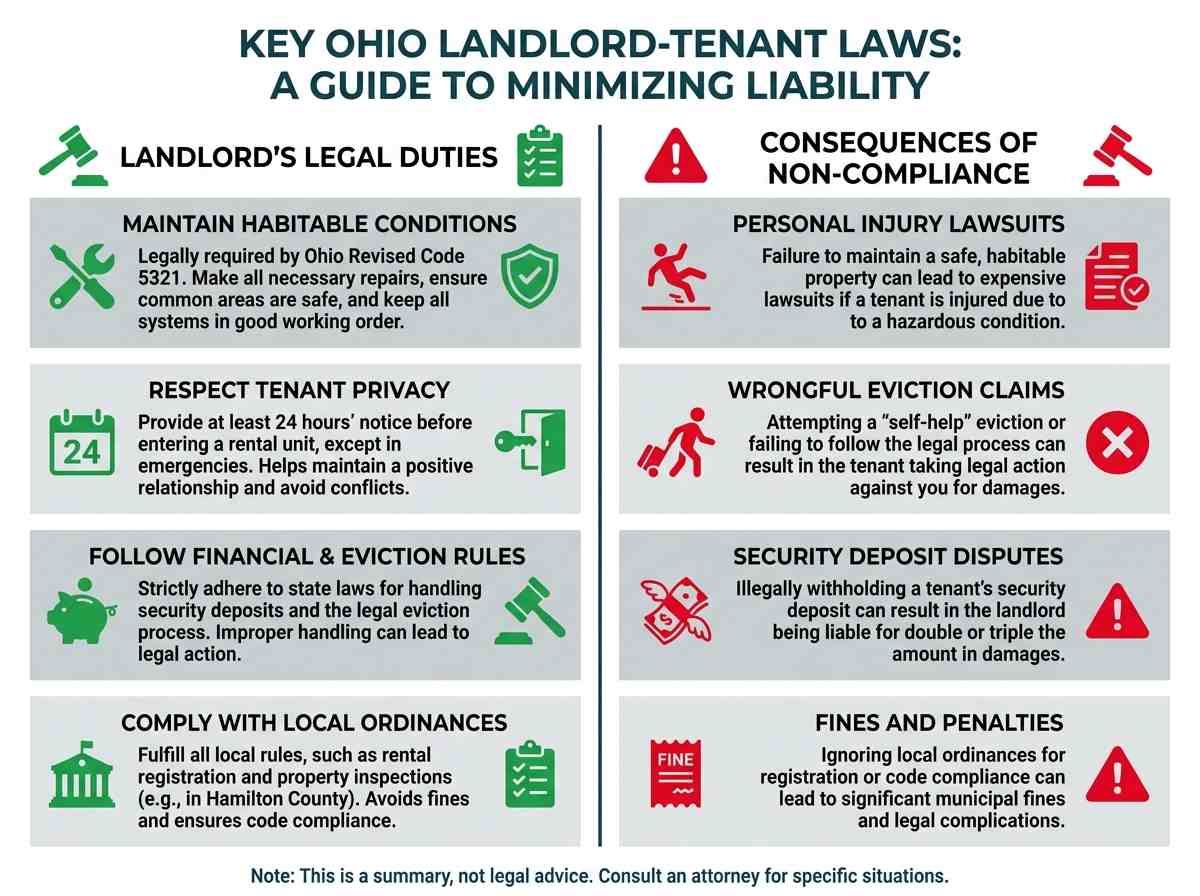
Your insurance policy is your financial backstop, but your first line of defense against liability claims is complying with state and local laws. Understanding your legal obligations can prevent many issues from escalating.
Duty to Maintain a Habitable Property: Under Ohio Revised Code 5321, landlords have a legal duty to keep the property in a "fit and habitable condition." This includes making all necessary repairs, keeping common areas safe and clean, and ensuring all electrical, plumbing, and heating systems are in good working order. Failure to do so can lead to lawsuits if a tenant is injured due to a hazardous condition.
Security Deposit and Eviction Rules: Ohio has specific laws governing the handling of security deposits and the legal process for eviction. Improperly withholding a deposit or attempting a "self-help" eviction can result in legal action from the tenant. Following the letter of the law is crucial.
24-Hour Notice of Entry: Except in emergencies, Ohio law requires landlords to provide tenants with at least 24 hours' notice before entering the rental unit. Respecting tenant privacy helps maintain a positive landlord-tenant relationship and reduces potential conflicts.
Hamilton County Rental Registration: Some municipalities within Hamilton County have rental registration or licensing ordinances. Landlords must comply with these local rules, which often involve property inspections to ensure safety and code compliance. Non-compliance can lead to fines and legal complications.
What OfferMarket Checks on Every Cincinnati Quote
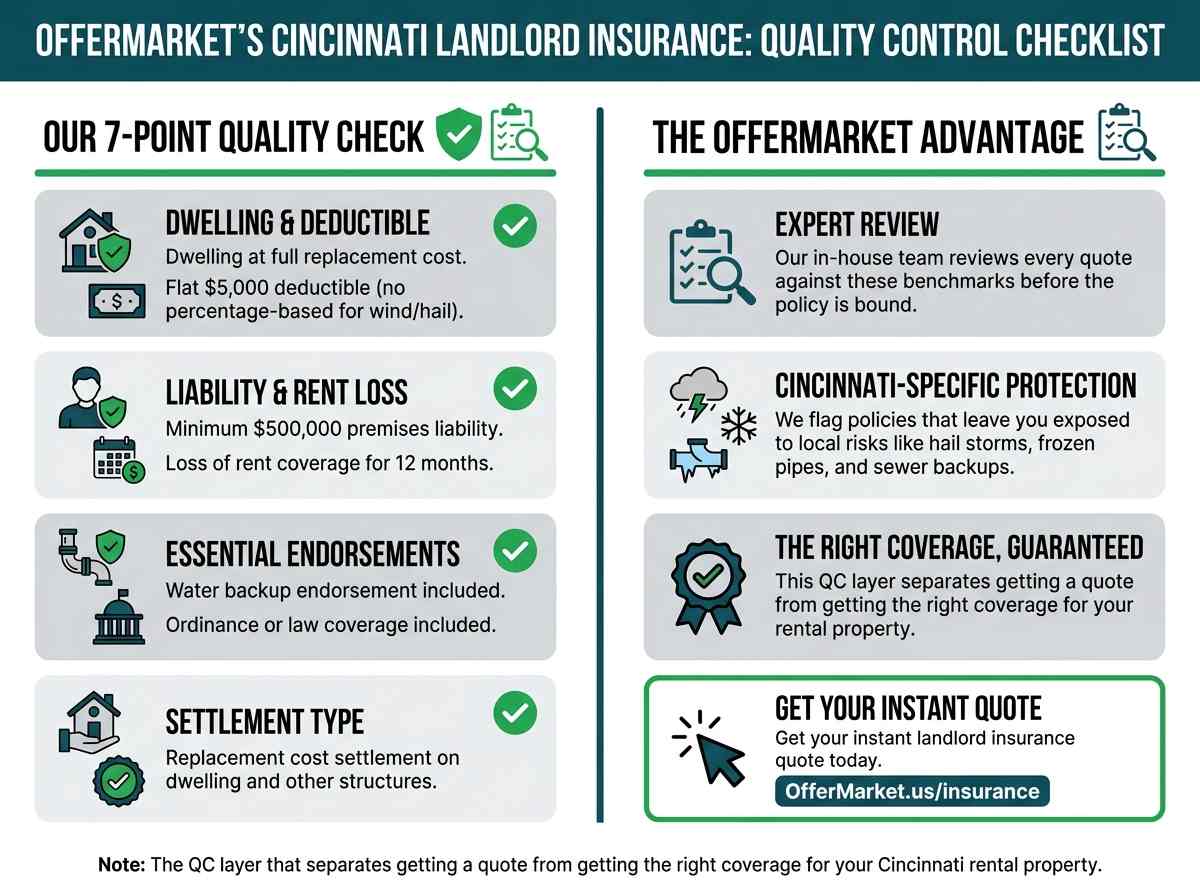
When you get an instant landlord insurance quote through OfferMarket, the in-house team reviews every quote against these benchmarks before the policy is bound:
- Dwelling coverage at full replacement cost value
- Flat $5,000 deductible across all perils including wind and hail (no percentage-based deductibles, which are especially costly in Ohio's hail-prone climate)
- Premises liability at $500,000 per occurrence minimum
- Loss of rent coverage for up to 12 months of rental income
- Ordinance or law coverage included
- Water backup endorsement included
- Replacement cost settlement on dwelling and other structures
If any of these are missing, below benchmark, or structured in a way that would leave you exposed after a Cincinnati storm, frozen pipe event, or sewer backup, the team flags it and works to correct it before the policy is bound. This is the QC layer that separates getting a quote from getting the right coverage for your Cincinnati rental property.
Get your instant landlord insurance quote →
Get an Instant Cincinnati Landlord Insurance Quote
Navigating the complexities of landlord insurance doesn't have to be a challenge. At OfferMarket, we've streamlined the process specifically for real estate investors in Cincinnati. Our platform is designed to find you the comprehensive coverage you need at the most competitive price.
Shop 40+ A-Rated Carriers Instantly: Use our free online landlord insurance tool to compare quotes from over 40 top insurance carriers in minutes. No more calling multiple agents and filling out endless paperwork.
Investor-Focused Benchmarks: Every quote we provide is automatically benchmarked for investors. We default to full Replacement Cost coverage, a minimum of $500,000 in liability, and include Loss of Rents protection, ensuring your asset is properly protected from day one.
Protect your investment and your cash flow. Get a no-obligation, instant quote for your Cincinnati rental property today.
Shop 40+ Carriers for Your Cincinnati Rental Property
Enter your property address, select your coverage type, and get an instant DP-3 quote in under a minute. OfferMarket's team reviews every quote for coverage gaps, verifies water backup is included, and confirms your policy meets Ohio lender requirements.
Get Insurance Quote →


OfferMarket Loans
Check your rate
60 seconds · no credit pull