*Quote takes 1 minute, no credit pull
Insurance*1 quote from 40+ carriers
Listings*New listings daily
Georgia Landlord Insurance
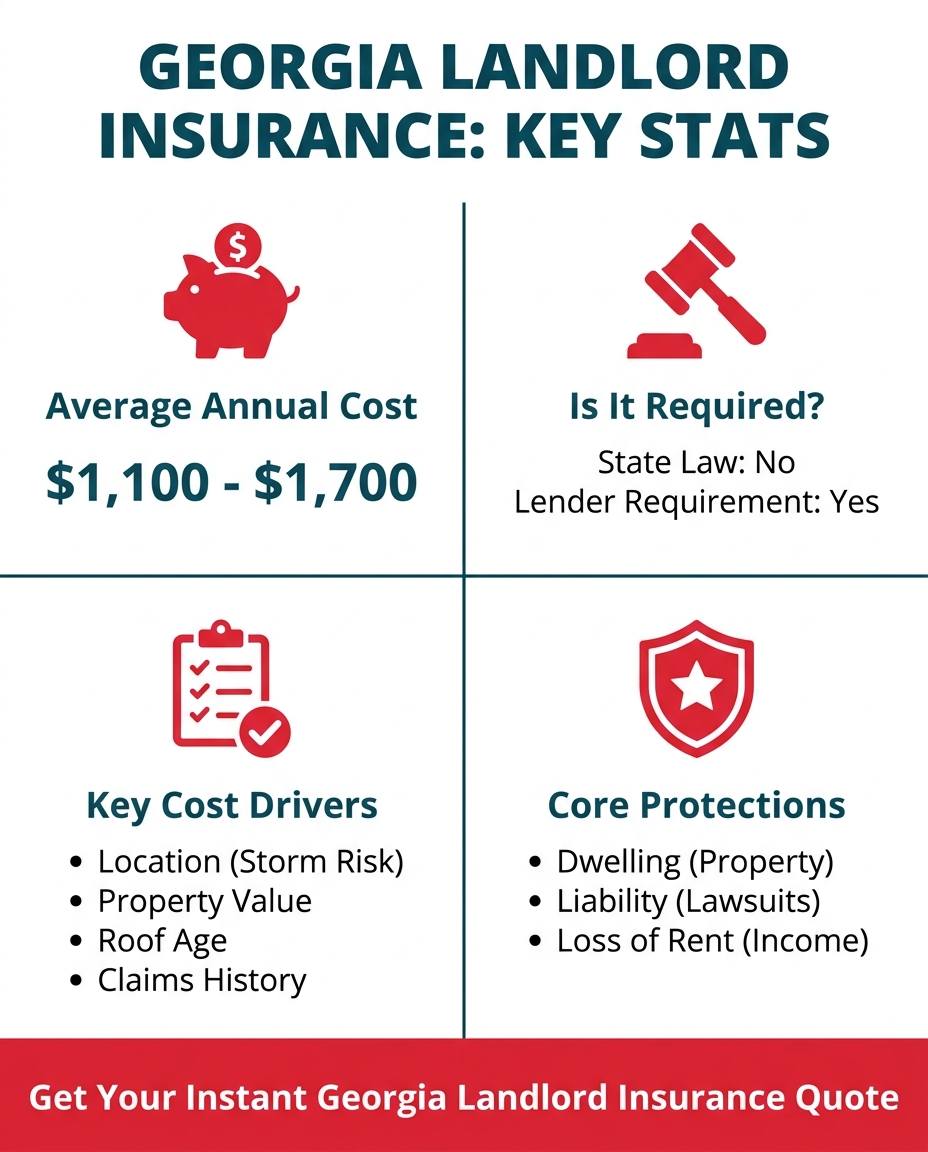
The average annual cost for landlord insurance in Georgia for a typical single-family rental property ranges from $1,100 to $1,700. While Georgia state law does not legally mandate landlords to carry this insurance, it is a non-negotiable requirement for virtually all mortgage lenders, including those offering DSCR loans.
Georgia Landlord Insurance: The 2026 Investor Snapshot
The core function of a landlord policy is threefold: it protects the physical structure of your property from damage, shields you from liability lawsuits arising from incidents on the property, and replaces lost rental income if the home becomes uninhabitable due to a covered event.
Key factors that drive your specific premium include the property's location (coastal areas with hurricane risk versus inland areas with tornado risk), the property's replacement cost value, the age and condition of the roof, your personal claims history, and local crime scores. Understanding these variables is the first step to securing the right protection for your Georgia real estate investment.
Insurance Cost Profiles by Georgia Investment Market
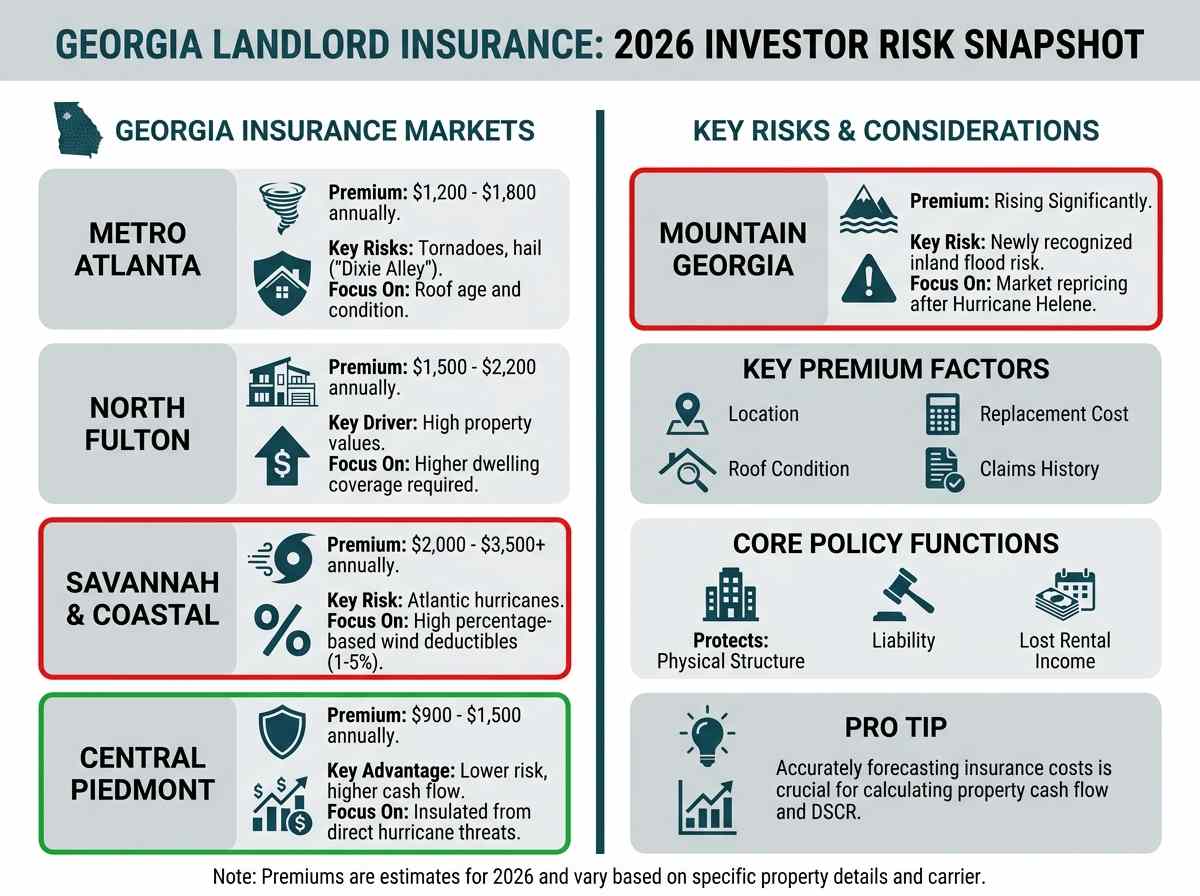
Insurance premiums for Georgia rental properties are not uniform across the state. Localized risks, property values, and weather patterns create distinct insurance markets. Understanding these regional differences is crucial for accurately forecasting cash flow and DSCR.
Metro Atlanta (East Atlanta, Gwinnett, South Fulton)
In the sprawling Metro Atlanta area, investors can expect annual premiums to range from "$1,200 to $1,800".
This region is part of "Dixie Alley," a southern corridor known for tornadic activity. The increasing frequency of severe convective storms, particularly hail and straight-line winds, has been a primary driver of rising premiums.
Insurers are paying close attention to roof age and condition in counties like Gwinnett and Cobb, which have seen significant hail damage in recent years. Despite these rising costs, the strong and consistent rental demand in these submarkets helps to offset the expense.
North Fulton (Alpharetta, Roswell, Johns Creek)
For higher-value rental properties in affluent North Fulton suburbs like Alpharetta and Roswell, premiums are typically higher, ranging from "$1,500 to $2,200 per year".
The primary driver here is the higher dwelling coverage required to insure these more expensive homes. A $600,000 rental in Johns Creek simply requires more coverage than a $300,000 rental in South Fulton. While the weather risks are similar to the rest of Metro Atlanta, the higher replacement costs directly translate to higher base premiums.
Savannah and Coastal Markets (Chatham County, Golden Isles)
The coastal region, including Savannah and Brunswick, faces the highest insurance costs in Georgia, with annual premiums often ranging from "$2,000 to $3,500 or more".
The direct exposure to Atlantic hurricanes and tropical storms is the single largest risk factor. Policies in this area almost always include a separate, and much higher, "windstorm or hurricane deductible".
Instead of a flat dollar amount, this is typically a percentage of the dwelling coverage, often between 1% and 5%. For a $400,000 property, a 3% hurricane deductible means the investor is responsible for the first $12,000 of wind-related damages.
Central Piedmont (Columbus, Macon, Augusta)
This inland region offers some of the most affordable landlord insurance in the state, with typical premiums between "$900 and $1,500 annually".
Properties in markets like Macon and Columbus are insulated from direct hurricane threats, and while they still face risks from tornadoes and thunderstorms, the frequency and severity are generally lower than in North Georgia.
These lower insurance costs contribute directly to higher cash flow and better cap rates for investors, making it an attractive area for buy-and-hold strategies. However, as Hurricane Helene demonstrated in 2024, even inland areas like Augusta can experience significant flooding from slow-moving systems.
Mountain Georgia (Blue Ridge, Dahlonega)
Historically one of the lowest-cost insurance zones, the North Georgia mountains are undergoing a significant risk reassessment by carriers. The catastrophic flooding caused by Hurricane Helene in September 2024 revealed a previously underestimated vulnerability.
The storm stalled over the region, dumping unprecedented amounts of rain and causing widespread water damage. Consequently, insurers are now repricing risk in this area, and investors who once enjoyed very low premiums should budget for significant increases as the market adjusts to this new understanding of inland flood risk from tropical systems.
Shop 40+ Carriers for Your Georgia Rental Property
Premiums are up 36% since 2019. Enter your property address and get an instant DP-3 quote in under a minute. OfferMarket's team catches percentage-based wind/hail deductibles and reviews every quote against Georgia-specific coverage benchmarks.
Get Insurance Quote →DP-1 vs DP-2 vs DP-3: Which Policy Does a Georgia Landlord Need
Landlord insurance policies are not one-size-fits-all. They are categorized into different forms, known as Dwelling Property (DP) policies.
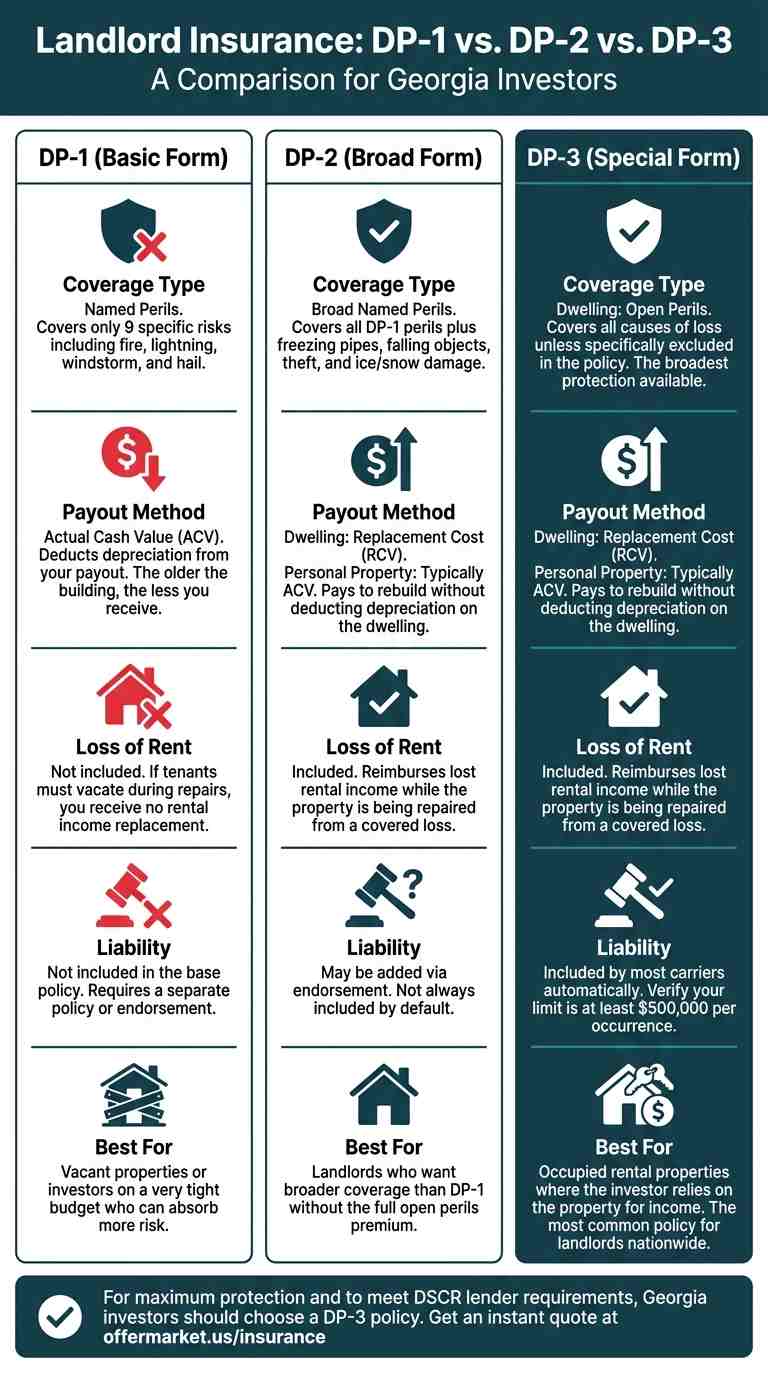
The three main types are DP-1, DP-2, and DP-3. For any Georgia investor with a tenant-occupied property, the DP-3 is the industry standard and the only policy that provides adequate protection.
DP-1 (Basic Form)
This is the most stripped-down and cheapest policy available. It covers only a handful of specific "named perils," such as:
- Fire
- Lightning
It pays out claims on an Actual Cash Value (ACV) basis, which means the insurance company deducts for depreciation. If your 15-year-old roof is destroyed, you'll only get a fraction of the cost to replace it. Crucially, DP-1 policies almost never include liability or loss of rent coverage.
- Best Use Case: A DP-1 is only suitable for a vacant property, such as during a long-term renovation where no tenants are present and you need the most basic coverage to satisfy a lender. It is wholly inadequate for an occupied rental.
DP-2 (Broad Form)
The DP-2 is a step up. It also operates on a "named perils" basis, but the list of covered perils is much broader than the DP-1, including things like damage from: , and .
- Damage from falling objects
- Weight of ice and snow
- Water damage from frozen pipes
It typically provides Replacement Cost Value (RCV) on the dwelling, which pays the full cost to repair or replace without deducting for depreciation. It also includes Loss of Rent coverage.
- Best Use Case: While better than a DP-1, the DP-2 still leaves you exposed. If damage occurs from a peril that is not on the specific list, you have no coverage. It's a mid-tier option that is rarely the best choice for a serious investor.
DP-3 (Special Form)
This is the gold standard for landlord insurance and the policy you should have for your occupied Georgia rental property. The key difference is that a DP-3 provides "open perils" coverage for the dwelling.
This means the structure is covered against all causes of loss unless the peril is specifically excluded in the policy.
Common exclusions are:
- Flood
- Earthquake
- Neglect
This "all-risk" approach shifts the burden of proof from you to the insurer. With a DP-2, you have to prove the damage was caused by a named peril; with a DP-3, the insurer has to prove it was caused by an excluded peril.
Key Features: Provides RCV settlement for the dwelling, includes Loss of Rent, and nearly all carriers package it with robust Premises Liability coverage.
Cost vs. Benefit: The premium difference between a DP-2 and a DP-3 is often surprisingly small, perhaps only $100 to $300 per year. The massive increase in protection makes the DP-3 the clear winner and the wisest investment for protecting your asset.
Understanding Your DP-3 Landlord Insurance Policy
A DP-3 policy is a package of several distinct coverages. As a Georgia landlord, it's vital to understand what each part does to protect you.
Dwelling Coverage (Coverage A)
This is the core of your policy. It protects the main physical structure of the rental property—the foundation, walls, roof, and built-in systems like plumbing and electrical. Under a DP-3, this coverage is "open perils," meaning it's protected from all sources of damage except those specifically listed as exclusions in your policy. The coverage amount should be set at the property's Replacement Cost Value (RCV), which is the estimated cost to rebuild the home from the ground up today, not its market value.
Other Structures (Coverage B)
This covers structures on the property that are detached from the main dwelling. This includes detached garages, sheds, fences, gazebos, and Accessory Dwelling Units (ADUs). Coverage B is typically set as a percentage of your Dwelling Coverage, most commonly 10% of Coverage A. If your home is insured for $350,000, you would automatically have $35,000 in coverage for other structures.
Personal Property (Coverage C)
This is a point of frequent confusion for new landlords. Coverage C on a landlord policy does not cover the tenant's belongings. It only covers personal property owned by the landlord and used to service the rental. This primarily includes appliances you provide, such as a refrigerator, washer/dryer, or stove, as well as equipment like lawnmowers. Unlike the dwelling, this coverage is typically on a "named perils" and ACV basis, though some carriers allow you to upgrade to RCV.
Loss of Rent / Fair Rental Value (Coverage D)
This is one of the most valuable protections for a real estate investor. If a covered event, like a fire or a major tornado, renders your property uninhabitable during repairs, (Coverage D) reimburses you for the lost rental income. This allows you to continue making your mortgage, tax, and insurance payments without drawing from your personal funds. Coverage is usually limited to a time period (e.g., 12 months) or a total dollar amount, often calculated as 10-20% of the dwelling coverage.
Premises Liability
This coverage protects your personal assets from lawsuits. If a tenant, their guest, or even a delivery person is injured on your property and you are found legally responsible, liability coverage pays for their medical expenses, your legal defense costs, and any court-awarded settlements or judgments, up to your policy limit.
Standard liability limits are often $300,000 or $500,000, but most savvy investors opt for a minimum of $1,000,000 or supplement their policy with a separate umbrella policy. Given recent changes in Georgia law, robust liability coverage is more critical than ever.
Check your rate
See rates, terms, and max LTV for your investment property in minutes — no credit check required.
Check my rate →Essential Endorsements for Georgia Investors
A standard DP-3 policy is a strong foundation, but several key endorsements (add-ons) are necessary to fully protect a Georgia rental property from common risks.
Water Backup and Sump Overflow
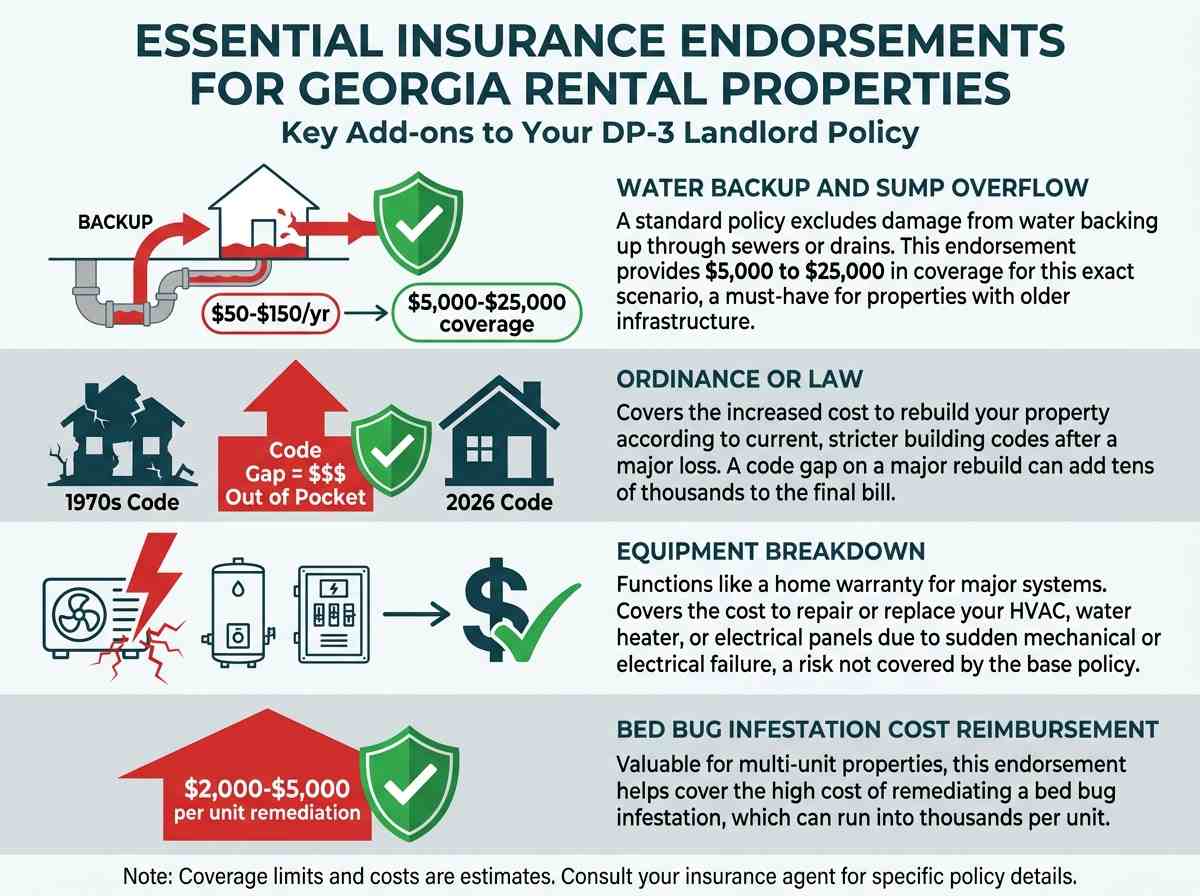
A standard policy excludes damage from water that backs up through sewers or drains. This is a critical gap, especially in older Atlanta neighborhoods or cities with aging municipal infrastructure. For a relatively low cost, typically $50 to $150 per year, you can add an endorsement that provides $5,000 to $25,000 in coverage for this exact scenario. A sewer backup can easily cause thousands in damage to flooring, drywall, and cabinetry, making this a must-have endorsement.
Ordinance or Law
After a major loss, you're required to rebuild your property according to current building codes, which may be much stricter than when the home was originally built. These code-mandated upgrades—such as new wiring, plumbing, or structural requirements—are not covered by a standard policy. The Ordinance or Law endorsement covers these increased costs. Most carriers will automatically include a baseline of 10% of your dwelling coverage, but for older Georgia properties, you may want to increase this limit. A code gap on a major rebuild can easily add tens of thousands of dollars to the final bill.
Equipment Breakdown
Your DP-3 covers your HVAC unit if a tree falls on it (an external peril), but it does not cover it if it suffers a sudden mechanical or electrical failure. Equipment Breakdown coverage functions like a home warranty for your major systems, including HVAC, water heaters, and electrical panels. It covers the cost to repair or replace these systems due to internal failure, a risk not covered by the base policy.
Bed Bug Infestation Cost Reimbursement
While less common, some carriers are beginning to offer endorsements that help cover the cost of remediating a bed bug infestation. This can be particularly valuable for multi-unit properties or rentals in areas with high tenant turnover. This coverage usually has specific limits per incident and a total aggregate limit for the policy term.
The Shifting Georgia Insurance Landscape: Why Premiums Are Rising
If you feel like your Georgia landlord insurance premiums are rising significantly, you're not wrong. The state's insurance market is under pressure from several converging factors, leading to sustained rate increases.
The turning point for many insurers was Hurricane Helene in September 2024. While coastal Georgia is accustomed to hurricane risk, Helene's path brought catastrophic flooding and high winds far inland. Atlanta received over 11 inches of rainfall, while communities in the North Georgia mountains experienced devastating floods and mudslides. This single event forced a statewide risk reassessment, proving that no part of Georgia is immune to the effects of a major tropical system.
This came on the heels of an already severe 2024 storm season, where Georgia recorded over 79 tornadoes and sustained more than $2.4 billion in insured losses, placing it among the hardest-hit states in the nation. According to the NOAA National Centers for Environmental Information, the frequency of billion-dollar weather events in Georgia has skyrocketed. The state has averaged 9.8 such events per year over the last five years, a dramatic increase from the historical average of 3.0 events per year.
The financial impact is clear: statewide insurance premiums have risen an average of 36% since 2019, with annual increases of 8-12% becoming the norm over the past three years. When modeling your long-term returns, it is prudent for Georgia investors to budget for annual premium increases of at least 5-8% for the foreseeable future.
Georgia's Four Insurance Risk Zones
To effectively underwrite risk, insurers divide Georgia into distinct zones based on primary weather perils.
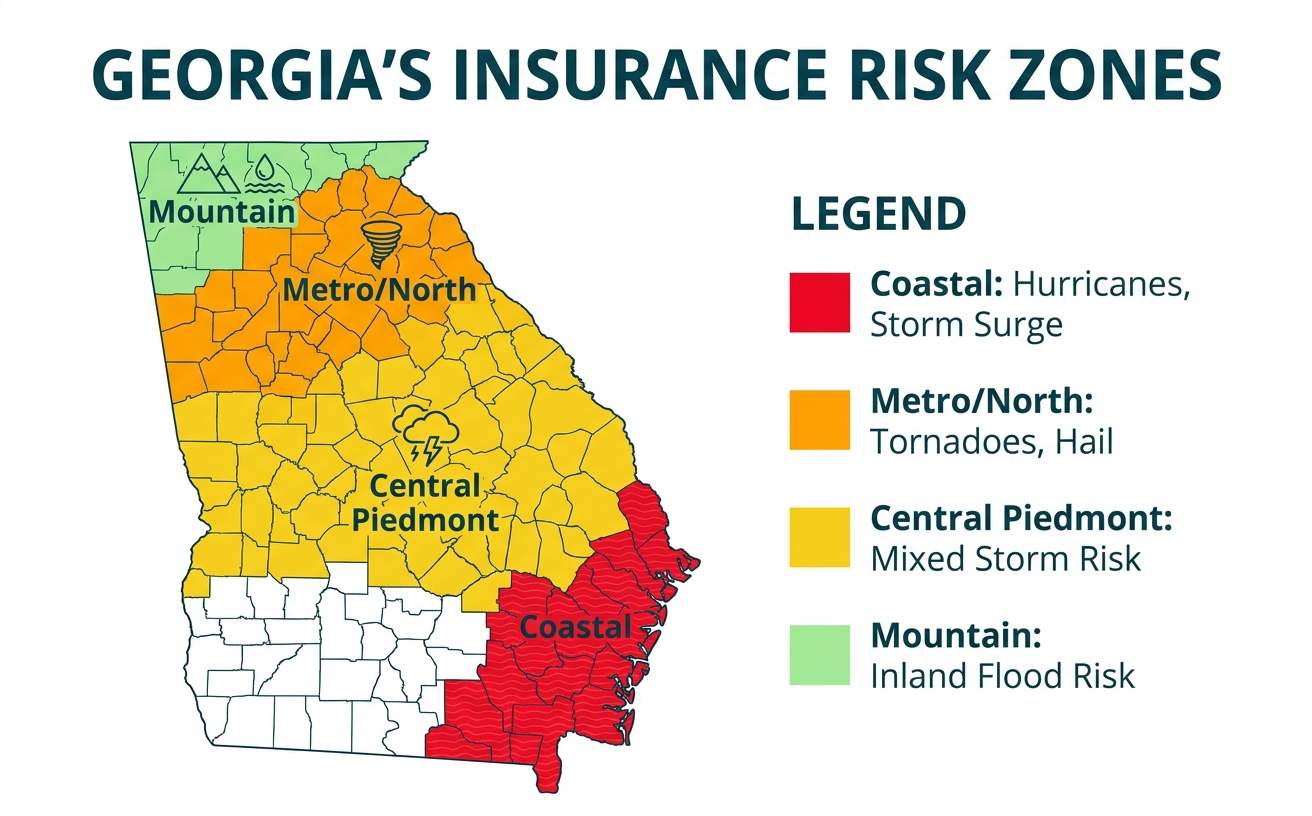
Coastal Georgia (Savannah, Brunswick, Golden Isles)
This is the state's highest-risk zone, defined by its full exposure to Atlantic hurricanes and tropical storms from June through November. Properties here face the dual threat of catastrophic wind damage and storm surge flooding.
Key Insurance Features:
- Separate windstorm/hurricane deductibles are standard, typically 1-5% of the dwelling coverage.
- Flood insurance is essential and almost always required by lenders.
- Premiums are the most expensive in the state by a significant margin.
Metro Atlanta and Northern Georgia
This region, part of the "Dixie Alley" tornado corridor, has a high frequency of severe convective storms. The primary risks are tornadoes, straight-line winds, and, most frequently, damaging hail.
Key Insurance Features:
- Statewide, Georgia averages 22-35 tornadoes per year, with the highest concentration in the northern part of the state.
- Counties like North Fulton, Gwinnett, and Cobb are among the most hail-damaged areas in the entire Southeast.
- Premiums are moderate but rising quickly due to the increasing frequency and severity of these storms.
Central Piedmont (Macon, Columbus, Augusta)
This central belt has a mixed risk profile. It experiences some tornado and hail risk but is largely spared the direct impact of coastal hurricanes.
Key Insurance Features:
- Insurance costs are generally moderate and more stable than in other zones.
- Hurricane Helene in 2024 served as a reminder that even this region is susceptible to major flooding from the remnants of slow-moving tropical systems, particularly near rivers.
Mountain Georgia (Blue Ridge, Dahlonega)
Once considered a low-risk haven, this zone's profile was permanently altered by Hurricane Helene. The mountainous terrain proved to be a catalyst for catastrophic rainfall and flash flooding.
Key Insurance Features:
- Insurers are actively re-evaluating and repricing risk in this region.
- The understanding of flood risk has expanded beyond rivers to include any area susceptible to extreme rainfall from stalled tropical systems.
- Investors in this area should anticipate significant premium adjustments as the market digests these new risks.
Critical Policy Details Georgia Landlords Must Verify
The devil is in the details. Before you bind a policy, you must verify several critical components that can dramatically affect your out-of-pocket costs after a claim.
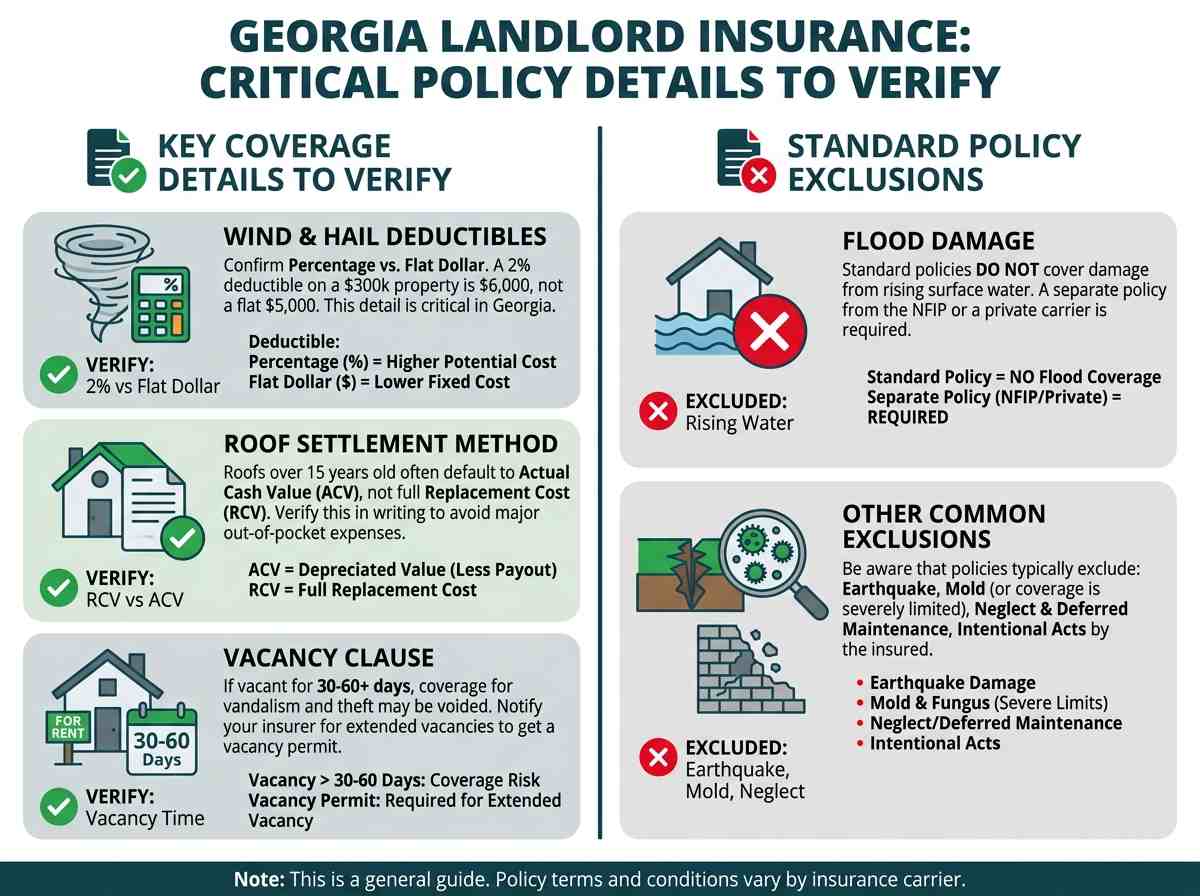
Wind and Hail Deductibles
This is arguably the most important detail for a Georgia investor. Many policies, especially in coastal and northern zones, have a separate deductible for wind and hail damage. This is often a percentage-based deductible (1%, 2%, 3%, or 5% of your dwelling coverage) rather than a flat dollar amount.
Example: On a property with $300,000 in dwelling coverage (Coverage A):
- A flat $5,000 deductible means you pay the first $5,000 of any covered loss.
- A 2% percentage deductible means you pay the first $6,000 of any wind or hail loss.
Always confirm if your deductible is a flat dollar amount or a percentage, as the difference can be thousands of dollars out of pocket.
Roof Age and Settlement Method
Given Georgia's frequent hail storms, the condition of your roof is the single most critical underwriting factor for most carriers. Many insurers will automatically change the loss settlement on your roof to Actual Cash Value (ACV) if it is over 15 years old, even if the rest of the policy is RCV.
Some carriers will decline to insure the property altogether if the roof is over 15 or 20 years old. Always ask your agent to confirm the roof settlement method in writing. An unexpected ACV settlement on a roof claim can leave you with a bill for more than half the replacement cost.
Vacancy Clause
Every landlord policy contains a vacancy clause. This clause states that if the property is vacant for a specified period, typically 30 to 60 consecutive days, certain coverages may be reduced or eliminated entirely.
Vandalism and theft are the most common coverages to be voided during vacancy. If you know your property will be vacant between tenants for more than 30 days, you must notify your insurance carrier. You may need to obtain a "vacancy permit" endorsement to maintain full coverage.
Flood Damage Exclusion
This cannot be overstated: standard DP-3 landlord policies do not cover damage from flooding. Flooding is defined as rising surface water. This requires a separate policy, either from the government-backed National Flood Insurance Program (NFIP) or a private flood insurance carrier.
After Hurricane Helene, the awareness of flood risk has expanded far beyond the coast. Inland communities near rivers and even those in the mountains are now recognized as having significant flood exposure.
Common Exclusions
Beyond flooding, be aware of other common perils excluded from a standard DP-3 policy. These include:
Earthquake: While rare in Georgia, it is a possible event and is not covered.
Mold: Coverage for mold is often excluded, or strictly limited (sublimited) to a small amount like $5,000, and only if the mold is the direct result of another covered peril (like a burst pipe).
Neglect and Deferred Maintenance: Insurance is for sudden and accidental events, not for damage that occurs over time due to a lack of upkeep.
Intentional Acts: Damage intentionally caused by you, the insured, is never covered.
Impact of Georgia Landlord-Tenant Law on Your Insurance Strategy
Your insurance policy and your legal obligations as a landlord are deeply intertwined. Recent changes in Georgia law have made having the right insurance coverage more important than ever.
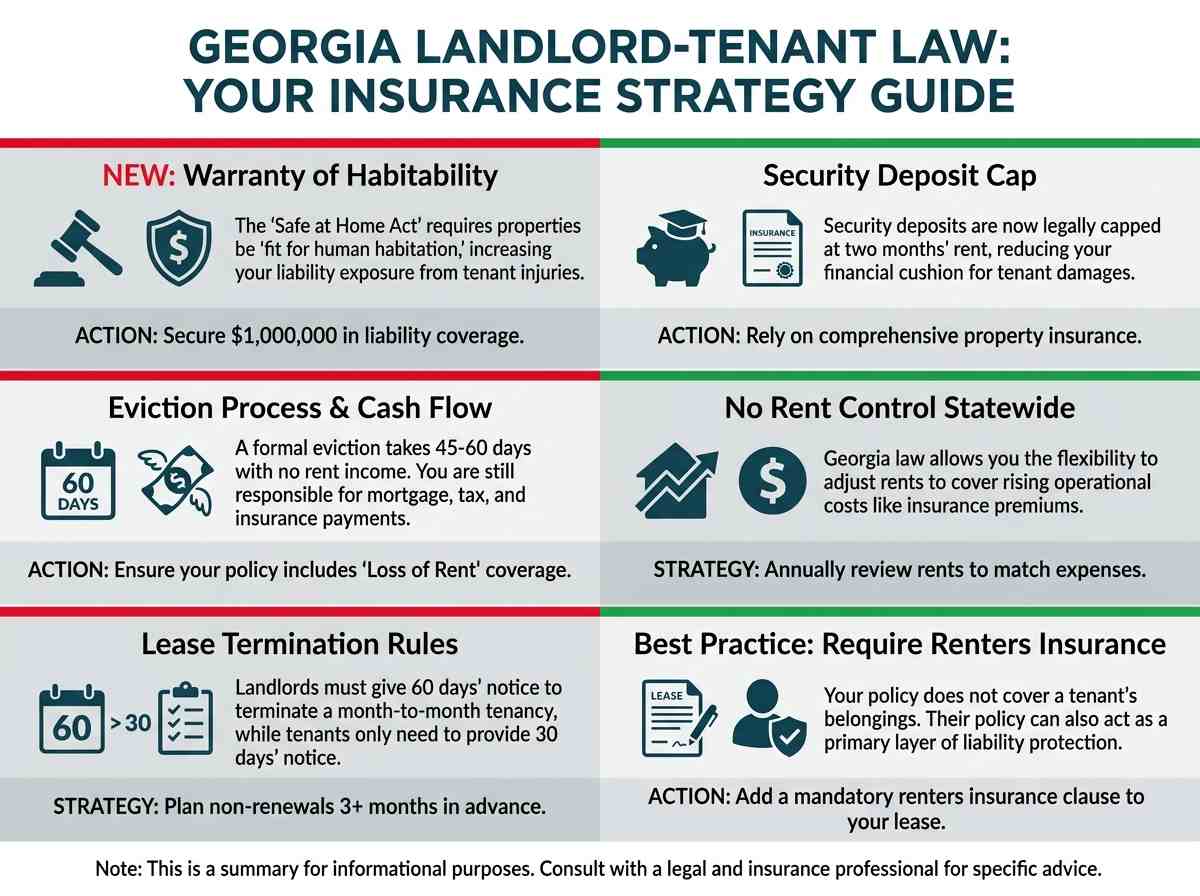
Safe at Home Act (HB 404, effective July 2024)
This landmark legislation fundamentally changed the landlord-tenant relationship in Georgia. It amended the official state code (O.C.G.A. 44-7-13(b)) to include an express statutory warranty of habitability.
This means landlords are now legally required to maintain a property that is "fit for human habitation." This significantly increases a landlord's potential liability exposure. If a tenant is injured due to a condition that could be deemed a breach of this warranty (e.g., a broken step, faulty wiring), the legal standing for a lawsuit is much stronger. This change makes having adequate premises liability coverage—at least $500,000, and preferably $1,000,000—an absolute necessity.
Security Deposit Cap
The same law also capped security deposits at a maximum of two months' rent. Previously, there was no statutory limit. This reduces the financial cushion a landlord has to cover damages left by a tenant, reinforcing the need for comprehensive property insurance and thorough tenant screening.
Eviction Process
In Georgia, a formal dispossessory (eviction) proceeding can take 45 to 60 days from the initial filing to the final removal of the tenant by a marshal.
During this entire period, you are not collecting rent, but you are still responsible for your mortgage, property taxes, and insurance payments. This is precisely why Loss of Rent coverage is so critical. It protects your income stream not just from physical damage but also during lengthy legal processes that interrupt cash flow.
No Rent Control
On a positive note for landlords, Georgia law preempts rent control statewide. This gives you the flexibility to adjust rents at lease renewal to cover rising operational costs, including escalating insurance premiums and property taxes.
Month-to-Month Termination
Georgia law requires landlords to give 60 days' notice to terminate a month-to-month tenancy, while the tenant only needs to provide 30 days' notice. This asymmetry means you need to plan further ahead for rent adjustments or non-renewals, factoring these timelines into your financial planning.
Require Renters Insurance
Your DP-3 policy does not cover your tenant's personal belongings. A best practice is to include a lease provision that contractually requires tenants to obtain and maintain their own renters insurance policy (an HO-4 policy) with a minimum amount of liability coverage.
This serves two purposes: it ensures your tenants can recover their own property after an event, and their liability coverage can act as a primary layer of protection, potentially reducing the likelihood of a claim against your policy.
The Property Tax Trap: How Non-Homestead Status Impacts Your Bottom Line
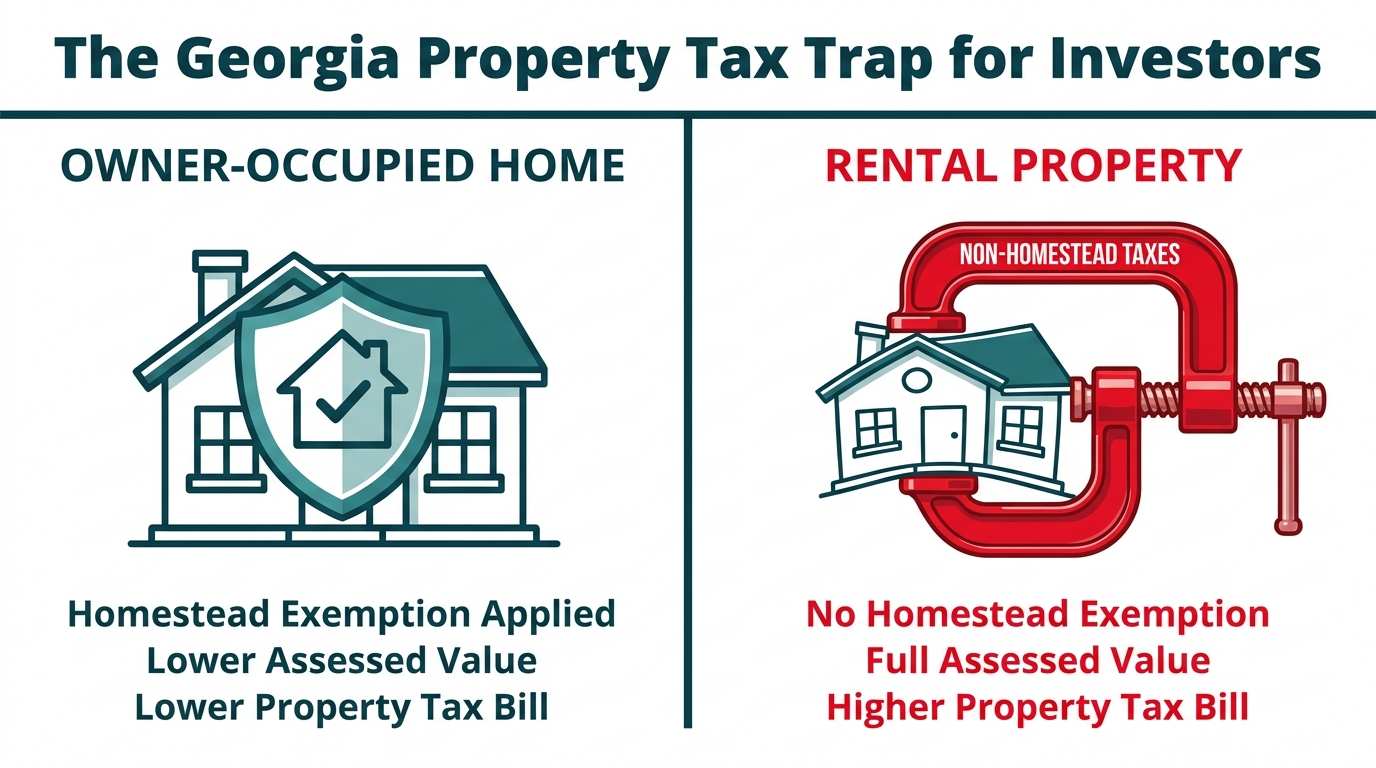
For new investors in Georgia, one of the biggest shocks to the budget is the property tax bill. The taxes on a rental property are often significantly higher than what the previous owner-occupant was paying. This is due to the state's homestead exemption laws.
Georgia's 40% Assessment Ratio
First, it's important to understand how taxes are calculated. A property's Fair Market Value is determined by the county tax assessor. The Assessed Value is then set at 40% of that market value. Your tax bill is that 40% assessed value multiplied by the local millage rate.
No Homestead Exemption for Rentals
Owner-occupants in Georgia are entitled to a homestead exemption, which reduces their assessed value before the tax is calculated. This exemption can range from a basic $2,000 to over $30,000 for seniors or disabled veterans, depending on the county.
Investment properties are not eligible for any homestead exemption. You pay tax on the full 40% assessed value. This is why you can never rely on the previous owner's tax bill to estimate your own.
HB 581 Assessment Cap Does Not Apply
In 2024, Georgia passed a law (HB 581) that caps the annual increase in a property's assessed value for homesteaded properties at the rate of inflation. This is a powerful protection against soaring property taxes for homeowners.
However, this cap only applies to owner-occupied, homesteaded properties. Your rental property will be reassessed at its full fair market value each year, with no cap on how much the assessment can increase.
County Millage Rate Disparities
Millage rates vary dramatically from one county to another. For example, the effective tax rate in Gwinnett County is approximately 1.41%, with a median tax bill around $4,400.
In nearby Cobb County, the effective rate is closer to 0.68%, with a median bill of just $2,200. This means the same $350,000 house could have a tax bill that is double in one county compared to the next. County-level tax analysis is essential before making an acquisition.
Calculating True Deal Economics
When underwriting a potential rental property in Georgia, you must factor in the full, non-homestead property tax bill and a realistic, market-rate insurance premium. Budgeting for 5-8% annual increases in both of these line items is a prudent way to ensure your projections remain accurate over a multi-year holding period.
Using a tool like OfferMarket's free DSCR Calculator allows you to accurately model these critical expenses and get a true picture of your potential cash flow and return on investment.
How to Get a Competitive Georgia Landlord Insurance Quote Through OfferMarket
In a complex and rising insurance market like Georgia's, shopping for the best policy is crucial. The spread between the least and most expensive carrier for the exact same property can be dramatic.
The Problem with Single-Carrier Agents
Working with a captive agent who only represents one insurance company severely limits your options. That one carrier may have taken heavy losses from recent storms and raised their rates significantly.
A single-carrier agent simply won't have access to other insurers who might still be offering competitive rates in your specific area. To get the best combination of coverage and price, you need to shop the entire market.
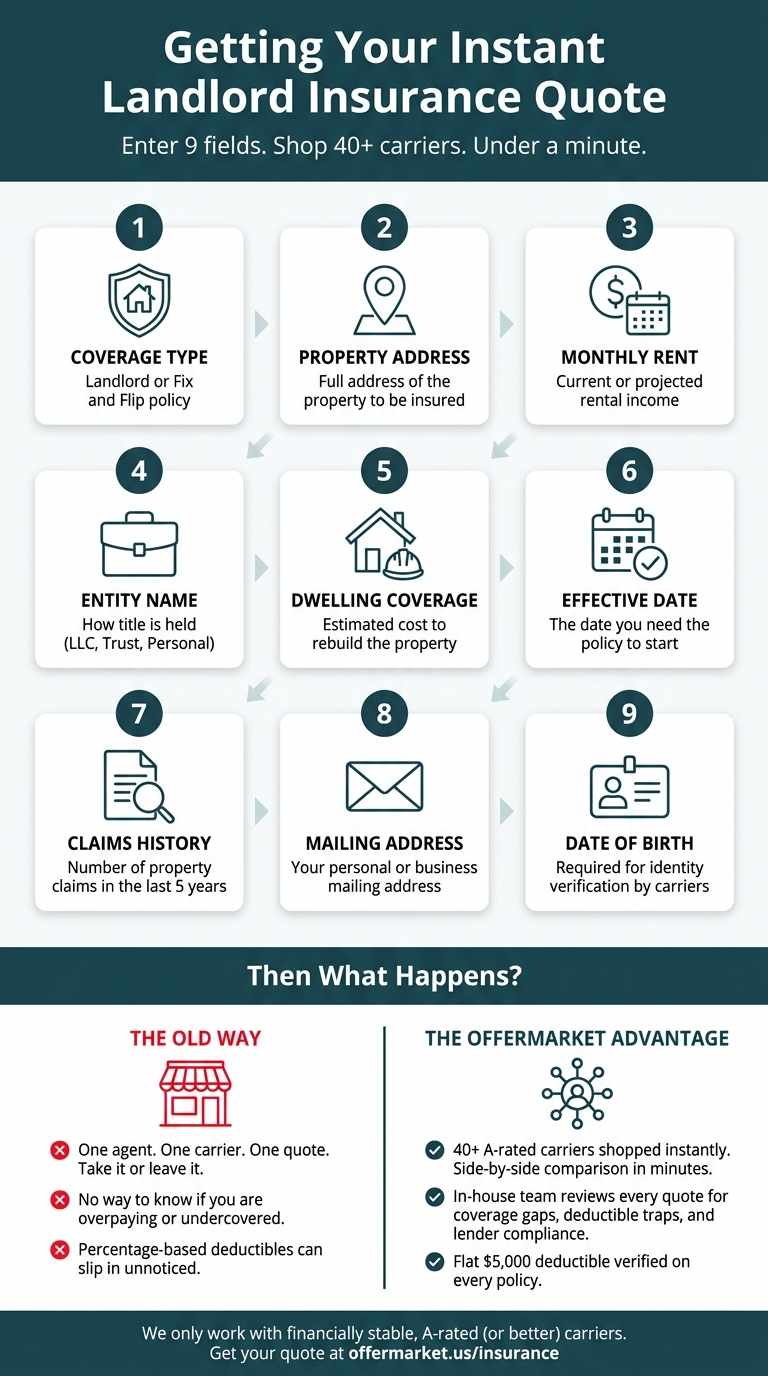
What You Need for a Quote
Getting a comprehensive quote is fast and easy. Having the following information ready will streamline the process:
- 🏠 Coverage Type: Specify if you need Landlord Insurance or coverage for a property under renovation Fix and Flip Insurance.
- 📍 Property Address: The full address of the rental property you need to insure.
- 💵 Monthly Rent: The current or projected monthly rental income.
- 🏢 Entity Name: How you hold the title (e.g., your LLC, a trust, or your personal name).
- 🏗️ Dwelling Coverage: Your best estimate of the cost to rebuild the property.
- 📅 Effective Date: When you need the policy to start (e.g., your closing date).
- 📋 Claims History: The number of property claims you've filed in the last 5 years.
- 📬 Mailing Address: Your personal or business mailing address.
- 🎂 Date of Birth: A standard requirement for identity verification by carriers.
How OfferMarket Shops the Market
Our platform is built for real estate investors. You enter your property information once, and our system instantly shops your request across a network of 40+ A-rated insurance carriers. Within minutes, you receive a competitive DP-3 quote.
Comparing Quotes Beyond Price
The cheapest quote isn't always the best. Our platform makes it easy to compare the critical details:
- Deductible Structure: Is it a flat dollar amount or a percentage-based deductible for wind/hail?
- Endorsements: Does the quote include essentials like Water Backup and Ordinance or Law?
- Carrier Ratings: We only work with financially stable, A-rated (or better) carriers from AM Best.
- Loss Settlement: Is the roof covered at RCV or ACV?
The QC Review
Before you ever see a policy, it goes through our expert in-house insurance team. They perform a Quality Control (QC) review, checking every quote against our strict Georgia-specific coverage benchmarks. This ensures you're not just getting a cheap policy, but the right policy.
OfferMarket's Georgia Coverage Benchmarks
We've analyzed thousands of claims and policies in Georgia. Based on this data, we've established a set of minimum coverage benchmarks that we believe every investor in the state should have. Our team ensures every policy we bind meets or exceeds these standards.
- 🏠 Dwelling Coverage: Set at full Replacement Cost Value with zero coinsurance penalties.
- 💵 Deductible: A flat $5,000 all-peril deductible. We actively avoid policies with separate, percentage-based wind and hail deductibles.
- ⚖️ Premises Liability: A minimum of $500,000 per occurrence.
- 💸 Loss of Rent: Coverage for up to 12 months of lost rental income.
- 📋 Ordinance or Law: Included, typically at 10% of dwelling coverage.
- 🚰 Water Backup: Included, typically with a $5,000 limit.
- 🏗️ Loss Settlement: Full Replacement Cost Value (RCV) on the dwelling, other structures, and landlord-owned personal property.
If a quote from a carrier is missing one of these key coverages or is structured in a way that would leave you exposed after a major Georgia storm, our team flags it and works with the underwriter to correct it before your policy is finalized. This hands-on approach provides peace of mind and ensures your investment is properly protected. Get your instant quote today and see how our investor-focused process can save you time and money while providing superior coverage.
Get an Instant Insurance Quote
Protect your Georgia investment property with competitive rates — quote in minutes.
Get Insurance Quote →


OfferMarket Loans
Check your rate
60 seconds · no credit pull